
Seminar
Emperors, epics, excavations
At the two-day conference on “Zoroastrianism in the New Millennium” international scholars shared their research findings
"Culture can only survive if it has teachers and priests… It is very important to realize that studies in humanities and liberal arts are suffering from cutbacks,” stressed ParZor director Dr Shernaz Cama in her introductory remarks at the two-day international conference on "Zoroastrianism in the New Millennium” at the National Museum in Delhi on March 22 and 23, 2016, planned as an adjunct event following the inauguration of three mega exhibitions on Zoroastrianism the preceding three days. "All of us need to reflect and build a plan so that Zoroastrian studies can thrive in the new millennium… We need to make it attractive and financially viable for our researchers… A lot of students from Central Asia want to (study at) the School of Oriental and African Studies (SOAS, University of London) but it is not affordable… We need to bring together Avestan and Vedic Sanskrit studies for future collaboration under the Hamari Dharohar project of the Ministry of Minority Affairs…We need to move beyond books,” she added.
Daryoosh Akbarzadeh, professor of Iranian Studies at the Research Institute of the Iran Cultural Heritage, Handicrafts and Tourism Organization "has been a key factor in bringing Iran and India together,” commented Cama. He read out a message from the Vice President of Iran Eshaq Jehangiri who declared that their country "is consolidating its relations with other nations.” He also conveyed that "Navroz has been the most important festival in Iran.”
Daryoosh Akbarzadeh, professor of Iranian Studies at the Research Institute of the Iran Cultural Heritage, Handicrafts and Tourism Organization "has been a key factor in bringing Iran and India together,” commented Cama. He read out a message from the Vice President of Iran Eshaq Jehangiri who declared that their country "is consolidating its relations with other nations.” He also conveyed that "Navroz has been the most important festival in Iran.”
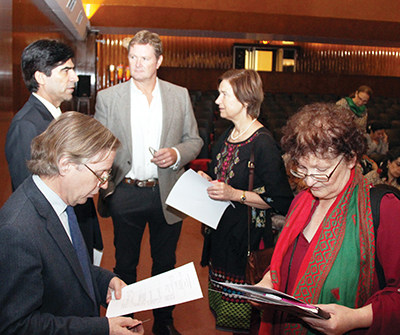
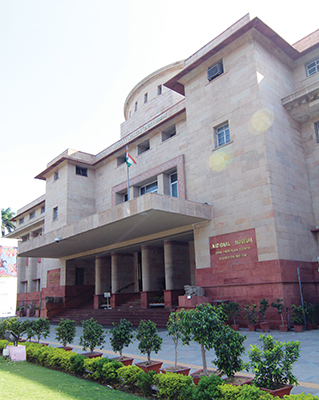
Interaction among scholars (left) before the launch of the conference at the National Museum
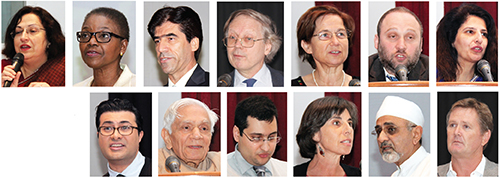
(From left, 1st row): Dr Shernaz Cama, Baroness Valerie Amos, Daryoosh Akbarzadeh,
Dr Nicholas Sims Williams, Dr Almut Hintze, Dr Pavel Lurje, Dr Rukshana Nanji;
(2nd row): B. K. Waghmar, Dr Lokesh Chandra, Pooriya Alimoradi, Dr Jenny Rose,
Ervad (Dr) Parvez Bajan, David Adams
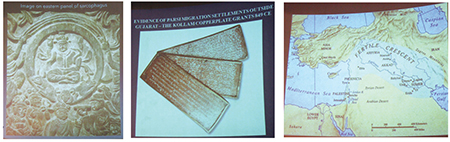
From left: Image on eastern panel of sarcophagus referred to by Rose; Kollam copperplate
grants 849 CE cited by Nanji as evidence of Parsi migration outside Gujarat; map shown by
Hintze to denote Cyrus the Great’s extensive empire
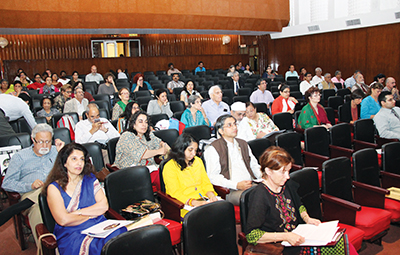
A section of the audience
Seeing Zoroastrianism being "given the attention it rightly deserves,” SOAS director Baroness Valerie Amos stated in her inaugural speech that the three exhibitions in Delhi — "The Everlasting Flame: Zoroastrianism in History and Imagination;” "Painted Encounters — Parsi Traders and The Community” with "No Parsi is an Island;” and "Threads of Continuity: Zoroastrian Life and Culture” — "instilled an appreciation of Zoroastrian culture” and provided an opportunity to "reflect on the past and look to the future. It has suggested new approaches to the study of Zoroastrianism.” The 100-year-old SOAS has "strong connections with India,” she said, and since 1929 Zoroastrian studies have been offered there. From the time "Prof Mary Boyce put Zoroastrianism on the world map,” many distinguished scholars have taken an interest in the subject. "Knowledge engagement and a quest for expertise (leads to) harnessing of energies and synergies like never before,” she stated before expressing, "SOAS currently hosts 600 stu-dents…The world needs to understand Asia and South Asia better. There is much to offer that is distinctive. Connections are more vital than ever before. We need to build on what has happened here over three days (inauguration of three exhibitions) so we remain committed to take the work forward.”
The first session of the Conference on "Excavations, Archeology and Central Asian History” was chaired by Dr Nicholas Sims Williams, emeritus professor of Iranian and Central Asian Studies, Department of Religions and Philosophies at SOAS. According to him, "It is difficult to assign Avestan language to any region.” He mentioned how scholar Dr Hemming Jorgensen had shown a similarity between Avestan and Sogdian. "Sogdian has words borrowed from Avestan.” Sogdiana was the region around Samarkand and is referred to in the first chapter of the Vendidad and even ossuaries found in Sogdiana bore names of Zoroastrian yazatas.
"The Cyrus Cylinder and the Good Deeds of Cyrus the Great” was the subject of Dr Almut Hintze’s paper. Zartoshty Brothers Professor of Zoroastrianism, Department of Religions and Philosophies at SOAS, she referred to Cyrus’ "multi-ethnic empire” that allowed divergent groups "to continue with their traditions so long as they paid tribute to his financial coffers…There is nothing constructive known about Cyrus,” she declared, although "fire altars and temples were believed to be Zoroastrian and the magi had authority in his court.” In the Cyrus Cylinder, 22.5x10 cm in size, "Cyrus is presented as the savior; not as conqueror but liberator,” whose policy of religious freedom allowed the conquered to return to their lands of origin and worship their gods.” As she further reminded, "The Achemenian is the most glorious period in the history of Iran. The Sassanians who eclipsed the Parthians declared themselves as the direct successors of Achemenians.”
"The most neglected part of history in India” are the years between the seventh and 14th centuries when very little data is available, stated Dr Rukshana Nanji, archeologist and independent researcher, in her presentation "On Indian Shores — The Archeology of Zoroastrian Settlements in India during the Early Medieval Period.” Referring to Sanjan as "one of the most important seaports in the early medieval period,” Nanji who has been involved with excavation work in the area mentioned that "Sanjan (also known as Sindan) was sought after because of its wealth. Sassanian kings are known to have had ties with Sanjan and (the Persian prince) Behram Gor would come to hunt every summer.”
When analyzing "the role of Sanjan in the settlement pattern of Parsis,” she referred to Sanjan Bunder or the embankment area with facilities for single berthing or anchorage. Evidence of brick walls and brick structures indicated these were not temporary settlements. In urban areas there was evidence of porcelain, Mesopotamian glass, turquoise and glazed ware, eggshell ware, Chinese pottery, storage jars, jewelry. "There was no dramatic reason for the site to be abandoned. Trading may have lessened so there was gradual movement to the hinterland.” The fact that there is no reference to Sanjan in the Rivayats indicates that its importance had ceased before that, she pointed out.
The other papers that morning were on "Zoroastrian and non-Zoroastrian Gods in Sogdiana and their Afterlife” by Dr Pavel Lurje, faculty member, The State Hermitage Museum, St Petersburg, and on "Central Asian Zoroastrianism in the Late Sasanian and Early Islamic Eras” by B. K. Waghmar, senior teaching fellow, Department of the Languages and Cultures of South Asia at SOAS.
In the post lunch session on "Comparative Traditions between India and Iran,” Dr Lokesh Chandra, president of the Indian Council for Cultural Relations who chaired the panel, mentioned how those who wanted to study Sanskrit were always advised to learn Persian too. There is reference to Daena as the conscience in Avestan and Dhena in Sanskrit meaning "that on which you meditate.” He explained how the Yasna refers to the "golden age of Yima” and how Sanskrit texts cite Yama, the controller of the Universe and his sister Yamuna. Further many Iranian names like Vishtaspa and Gushtaspa end with ‘aspa’ connected with horses, while ‘ashwa’ in Sanskrit relates to mastery. Just as Kay as in Persian Kayanian indicated wise rulers, Kavi in Sanskrit referred to a wise poet. There are two countries in the world which have ‘ir’ in their name — Ireland and Iran — denoting people who travel or who conquer. According to him the best doctors in ancient times were from Iran and he referred to Jeevaka, the Buddhist physician, consulting Iranian men dressed in white robes and learning the importance of sanitation and hygiene from them.
"Rustam and Indian Heroes: A Comparative Study” was the subject addressed by Pooriya Alimoradi, PhD candidate, Department of Near and Middle Eastern Civilizations, University of Toronto. He explained how Rustam, the third character in Shahnameh, is the main hero of the epic who "has the strength of the king…He is the… ultimate hero who has attracted epithets and (has) been made into a super hero.” He goes beyond nationalist boundaries for there are references to his name in Iranian, Syrian and Turanian history. When comparing Rustam to Indra, he said both were "huge eaters.” Rustam and Arjuna were both considered "invincible.”
Dr Jenny Rose, adjunct professor (Zoroastrian Studies), Department of Religion, Claremont Graduate University speaking on "Wind, Fire and the Farr: Encounters Between Ancient Iranian and Indian Themes” referred to "the rich cultural exchange.” She described a sarcophagus in Xi’an City Museum, China with a depiction of the holy trident associated with Lord Shiva or Pashupati. The epitaph indicated that the man who died in 579AC came from Sogdiana and was not an Indian devotee of Shiva. On another ossuary bearing bones of a couple, there is depiction of Vayu taking the soul of the righteous couple. To further indicate the influence of Zoroastrianism on Kushans, she referred to a Sogdian Buddhist text and a Parthian king making an offering to the fire. Further Parthian figurative art too showed Iranian features like necklaces and earrings. (Farr was a blessing conferred by Ahura Mazda upon special individuals as a reward for admirable foresight and commitment.)
Rivayats are a shrouded text where the "responses are couched in veiled language,” commented Ervad (Dr) Parvez Bajan, honorary lecturer, Department of Avesta Pahlavi, St Xavier’s College, Bombay. When elaborating on "Medieval Ecc-lesiastical Ques-tionnaire on Persian Manners, Customs, Tenets and Traditions Exchanged between India and Iran forming a corpus of Rivayats” he mentioned how the responses from Iran were "written in florid and ornate style” addressing coreligionists in Bharuch, Khambhat, Surat and Navsari when "religious knowledge in these towns was at its lowest ebb.” To counter pollution, purity norms were minutely followed although many Zoroastrian practices had to be abandoned "with an eye to the greatest good.” The Rivayats reflect "familiarity with the Avestan text” for words like "juddin” and "nirang” were written in Avestan character because the Iranian priests feared putting it in black and white. Cures and spells mentioned in the Rivayats were similar to the charms described in the Atharva Veda.
The last session of the day was devoted to the screening of the fourth episode of Alexander’s Lost World, co-produced by David Adams Films and Sky Vision, Australia. Having spent five and a half months on the Tajik-Afghanistan border with his team, Adams sought to explore "an incredible civilization” that was discovered by Alexander, the iconic hero of ancient Greece who claimed for himself the title of "emperor of the east.” When traversing the "desert tracks that lead everywhere and nowhere” and exploring the incredible canals that contributed to the "biggest irrigation system in Bactria,” Adams was clear that "the idea of this film is not academic but to reach a wider audience.”
The second day’s proceedings will appear in the next issue of Parsiana.
◆ ◆ ◆
From the archive