
Seminar
Revisiting religion
The WZO seminar in London presented insights into Zoroastrian history and culture
Realizing the need "to give recent research by our young scholars an airing… each year WZO (The World Zoroastrian Organisation) endeavors to vary the subject matter so as to offer a new dimension, be it on religion, history or culture,” stated honorary secretary Darayus Motivala in his welcome address at the seminar on Zoroastrian Religion, History and Culture, attended by around 60 people on June 8, 2014. It was conducted by WZO in association with the World Zarathushtrian Trust Fund (a small UK charity formed by WZO chairman Shahpur Captain following a generous endowment from Mehraban and Goli Farhangi of Iran) at the International Students House in London.
According to a report of the day’s proceedings sent by WZO president Sammy Bhiwandiwalla, Arash Zeini in his talk on "Aspects of Zoroastrian exegesis in the late antique era” referred to the relationship among priests, kingship and warriors that sustained the Sassanid Empire in its early stages but was also responsible for weakening the Empire when each group tried to impose its power on the other.
According to a report of the day’s proceedings sent by WZO president Sammy Bhiwandiwalla, Arash Zeini in his talk on "Aspects of Zoroastrian exegesis in the late antique era” referred to the relationship among priests, kingship and warriors that sustained the Sassanid Empire in its early stages but was also responsible for weakening the Empire when each group tried to impose its power on the other.
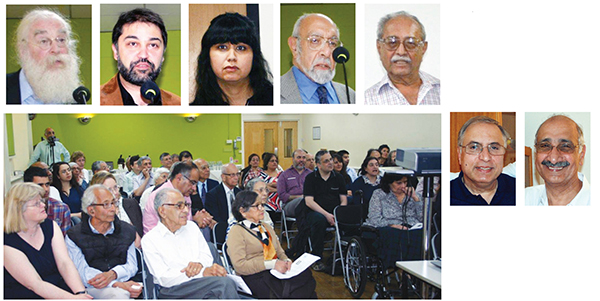
Clockwise from top left: Dr Irving Finkel, Arash Zeini, Nazneen Engineer, Farrokh Vajifdar, Shahpur Captain,
Sammy Bhiwandiwalla, Darayus Motivala; a section of the audience
Of the two other guest speakers Dr Irving Finkel dwelt on how the Cyrus Cylinder and its inscription should be interpreted today, while Nazneen Engineer spoke on "Conversion in Zoroastrianism.” She provided a broad historical narrative and explained how conversion has impacted the religious, political and socioeconomic practices of the Zoroastrian community.
According to Zeini, a research fellow at the School of History, University of St Andrews, whose interests encompass the study of ancient Iran, Zoroastrianism and digital humanities, disagreements between the priests and the warriors led to fragmentation within the Sassanid Empire (226-40 AD) and its subsequent downfall. The Zoroastrian religion and state were considered inseparable under the Sassanid rulers and the priesthood became immensely powerful. The head of the priestly class, the mobadan mobed, as also the military commander were accorded due respect in the state.
The lasting heritage of the Sassanid Empire is the sacred Avesta. The Zoroastrian high priest Tansar established the canon of religious texts containing hymns of great antiquity and younger texts, as also books on cosmogony and law with several expositions.
The close relationship between the Sassanian kings and the priesthood is borne out by rock reliefs which often depict the investiture scenes where Ahura Mazda, seated on a horse, hands over power to a king. One of the earliest rock reliefs is the one at Naqsh-i-Rajab which shows Ardashir I, the founder of the Sassanian Empire being invested by Ahura Mazda who holds the diadem (crown). The depiction of the king reaching for it indicates the dependence of the mortal king on God’s favors. What makes this relief historically so important is its inscription by the priest Kartir who was not only the founder of the Sassanian state church but also played an important role in politics. The inscription proclaiming his personal beliefs shows Kartir with hand raised in a gesture of homage to the God and the king.
As assistant keeper of Ancient Mesopotamian (i.e. Sumerian, Babylonian and Assyrian) script, languages and cultures in the Middle East department at the British Museum, Finkel specializes in Mesopotamian medicine and magic and takes a keen interest in the history of board games throughout the world. The knowledgeable curator in charge of cuneiform inscriptions on tablets of clay of nearly 1,30,000 pieces regretted that many people talk about the Cyrus Cylinder without ever having read it in its original or translation. In his animated and humorous talk he narrated how the fragments of the Cylinder were discovered — one, from the British Museum’s own store room and the other from Yale University — but yet remains largely incomplete.
Dating to sixth century BC, the barrel shaped clay Cylinder, nine inches long, was used as a foundation deposit following the Persian conquest of Babylon in 539 BC by Cyrus the Great. It was discovered by Hormuzd Rassam in 1879 during excavations in Mesopotamia. The Cylinder records in microcosm the entire history of its period and details Cyrus’ capture and deposition of Nabonidus, an oppressive Babylonian ruler, and proclaiming himself, aided by the god Marduk as liberator. His annexation of Babylon was to become the platform upon which the Achemenid Empire extended its borders. The Cylinder also records Cyrus’ benefactions for the citizens of Babylon, improving their lives, repatriating displaced people and restoring temples across the region.
The Cylinder being called the oldest known charter or symbol of universal human rights is viewed by some as a representation of an event in a historical context in which it could not have occurred or existed. It is a typical overstatement made by a new monarch at the beginning of his reign. In antiquity there were no human rights but we see this as an attempt to run a nation with a more civilized and enlightened ruler, said Finkel.
Working on her doctorate at the School of Oriental and African Studies under the supervision of Drs Almut Hintze and Sarah Stewart, Engineer traversed a historical journey of nearly 150 years to identify references to conversion, which she considered the single most controversial subject that has blighted and inflicted pain on the Parsi community.
In 1818 the community elders had decreed that a Parsi can only undergo the navjote ceremony if both his/her parents were Parsis unless permission was sought from and granted by the Punchayet. Subsequently the resolution was amended to a total ban on such conversion. A major upheaval for the community came in 1839 when a Scottish missionary Rev John Wilson converted two Parsi boys, aged 16 and 18 to Christianity. Dhunjibhai Nouroji was one of the converts who later also became a priest. News of his baptism was perceived as an attack on the Zoroastrian religion and the Parsi community, instead of his decision being viewed as a private and personal one. Concerned that this act showed a weakness in the community to maintain control over one of its own, they condemned the deed. To send a strong message of intolerance and dissuade anyone from following Dhunjibhai’s footsteps, the newspapers broadcast the news that Dhunjibhai was about to leave the religion of his forefathers and enter that of strangers with a warning: "If one converts out of the religion then one is no longer a Parsi. No longer a Zoroastrian then no longer a Parsi.” Thus religion and ethnicity were bound together.
In 1865, legally binding Parsi laws came into effect, focusing on inheritance, succession, and marriage and divorce. However, the Parsi laws offered no legal recourse to ‘half Parsi’ children, the offspring of a Parsi father and non-Parsi mother. Community elders attempted to deal with the issue of ‘half Parsi’ children but questioned their existence in the community.
The Mazagon Docks navjotes of 1882 when nine ‘half Parsis’ between the ages of seven and 35 living opposite to and working in the Docks were initiated in front of the Parsi community evoked great excitement. This incident set a precedent for how the community should deal with the ‘half Parsi’ issue. Thereafter it was not uncommon that navjote ceremonies of ‘half Parsi’ children were performed in Bombay. However these initiations were not without controversy both within the laity and priesthood, with some refusing to recognize the initiates as Parsis.
In 1903 Ratanji Dadabhoy Tata married a French lady, Suzanne Briere, according to the Zoroastrian ashirvad rites after getting her navjote performed by a duly ordained dastur. Following three years of debate on whether she was entitled to enter the fire temple and enjoy the benefits of Parsi trusts managing such fire temples, dakhmas and other public charities, ultimately a court case was filed in 1906. The famous Parsi Panchayat Case between seven prominent members of the Parsi community and five trustees of the Panchayat touched upon several religious and social issues.
The case primarily dealt with the issue of whether a non-Parsi juddin could enjoy the benefits of Parsi funds and facilities rather than whether their children could be recognized as Parsis. Justices Dinshaw Davar and Frank Beaman ruled that she could not be considered a Parsi for according to them Parsis included those descended from the original Persian emigrants who are born of both Zoroastrian parents and who profess the Zoroastrian religion; or the Iranis from Persia professing the Zoroastrian religion; or the children of Parsi fathers by ‘alien’ (non-Parsi) mothers who have been duly and properly admitted into the religion. The third classification, believed Engineer, was a direct result of the Mazagon navjotes and the presence of documented proof that the practice was conducted and accepted in the past. This category excluded the children of Parsi mothers by ‘alien’ fathers since there was no clear evidence that this practice was accepted in the past.
In addition to the three main sessions at the Seminar that were assigned time slots of nearly 75 minutes each, there was also a 15-minute period reserved for Farrokh Vajifdar to give an introduction to the book, Parsis: A People of the Book. This 85-year-old publication by S. M. Taher Rezwi, a 19-year-old Shi’a Muslim scholar from Calcutta, that was revised and edited by Vajifdar, had been relaunched in early June 2014 by WZO. As stated Vajifdar, "The chief interest of this rare book lies in the young author’s dextrous use of the materials available to him on Zoroastrianism which he pertinently set alongside the three Abrahamic systems. But even more intriguing was his inclusion of extracts from little known Islamic manuscripts tucked away in Patna’s Khudabakhsh Library archives. His purpose? To properly collate, with exact references, the rich materials he had assembled in pursuance of his stated aim of bringing this ancient book religion to the attention of his Muslim co-religionists amongst whom there prevailed "indifference and disinformation” about Zoroastrianism. Supporting the young Muslim in his worthy endeavor were some enlightened Parsis like Sir Hormusjee Cowasjee Dinshaw (Adenwala), Prof Irach Taraporewala and the much under-rated savant Gushtaspshah K. Nariman.”
At the end of the plenary session, Captain thanked the speakers and Bhiwandiwalla presented them with tokens of appreciation.
◆ ◆ ◆
From the archive