
Exhibition euphoria - I
Around 300 artifacts from 42 lenders provide visual stimulation at “The Everlasting Flame” for a rare glimpse of Zoroastrian history
"Another flame has been lit,” remarked Dr Najma Heptulla, union minister for minorities, at the inauguration of the mega exhibition, "The Everlasting Flame (TEF): Zoroastrianism in History and Imagination” at the National Museum in New Delhi on March 19, 2016. The first of the three exhibitions in the capital to introduce the Indian populace to the antecedents of the Zoroastrian community, TEF had originally been conceived and mounted at the Brunei Gallery at the School of Oriental and African Studies (SOAS), University of London, in 2013.
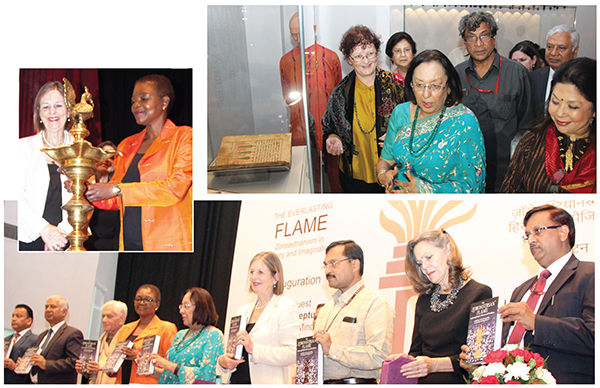
"Engage with the 300 pieces that have traveled to India,” recommended Heptulla, inducing "students of history, culture, geography, geology to come and visit the exhibition (which) explores the history of the ancient religion, language and culture transcended through centuries.” Establishing an instant rapport with members of the Parsi community, Heptulla stated in Gujarati, "Aaj no din jeevan no historic divas chhè (today is a historic day in our lives).” She further expressed, "I am really very happy that the dream that we started a year and a half ago has come true today.”
Whilst acknowledging "the initiative of the curators” — Sarah Stewart, Firoza Punthakey Mistree, Ursula Sims-Williams, Almut Hintze, Pheroza Godrej and Shernaz Cama — Heptulla added, "This initiative would not have been possible without the contribution of the Parsi community,” and lauded their "excellence, sharing and innovation…which are evident in the exhibition. The Parsis of India are very important to the Indian tapestry,” she summed up. "Really touched and so thankful that Ratan Tata came” for the morning function of TEF International Programme at Parliament House, she recalled his words, "How could I not come? You almost bullied me!”
The exhibition was to be inaugurated by Dr Mahesh Sharma, minister of state for culture and tourism (I/C) and civil avation, who was present at the morning function at Parliament House but not at the National Musuem in the evening. However the catalog supplement that was released in the evening carried a message from him wherein he wrote, "In a country like India which is known for its plurality, we are proud to celebrate another ancient wisdom which arrived in our country many centuries ago and continues to enrich our knowledge systems…By supporting such programs we are not only bringing increased awareness and appreciation for lesser known cultures but also highlighting that people have always been related across continents and civilizations have developed in conversation with each other.”
"Zoroastrianism and Hinduism are the oldest religions known to humanity.” Zoroastrianism enjoys a unique place with its emphasis on "primacy of ethical choice in human life,” stated Sanjiv Mittal, director general of the National Museum. In the catalog supplement he further elaborated how "The exhibition is unique and a first of its kind with over 42 lenders including the British Library, Victoria and Albert Museum (VAM), The Wellcome Trust, the John Rylands Library, Ancient India and Iran Trust, The Zoroastrian Trust Funds of Europe and the Warburg Institute in the UK, The State Hermitage Museum, St Petersburg and the National Museum of Iran, Tehran many of whom are lending to India for the first time. Members of the Parsi community in India and abroad have generously come forward and lent objects to the exhibition which truly marks their support for the initiative.”
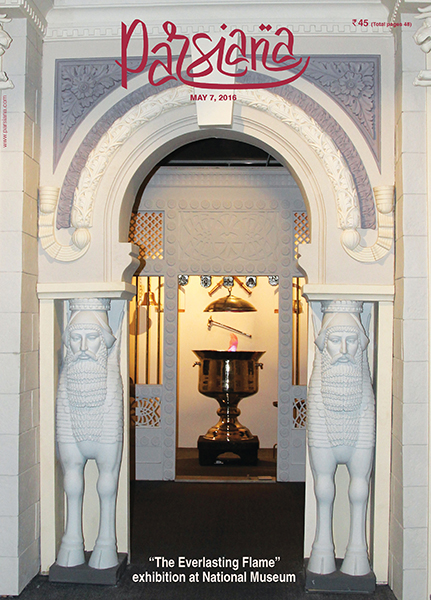
Describing the exhibition "as a truly collaborative event…bridging London and India,” Stewart was happy that they "found new colleagues for future work. We have learnt to question the way we do things.” On behalf of the curators she gave an overview of the exhibition content that is divided into 10 sections, indicating "in what way Zoroastrianism has influenced world religious thought.” Referring to the first two sections, "The ancient world” and "Zoroastrian texts,” she noted, "much belongs to speculation.” She realized that of great interest to most non Parsis would be the installation of the interiors of a fire temple, courtesy Dr Cyrus Poonawalla, that offers a glimpse into the inner sanctuary. Some of the other subjects that the exhibition seeks to explore are: How did Zoroastrians successfully negotiate their minority status? What took Parsis to China and other areas in the 19th century?
"SOAS has had a strong connection with India since its inception in 1916,” reminded Baroness Valerie Ann Amos, director, SOAS. "This exhibition is the first of our major centenary events… This is the first SOAS exhibition to be taken on tour,” she added. Zoroastrianism has been studied at SOAS since 1929 but was put on the world map of Zoroastrian studies by the late Prof Mary Boyce during the years she taught and carried out research there from 1947-82, stated Amos, stressing that SOAS has instituted the Zartoshty Brothers chair and lectureship as also courses in religious texts and languages.
Referring to the "enormous influence of Zoroastrianism in time and space,” Baroness Tessa Blackstone, chairperson of The British Library Trust, mentioned that there were 29 items from the British Library that were loaned "for the first time to India.” She was especially delighted to "collaborate with international partners and share unique treasures with the larger public.”
Commented Ministry of Minority Affairs (MoMA) secretary Rakesh Garg, "I couldn’t have believed such a micro minority” could have had such a rich history. Referring to the artifacts which were loaned by institutions and museums from across the world, he pointed out that they have to be handled "like infants.”
As compared to the numerical strength of the Zoroastrian community, "their contribution seems 1,000 times more with a multiplier effect on nation building,” mentioned Narendra Kumar Sinha, secretary, ministry of culture. According to him, the exhibition provides "intellectual content and visual stimulation for a rare glimpse of Zoroastrian history.” In his vote of thanks, Dinesh Bist, joint secretary MoMA, described Heptulla as "the leading light and spirit behind this exhibition (whose) enthusiasm kept our motivation levels high.”
Expanding the exhibition
Of the diverse collection of 300 artifacts, texts, paintings and textiles on view until May 29, 2016 at TEF exhibition in Delhi, most items were similar to the earlier 2013 exhibition by the same name in London, viewed by over 23,000 visitors (see "Enthused by the exhibition,” Parsiana, November 7 and 21, 2013). The second edition of TEF exhibition however included 77 different items, some of which were substitutes for exhibits which were unavailable while others were completely new.
In case of both the exhibitions, the visual narrative commenced with the history of Zoroastrianism in Iran where it was the foremost religion of the Achemenid and Parthian empires and was consolidated as the state religion under the Sasanians. Its influence in Central Asia, China and other regions has also been covered.
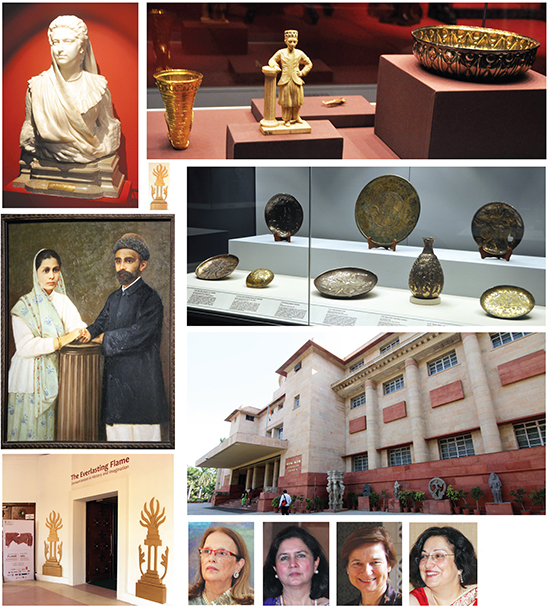
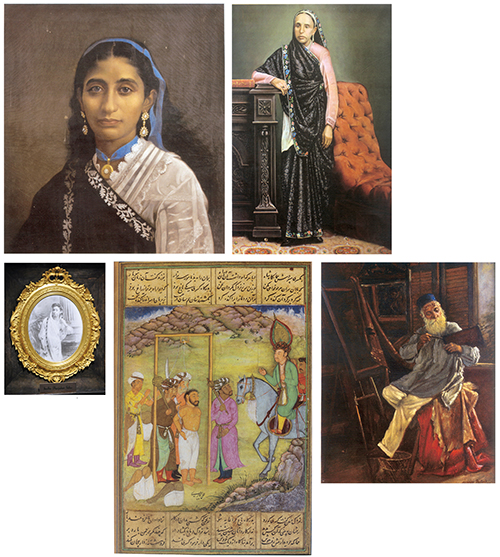
Most of the new artifacts at the National Museum exhibition feature in the section on "Parsi salon” with its array of Indo-Portuguese carved furniture, the Iranian Zoroastrian costume and the exquisite garas. As explained by Cama in the supplement, the gara’s "recent revival is a way of reaffirming identity and connecting the community to its roots.”
Many generations have enjoyed Rudyard Kipling’s story How the Rhinoceros got his skin wherein he mentions a Parsi, Pestonjee Bomanjee. It now comes to light in "Parsi Salon” that Pestonjee Bomanjee who later earned fame as a portraitist was then an aspiring artist who studied at the Sir J. J. School of Art and Industry when Kipling’s father John was appointed artist-craftsman there. Paintings from the Bhabha Sanatorium in Bandra that were restored at the expense of the Bombay Parsi Punchayet also feature in TEF in Delhi.
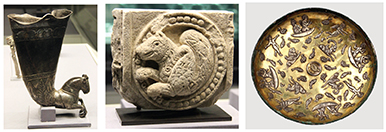
Yet another section, "Imperial Iran,” was enriched by many new items. "The exhibition has been greatly enhanced by loans from the National Museum of Iran, Tehran. The Sassanian silver dishes, in particular, complement those that have been lent by the State Hermitage Museum,” reports Stewart. The glass etching, 2.4 m x 10.5 m, specially recreating the west staircase of the palace of Darius at Persepolis continued to be the most imposing piece in this section as it was at the London exhibition.
Yet another special acquisition for this exhibition was the gold and copper enameled reliquary casket (a container in which sacred relics are kept), c 1250 CE, from the British Museum, that features in the section "Judaeo-Christian World.” The casket portrays the Biblical Wise Men or Three Kings dressed in Persian tunics and trousers who made the journey to Bethlehem to worship the Christ child.
Among the important manuscripts loaned by the British Library are "an imperial copy of the Shahnameh illustrated around 1613 in the studio of the Mughal statesman Khankhanan ‘Abd al-Rahim… (as also) the coins from the Mughal period of which the gold mohurs of Emperor Akbar are particularly significant insofar as they show the Zoroastrian month names.” These can be viewed in the sections "Post Arab Conquest” and "Journey and settlement.”
The great Persian hero Rostam in combat either with demons or warriors is seen in different wall paintings from Penjikent, courtesy of the State Hermitage in St Petersburg, in the section on "The Silk Road, Central Asia and China.” Rostam and his horse Rakhsh even find a mention in a ninth century Sogdian fragment from Dunhuang, China, courtesy British Library.
"Rostam in battle and having his wounds tended to by the mythical bird, simorgh, is also the subject of two illustrated folios from a copy of the Shahnameh in the National Museum… Different manifestations of the simorgh (Pahlavi senmurv) occur throughout the exhibition… We are pleased this time to include textile fragments from the VAM, London, that depict the senmurv in decorative pearl roundels,” writes Stewart in the 102-page supplement published in 2016 by the National Museum to explain the additional exhibits.
The supplement is a continuum of the earlier 260-page catalog (published in 2013 by I. B. Tauris and Company Limited in association with SOAS) that provided a detailed understanding of the common items on display. Being identical in content, the first two sections of the exhibition, "The ancient world” and "Sacred texts” do not feature in the supplement; nor do the last two "Fire temple” and "Zoroastrian communities around the world.”
Contributing to the impressive layout and design of TEF exhibition in Delhi were Colin Morris and his colleagues who had also undertaken the responsibility in London. For the success of TEF, the National Museum’s Outreach team led by Joyoti Roy and including Ruchira Verma, Vasundhra Sangwan, Rige Shiba and K. K. Sharma were given credit for their dedication as were SOAS members Chris Ince, John Hollingworth and Jahan Foster. Serving as advisors to the exhibition were scholars Frantz Grenet, Philip Kreyenbroek, Alan Williams, Jenny Rose and Vesta Sarkhosh Curtis.
As summed up Cama, "This seminal exhibition brings together institutions and individuals from all parts of the world, combining academic scholarship as well as living history. Thus it brings alive a complete picture of an ancient civilization and its modern people.”
The reports on the other two exhibitions in Delhi will appear in forthcoming issues of Parsiana.