
Zoroastrians Abroad
Antiquity and authority — I
The School of Oriental and African Studies offered a platform to 18 international scholars to share their views on shaping Zoroastrian identity
"We have had 18 courses, some longer than others. I am feeling stuffed in the nicest possible way,” remarked Prof Alan Williams when summing up the intellectual contributions of 18 scholars who had presented papers at the two-day international conference on "Looking Back: Zoroastrian Identity Formation through Recourse to the Past.” Organized at the School of Oriental and African Studies (SOAS), London on October 11 and 12, 2013 to coincide with the opening of the exhibition "The Everlasting Flame: Zoroastrianism in History and Imagination,” the sessions were attended by both, "the specialized academics and the lay audience.”
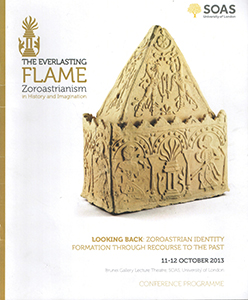 Another appealing feature of this conference was that members of the audience did not have to make a choice of which plenary session to attend because there were no concurrent symposia demanding loyalty, added Williams who teaches Iranian Studies and Comparative Religion at the University of Manchester. There were nine scholars distributed over three sessions on the first day, and another eight speakers distributed over three sessions on the second day. The keynote speech was delivered by Prof Philip Kreyenbroek on the first day whilst Lord Karan Bilimoria’s address was slated for the second day.
As reminded Dr Sarah Stewart, lecturer in Zoroastrianism at SOAS, in her welcome address, due to paucity of historical material on the Zoroastrian religion and polarized views on the genesis of the faith and its founder as also the concepts of monotheism/dualism, this conference "does not seek to answer but to provide a platform for debate.” Such a conference "typifies SOAS at its best and exemplifies the depth of knowledge,” observed SOAS director and principal Dr Paul Webley who confessed that usually he would make an exit after giving the welcome but "today I will stay.”
The audience included members of the Zoroastrian community from London as also those who had come from overseas to attend the exhibition. There were several in the Brunei Gallery Lecture Theatre at SOAS who had no connection with the community but had registered for the Congress on payment of £ 30 because they wanted to learn more about this ancient faith. Affiliates of the London Middle East Institute were offered a concessional rate of £ 20, whilst students could avail of the sessions for free with prior registration.
Another appealing feature of this conference was that members of the audience did not have to make a choice of which plenary session to attend because there were no concurrent symposia demanding loyalty, added Williams who teaches Iranian Studies and Comparative Religion at the University of Manchester. There were nine scholars distributed over three sessions on the first day, and another eight speakers distributed over three sessions on the second day. The keynote speech was delivered by Prof Philip Kreyenbroek on the first day whilst Lord Karan Bilimoria’s address was slated for the second day.As reminded Dr Sarah Stewart, lecturer in Zoroastrianism at SOAS, in her welcome address, due to paucity of historical material on the Zoroastrian religion and polarized views on the genesis of the faith and its founder as also the concepts of monotheism/dualism, this conference "does not seek to answer but to provide a platform for debate.” Such a conference "typifies SOAS at its best and exemplifies the depth of knowledge,” observed SOAS director and principal Dr Paul Webley who confessed that usually he would make an exit after giving the welcome but "today I will stay.”
The audience included members of the Zoroastrian community from London as also those who had come from overseas to attend the exhibition. There were several in the Brunei Gallery Lecture Theatre at SOAS who had no connection with the community but had registered for the Congress on payment of £ 30 because they wanted to learn more about this ancient faith. Affiliates of the London Middle East Institute were offered a concessional rate of £ 20, whilst students could avail of the sessions for free with prior registration.
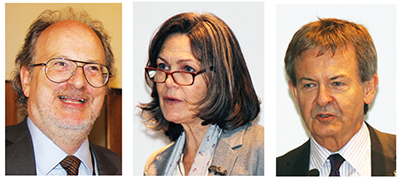
From left: Dr Paul Webley, Dr Sarah Stewart and Prof Alan Williams
Images and icons
"Throughout their long history Zoroastrians have referred to and relied upon notions of what is traditional and authoritative in order to conserve their identity… However tradition is not a simple or static phenomenon; it is ongoing, accumulative and responsive to the need for change in social and cultural contexts,” summarized the invite to the meet. "In this two-day conference we examine patterns of identity formation in ancient, medieval and more recent periods, looking at how texts, traditions, icons, rituals, stories and symbols have been used…” specified the invite.
Of the three sessions scheduled for the first day, the first on "Scripture and Significance for the Tradition” included panelists Dr Almut Hintze, Dastur (Dr) Firoze Kotwal and Prof Alberto Cantera.
"Throughout their long history Zoroastrians have referred to and relied upon notions of what is traditional and authoritative in order to conserve their identity… However tradition is not a simple or static phenomenon; it is ongoing, accumulative and responsive to the need for change in social and cultural contexts,” summarized the invite to the meet. "In this two-day conference we examine patterns of identity formation in ancient, medieval and more recent periods, looking at how texts, traditions, icons, rituals, stories and symbols have been used…” specified the invite.
Of the three sessions scheduled for the first day, the first on "Scripture and Significance for the Tradition” included panelists Dr Almut Hintze, Dastur (Dr) Firoze Kotwal and Prof Alberto Cantera.
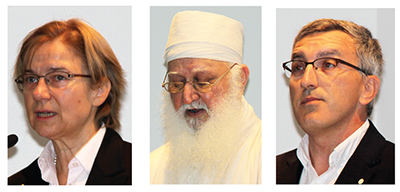
Dr Almut Hintze, Dastur (Dr) Firoze Kotwal and Prof Alberto Cantera
In her paper on "A Zoroastrian Vision,” Hintze analyzed Zoroastrian beliefs and observances including the ritual and devotional worship of Ahura Mazda and the Yazatas; and the rejection of Angra Mainyu and the Daevas. The creative and destructive powers being the twin forces in existence, it is up to each person to discriminate with a clear mind, reminded Hintze who is the Zartoshty Brothers Professor of Zoroastrianism at SOAS. Whilst elaborating on a series of purity laws, she referred to the vivid imagery in the texts relating to the fate of the soul after death whereby a truthful, joyous soul sits in an orderly fashion whilst the deceitful soul scuttles nervously and experiences cold winds and stench. Interpreting an iconographic image from Sogdiana, an ancient civilization of Iranian peoples, in a Mazdayasnan temple, she mentioned how a truthful soul with a good daena (repository of righteous deeds) is supposedly in the company of a dog whilst the one with a bad daena has a wolf, snake, beetle and scorpion as companions. Further, Mazdayasnans who worship the One God, Ahura Mazda are shown with their eyes open as against Daevayasnans (polytheists who venerate tribal deities) who were depicted with their eyes half closed.
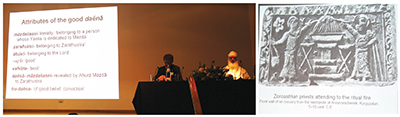
Slide qualifying a good daena and iconographic image depicting priests tending a fire
In modern times, controversies regarding the correct performance of rituals have raged among the Parsi priestly community, stated Kotwal in his paper titled "Continuity, Controversy and Change: a study of the ritual practice of the Bhagaria priests of Navsari.” Erstwhile High Priest of the H. B. Wadia Atash Behram, Kotwal himself comes from the Bhagaria sect and his collected writings will soon be published as the first volume of a new series of books on Parsi priestly history and ritual. He referred to the practice among the Sanjana sect of priests in Udvada of making the child recite the Avestan alphabet before the initiation ceremony. Different texts were then explored to determine whether bowing or lowering of the head or touching one’s head to the ground was necessary as a sign of veneration during the recitation of the Khorshed Nyaish. He further detailed the Atash Zohr ritual of yore of offering fat in the fire which is now lost to the community.
The Zoroastrian faith is also referred to as ‘Mazdayasna’ for the term connotates "celebrating a yasna to Mazda,” stated Cantera in his presentation on "The ‘Sacrifice’ (Yasna) to Mazda: its antiquity and variety.” The yasna liturgy that is currently performed by Parsis appears to have been derived from a fragment of the original long ceremony that is believed to have been composed before other Avestan texts, noted the professor from the University of Salamanca in Spain who is also the director of the Avestan Digital Archive (www.avesta-archive.com), a project that aims to identify, digitize and publish online Avestan manuscripts which are still available.
The morning’s second session on "Tradition, Authority, Orthodoxy, Continuity, Change, Origins, Conservatism and Innovation in Zoroastrian (Iranian and Parsi) Religion and Culture” featured papers by Prof Touraj Daryaee, Prof Antonio Panaino and Dr Yuhan Sohrab-Dinshaw Vevaina.
We tend to pontificate on how Alexander of Macedon and the coming of Arabs enfeebled the good religion of Zarathushtra, stated Daryaee in his paper on "Refashioning the Zoroastrian Past: From Alexander to Islam.” The Howard Baskerville Professor in the History of Iran and the associate director of the Dr Samuel Jordan Center for Persian Studies and Culture at the University of California, Irvine, Daryaee’s work focuses on ancient Iranian history, Middle Persian texts and the Zoroastrian religion. He explained how religious and mythical traditions have been used to reconstruct and refashion the past.
In his paper on "Uranography and Astrology in the History of Zoroastrianism,” Panaino mentioned that astrology was not known in the Mazdean framework until the Parthian period. Avestan sources only refer to the sun, moon and fixed stars as divinities that helped preserve cosmic order. Having learnt of planets from the Mesopotamians, they put them in the same category as shooting stars that are responsible for the disorder and chaos in the world, observed the professor from the University of Bologna, Italy who has been dean of the faculty for the Preservation of Cultural Heritage.
"The only thing unique about Zoroastrians is their obsession about being unique,” commented Vevaina in his talk on "No One Stands Nowhere: the insider-outsider problem in the study of Zoroastrianism.” According to the lecturer in the Department of Religious Studies at Stanford University, California, USA limited attention has been paid to questions of location, position, relation and boundaries between scholars and believers. How can scholars meaningfully and objectively analyze questions of faith, theology and the practices of living Zoroastrians? he queried. Passing value judgments should be viewed as an enterprise quite distinct from the ability to remain neutral, said Vevaina who is currently working on a book on Zoroastrian scriptural interpretation in late antiquity.
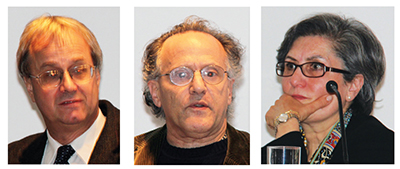
Dr Frantz Grenet, Prof James Russell and Dr Vesta Sarkhosh-Curtis
Participating in the afternoon session on "Enduring Zoroastrian Symbols and Iconic Forms in Art and Architecture” were Dr Frantz Grenet, Dr Vesta Sarkhosh-Curtis and Prof James Russell.
The figures, motifs and symbols on a Bactrian silver plate known traditionally as the ‘Anaitis Plate’ that is in the collection of Bibliotheque Nationale in Paris were analyzed by Grenet who for 32 years was a research fellow in the French National Centre for Scientific Research and is currently professor at the Collège de France (Paris) and chair of History and Cultures of Pre-Islamic Central Asia. Whilst the lady in transparent dress on the center of the Anaitis Plate is shown riding a griffin (a mythical creature with the head and wings of an eagle and the body of a lion), along the periphery are four dancing pairs representing different seasons. Giving his own interpretation to the symbols, Grenet who has been on archeological missions to Afghanistan and Sogdiana deduced that the Anaitis Plate was produced during the second half of the seventh century when Navroz was celebrated not in March but in June due to the calendar moving independently of the solar year in the absence of an intercalation of an extra day every four years.
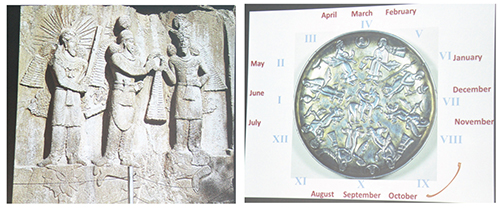
Sasanian bas relief of Mithra from Taq-e Bostan (left) and Bactrian ‘Anaitis Plate;’
Curator in the Department of Coins and Medals at the British Museum, Sarkhosh-Curtis who has completed a collaborative project with the National Musuem of Iran on Sasanian coins and is currently the joint director of the International Parthian Coin project addressed the audience on "Zoroastrian Symbols in Parthian and Sasanian Cultures.” Examining the religious and royal iconography from the third century BCE to seventh century CE she explained that during certain periods the holder of the bow symbolized kingship and at other times the holder of fire was considered the legitimate ruler. The king receiving a diadem (a jewelled crown or headband) from a goddess was also a familiar icon.
There is no definite image of Zarathushtra that has been preserved in ancient Iranian art, stated Russell who is Mashtots Professor of Armenian Studies at Harvard University, USA having previously taught Ancient Iranian Studies at Columbia University, USA and the Hebrew University of Jerusalem. In his talk on "Imagery of Zarathushtra: continuity and change in tradition,” he observed that the image of most present day depictions of Prophet Zarathushtra seems to have been derived from the Sasanian bas relief of Mithra from Taq-e Bostan. By portraying Zarathushtra as Mithra they were depicting the Prophet as "the most God-like of men and the most man-like of Gods.” Since Zarathushtra was considered an astrologer, a scroll in hand seemed appropriate. Armenians interpreted the word Zarathushtra to mean a sacred covenant and not "He of Golden Light” or "keeper of golden camels” as is frequently believed. Zarathushtra represented truth, love, friendship, providence, said Russell, adding, "Every Zarathushti will see an image of Zarathushtra if he looks at himself in the mirror.”
The other sessions of the conference will be covered in forthcoming issues of Parsiana.
◆ ◆ ◆
From the archive