
Seminar
“The road well traveled” – II
Scholars at The K. R. Cama Oriental Institute’s annual seminar challenged certain commonly held beliefs about Central Asia
While it is commonly assumed that Persian art and culture reached its golden age during the rule of the Sasanians (226-651 CE), "very little can be said definitively about this period,” according to Dr Matteo Compareti. A professor at the School of Art at the Renmin University in Beijing was speaking on "The Sasanians and the Silk Roads: Eastern Iranian elements in pre-Islamic Persian art” on the second day of the two-day seminar "From Nisa to Niya: reappraising cultural conduits and commercial centers along the Silk Road” organized by The K. R. Cama Oriental Institute on January 6 and 7, 2018. Compareti believes the perception that the Sasanian period was perhaps the "golden age” emerged only during the rule of Abbasids (late 8th century).
The first day’s proceedings of the seminar were covered previously (see "The road well traveled,” Parsiana, March 7, 2018). This article covers the second day’s talks on the themes of the Sasanian legacy, chaired by assistant curator and in-charge of the Central Asian antiquities collection at the National Musem, Delhi, Dr Binoy Sahay; head of the department of ancient Indian history, culture and archeology at St Xavier’s College Dr Anita Rane-Kothare chaired the lectures on Serindia/Silk Road. According to Rane-Kothare, the term Serindia combines Seres (China) and India and refers to the part of Asia also known as Sinkiang or Chinese Turkestan.
 The Sasanians "accepted” concepts, including Buddhist, Sogdian and Turkic motifs, from Central Asia in their textile decorations, Compareti said. With slides of the Taq-e-Bustan, the rock relief near Kermanshah in Iran, the historian demonstrated that Emperor Khushru II was depicted with a Simurg (the benevolent bird of Iranian mythology). Iconography used in Sasanian times could have come from distant Sogdiana (areas now under Tajikistan and Uzbekistan) or even Byzantium (today’s Istanbul), he suggested. Comparing reliefs from Taq-e-Bustan with those from an arch in Niniveh in Mesopotamia, the historian suggested that the Bustan reliefs were influenced by Parthian and Assyrian art. "Realism in art was imported into Sasanian Persia from other cultures,” according to him.
Over 12,000 items of Central Asian art discovered by cartographer and explorer Sir Mark Aurel Stein (1862-1943) are housed in the National Museum in Delhi. Of these, only 248 artifacts are on display, with the remaining in storage, said Sahay. The curator, who is the nodal officer for digitization of the Museum’s collection, was speaking on "Masterpieces from Stein’s Central Asian Antiquities Collection.” Stein "wrote tons and tons of books” on the region that "was a crucible of people from different races, customs, religions and ideas,” noted Sahay.
"To understand Central Asia (encompassing today’s Tajikistan, Uzbekistan, Turkmenistan, Kyrgyzstan and Kazakhstan and parts of China) is very complex,” he began. Srinagar based Stein "explored sand dunes during the day and wrote by night,” he informed the audience. The Hungarian-British archeologist had led three expeditions to Central Asia: 1900-1901, 1906-1908 and 1913-1916. Besides the National Museum, the Indian Museum in Calcutta with 1,800 artifacts and the Shri Pratap Singh Museum in Srinagar with 285 pieces are the only two other locations in India that house significant finds from Central Asia, according to Sahay. The British Museum, the British Library and the Victoria and Albert Museum have collections too, he added.
The first day’s proceedings of the seminar were covered previously (see "The road well traveled,” Parsiana, March 7, 2018). This article covers the second day’s talks on the themes of the Sasanian legacy, chaired by assistant curator and in-charge of the Central Asian antiquities collection at the National Musem, Delhi, Dr Binoy Sahay; head of the department of ancient Indian history, culture and archeology at St Xavier’s College Dr Anita Rane-Kothare chaired the lectures on Serindia/Silk Road. According to Rane-Kothare, the term Serindia combines Seres (China) and India and refers to the part of Asia also known as Sinkiang or Chinese Turkestan.
The Sasanians "accepted” concepts, including Buddhist, Sogdian and Turkic motifs, from Central Asia in their textile decorations, Compareti said. With slides of the Taq-e-Bustan, the rock relief near Kermanshah in Iran, the historian demonstrated that Emperor Khushru II was depicted with a Simurg (the benevolent bird of Iranian mythology). Iconography used in Sasanian times could have come from distant Sogdiana (areas now under Tajikistan and Uzbekistan) or even Byzantium (today’s Istanbul), he suggested. Comparing reliefs from Taq-e-Bustan with those from an arch in Niniveh in Mesopotamia, the historian suggested that the Bustan reliefs were influenced by Parthian and Assyrian art. "Realism in art was imported into Sasanian Persia from other cultures,” according to him. Over 12,000 items of Central Asian art discovered by cartographer and explorer Sir Mark Aurel Stein (1862-1943) are housed in the National Museum in Delhi. Of these, only 248 artifacts are on display, with the remaining in storage, said Sahay. The curator, who is the nodal officer for digitization of the Museum’s collection, was speaking on "Masterpieces from Stein’s Central Asian Antiquities Collection.” Stein "wrote tons and tons of books” on the region that "was a crucible of people from different races, customs, religions and ideas,” noted Sahay.
"To understand Central Asia (encompassing today’s Tajikistan, Uzbekistan, Turkmenistan, Kyrgyzstan and Kazakhstan and parts of China) is very complex,” he began. Srinagar based Stein "explored sand dunes during the day and wrote by night,” he informed the audience. The Hungarian-British archeologist had led three expeditions to Central Asia: 1900-1901, 1906-1908 and 1913-1916. Besides the National Museum, the Indian Museum in Calcutta with 1,800 artifacts and the Shri Pratap Singh Museum in Srinagar with 285 pieces are the only two other locations in India that house significant finds from Central Asia, according to Sahay. The British Museum, the British Library and the Victoria and Albert Museum have collections too, he added.
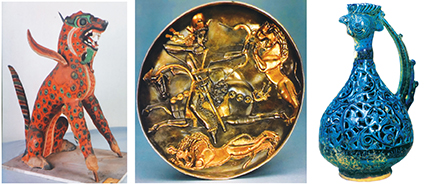
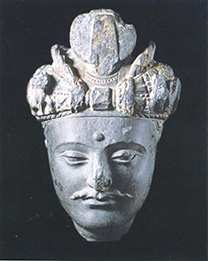
Top: embellished head of a Bodhisattva; above, from l: painted griffon in stucco; silver gilt dish;
ewer with pierced decoration and underglaze painting
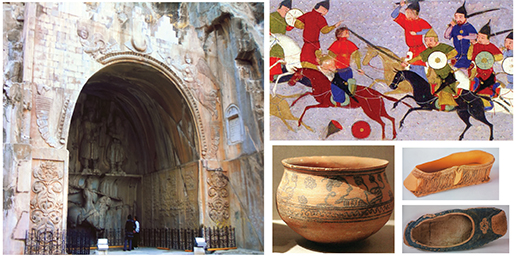
Clockwise from above: Entrance at Taq-e-Bustan; Genghis Khan pursues an enemy;
footwear from National Museum’s collection; bowl decorated with procession of women
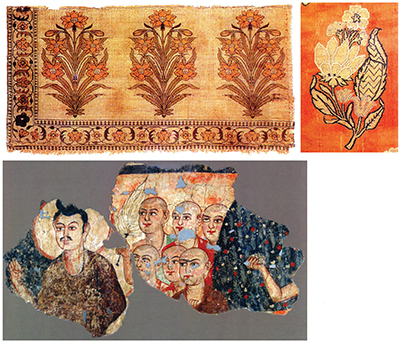
Clockwise from above left: Sash end panel from Persia; pattern found in Kashmiri shawls;
leaf pattern on Persian silk fragment, wall painting of Buddha with six disciples
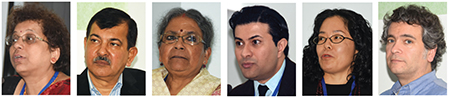
From l: Dr Anita Rane-Kothari, Dr Binoy Sahay, Dr Chhaya Bhattacharya-Haesner,
Burzine Waghmar, Dr Yuka Kadoi, Dr Matteo Compareti
The art of Central Asia represents an amalgam of various philosophies: Zoroastrian, Manichean and Buddhist, said Sahay. "It is from here that Buddhism travelled to the far corners of China, Japan and Korea. Stein’s finds include terracotta bottles used by pilgrims, of which approximately 350 were embellished with monkeys, "including a 1.5 cm piece used as a talisman.” Other finds include the stucco head of a Bodhisattva with Hellenistic influences, spectacles made of silver, approximately 750 wood carvings in Kharoshti (an ancient script used in Gandhara), carved wooden beams from Niya and fragments of combs used to treat silk. Shoes and sandals from hemp, canvas, string and even silk and paper feature in the National Museum, Sahay demonstrated, with detailed slides. "Many textiles came from China… we learn about them from Chinese documents… the chain-stitch used in clothing fragments found in Dunhuang in Western China is now used in Kashmiri embroidery,” he pointed out. Some of the art at the Museum in Delhi can be viewed at http://www.nationalmuseumindia.gov.in/departments-central-asian-antiquity.asp?lk=dp5
Dr Chhaya Bhattacharya-Haesner, who is cataloguing banners found in the Dunhuang region of China under the Tagore National Fellowship, believes that "styles, themes, features and dresses” aid historians in tracing the "ethnic origin and cultural backgrounds” of the banners’ creators, when no written information is available on them. Banners in China, she said, were used for "religious, festive and martial purposes.” Bhattacharya-Haesner obtained her doctorate from Free University, Berlin on wooden objects in Central Asian art. The scholar demonstrated with slides how fragments of paintings on hand made paper discovered in Dunhuang showing the Eight Great Bodhisattvas could be pieced together with the help of similar images of mandalas (ritual symbols in Hinduism and Buddhism, representing the universe) from Maharashtra and Orissa.
Burzine Waghmar, author of the theme paper of the conference believes that the Sakas (also known as Scythians), inhabitants of the Tarim Basin in China, were "the first of the great Asian civilizations.” The senior teaching fellow of the School of Oriental and African Studies was speaking on "Sakas of the Silk Road,” who belonged to the "easternmost edge of the Iranic world.” They "ran the kingdom of Khotan as Iranian-speaking Buddhists” and were known to "trade and tussle” with their Chinese and Tibetan neighbors. Both Saka men and women were adept at riding and with the use of bows "and they could shoot backwards from their horses,” he said. The collapse of the Parthian Empire was due to the Saka invasion; the Sakas, were ultimately converted to Islam.
"While Chinese travelers came to India to collect bale loads of religious manuscripts, there is not much literature of Indian origin on trade along the Silk Road,” said Rane-Kothare while summing up the morning’s proceedings. While there are lots of Indian source documents on general economic activities, Central Asia figures "only in passing” in the work of some Indologists. Not much is known, for instance, about Emperor Ashoka sending his son to Dunhuang to preach about the faith (Buddhism). "The Jataka Tales mention the trade with South East Asia, but commerce with Central Asia is largely ignored in Indian literature. "Traders (who formed the bulk of the Indian movement on the Silk Road) were not seen in a higher light in Brahmanical literature,” she concluded.
Delivering "the only paper on Islamic art” in the seminar, Dr Yuka Kadoi, guest-curator of an exhibition on Persian art at the Liang Yi Museum in Hong Kong said she wanted "to destroy commonly held notions about Persian art.” She was speaking on "In search of Mani: images of subalterns in pre-Safavid Persian paintings.” It is generally believed that illustrated manuscripts created in Persian lands prior to 1300 CE have been destructed by successive Mongol invasions. Kadoi believes that with the establishment of a Mongol-origin Ilkhanate dynasty in Iran, "who portrayed themselves as the legitimate successors of Persian civilization,” richly illustrated manuscripts were produced. These manuscripts served to form the basis of what came to be known as Persian art. The Ilkhanid capital of Tabriz hosted artisans from conquered lands, which led to proliferation of what is now known as Persian art. Non-Iranian characters — Central Asian nomads, the Chinese elite, and Iranian subalterns such as soldiers, slaves and servants began to feature in Persian paintings in this period with painters "under the spell of Central Asia’s Buddhist and Manichean traditions.” Persian painting reached its apogee during Safavid times (1501-1736) and included Turkish motifs, according to Kadoi.
As mentioned by head of East Asia division of the Indira Gandhi National Centre for the Arts Dr Radha Bannerjee Sarkar while delivering the inaugural address on January 6, "the Silk Road has made a major contribution to the civilization of mankind.” Concluded
◆ ◆ ◆
From the archive