
Scholarship
Roots & research
The two-day conference on “Zoroastrianism in the New Millennium” recommended the need for extensive research facilities in India
"Where are your young people?” was the question repeatedly posed to Dr Shernaz Cama, Parzor director who had masterminded the two-day conference on "Zoroastrianism In The New Millennium” (ZITNM) on March 22 and 23, 2016 at the National Museum to create an intellectual interest in the four exhibitions on Zoroastrianism in Delhi. The coming together of international scholars at such meets was akin to the creation of "a ‘global baug;’ not with the intention of spreading gossip but just to ensure that we are comfortable in our own skin... Baugs and mohallas kept our ethnic identity together,” said Cama.
.JPG)
A scene from Ardavirafnamah
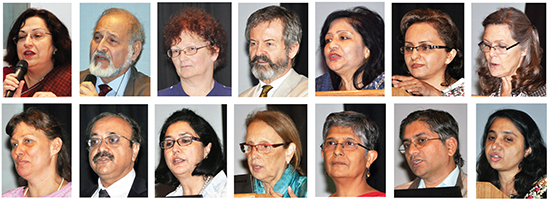
From left (top row) Dr Shernaz Cama, Khojeste Mistree, Ursula Sims Williams, Dr Alan Williams,
Dr Anupa Pande, Dr Farzaneh Goshtasb, Dr Sarah Stewart;
(2nd row) Galina Woodova, Dr R. K. Khetrapal, Firoza Punthakey Mistree, Dr Pheroza Godrej,
Dr Indira Chowdhury, Murali Ranganathan, Dr Meher Kelawala Mistry
For a small community "it is very important that the ethnic identity is preserved” to ensure the "perpetuity of faith, community and way of life,” stated Khojeste Mistree, founder of Zoroastrian Studies, when chairing the first session on the second day on "Religion and Endurance: Antiquity, Survival and Methods of Posterity.” The arrival of Zoroastrians in India marked a new chapter and like all migrant communities they had to "reinvent themselves in their host country (and)...position the community on safe grounds” by concurrently finding similarities with the host and restricting dissimilarities. On matters of dress, language, music, they chose to adopt a secular code. But certain stand-alone patterns that distinguished them were their mode of worship and disposal of the dead. "Most Parsis will be able to tell you about rituals, more than theology... Practice more than philosophy is important... There is a premium placed on righteous behavior in Zoroastrianism,” said Mistree. Their policy of non conversion "safeguarded the community” for they were perceived as "a peace loving and non-threatening force.” Their philanthropic ideas "added to the community’s status… and they could negotiate their position in society without being invasive or intrusive.”
Dr Jamsheed Choksy, chairman, Department of Central Eurasian Studies, Indiana University, Bloomington submitted a paper, "Zoroastrians of Sri Lanka: Persistence and Adaptation,” which in his absence was read by Vanshika Singh. "Adaptation and accommodation went hand in hand with growth in Sri Lanka (which means resplendent land),” known for its jewels, spices and ivory. More familiar with Sinhala and Tamil, after two generations the Zoroastrian community in Sri Lanka was left with only "rudimentary knowledge of Gujarati” and that too was spoken when they "did not want the servants to understand the language!” They realized that "aspirations for future growth lay with western education” and in dress too they adopted the western suit, leaving the daglis for community events. In 1956 when Sinhalese became the official language of the island many migrated to Australia or sought educational opportunities in the US and Canada. By 1984 there were only 60 Zoroastrians remaining in Sri Lanka and although the Zoroastrian Anjuman maintained a membership register with a roster of births and deaths, children of outmarried mothers were not recognized as members. They also have a Colombo Parsi Priests Maintenance Fund.
Sri Lanka has a circular aramgah to resemble a dakhma but they do not have professional corpse bearers. The caretaker is usually a Sinhalese. They have never had a ritual fire of the atash behram or atash adarian status but only light a dadgah fire before a ritual. The reading room at the fire temple is rarely used for the youngsters do not have "the quest as did the bygone generation.” Bareshnum over nine days has never been performed on the island for there are no priests or facilities to conduct the ceremony. The membership of the Anjuman has now declined to 34 so "the long-term viability of the community remains uncertain” even though it would appear that "diminishing numbers have brought them closer.”
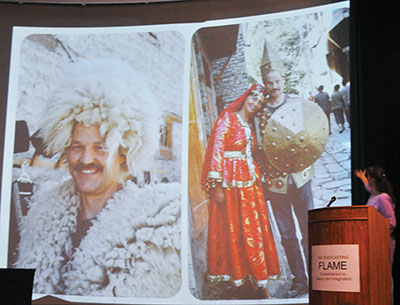
Iranians in Lahij
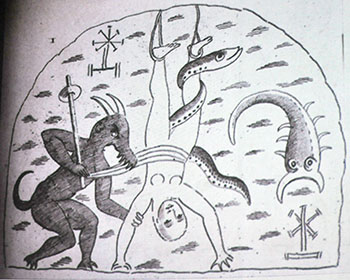
Post death punishment for a sinner, illustrated in the Ardavirafnamah
"An Illustrated Ardavirafnamah: John Rylands MSPersian 41 (Manuscript)” was analyzed by Ursula Sims Williams, curator of Iranian Languages at the British Library. In her study of the text that supposedly relates the travails of righteous and errant souls after death, she realized that the focus is "more on sins than good behavior.” For misdemeanors like overindulgence, the punishment meted out was eating one’s own flesh, and liars were cautioned that their tongues would be cut out.
The well-known "fable/legend” of Qesse-ye Sanjan that is interpreted as an account of the arrival of the community on the shores of India is "not to be treated as a scripture…for it is a mirror, not a clock; a reflection but not a chronological account,” summarized Dr Alan Williams, professor of Iranian Studies and British Academy Wolfson Research Professsor at the University of Manchester. When analyzing "The Qesse-ye Sanjan as the Parsi Foundation Document,” Williams commented that in the late 16th century poem with 432 couplets one can "discern a structure pattern and cross-fertilization from other sources.” Of the 432 verses only 38 actually dwell on the journey from Iran to India and only once does the author Bahman Kaikobad refer to his subjects as "Parsis.” Elsewhere he describes them as "those of the good religion.”
When romanticizing and mythologizing the story he seems to be "taking pride in the past and building on the future.” The account should be interpreted as "a rite of passage” for it is titled Qesse-ye Sanjan and not ‘Qesse-ye Zarathushtis’, he pointed out. There are nine couplets dealing with women in menses when they are forbidden from socializing and moving freely. "It shows we keep our women in check, in control,” stated Williams. Sins concerning women mainly related to her body or within her home; for men it was crimes like stealing, performed outside the house.
In the session on "Oral Traditions — Continuity and Flux,” chaired by Prof (Dr) Anupa Pande, dean of the National Museum Institute of History of Art, Conservation and Museology, she stressed that oral traditions "trusted the retentive memory (where) each narrative has its own flourish to add… It is not linear and straitjacketed… Oral tradition gives space for art forms to be preserved.”
"Water (from a clean source), fire… metal utensils, fruits, dry fruits (lork), fresh bread with sunflower seeds, twig of an evergreen tree (cypress or myrtle) are present in all Zoroastrian rituals,” mentioned Dr Farzaneh Goshtasb, faculty member of the Department of Ancient Iranian Culture and Languages, Institute for Humanities and Central Studies, Tehran in her paper on "The Key Components of Zoroastrian Rituals in Iran.” Viewing rituals as a continuum, she referred to the presence of priests and the interconnectivity of rites.
The ninth century song of fire, Atash nu geet, was dwelt on at length by Dr Sarah Stewart, lecturer in Zoroastrianism, Department of Religions and Philosophies at the School of Oriental and African Studies (SOAS) in her presentation "On the relationship between Oral Texts and Oral Testimony in a Zoroastrian Context in India/Iran.” The song in honor of the second grade of fire (adaran) offers insights into prevalent "notions of morality… with its allusion to people and events… how the religion is practised. It served to bring about a sense of unity within the community.” The song is accompanied by rituals when the singers or goyans move in a circle on auspicious occasions like weddings or navjotes. "Distinctive yet repetitive,” it is sung in two voices with constant interaction between them. There is reference to the audience in the song as also to the performance of a priestly yasna and finally includes the names of the family by whom it is commissioned. It gave the diaspora community "a sense of inclusion.”
"Stories that Zoroastrians tell themselves about themselves” constitute oral traditions, she elaborated. While the narrative of a place resulted in a sense of belonging, a historical narrative contributed to the collective memory. Both these are included in folklore.
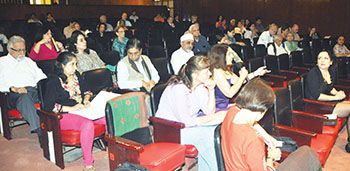
Audience at the Conference
The resilience of the community in Lahij and the struggle they are going through was explained by Galina Woodova, PhD candidate, Department of Near Eastern and African Studies, Charles University, Prague. In her talk on "Novruz in Lahij, Azerbaijan,” she related that the Iranian people in Lahij who believe in a God "Khudo” are bilingual, as they also speak Turkish, and "Navroz is part of their identity. If anyone holds a grudge from winter to spring, he/she is expected to make peace before Navroz.”
Primarily craftsmen, "they work with their hands,” as seen in the case of the breadwinners, many of whom are coppersmiths and carpenters. The day a man earns a living is cause for celebration because that means they have food to eat. They have a blessing for every occasion. "They don’t have drug stores,” preferring to use herbs from mountains and natural cures. "Their frugality showed in other ways too.” Their mode of survival "deserves to be on the cultural landscape of UNESCO (United Nations Educational, Scientific and Cultural Organisation),” she opined. On the surface it appears as if they pray in a mosque but on marriage they tie a cord like the kusti and walk around the fire three times.
Married to an Iranian, Dr R. K. Khetrapal of the Indian Spinal Injuries Centre, New Delhi, offered to take the audience "home” with his 175 slides of Pasargade, Persepolis, Yazd, Kermanshah, Shapur, Azerbaijan in his presentation on "Safarnameh e Farzandha Ye Ahura Mazda/ The Journey of Ahura Mazda’s Children.” An Iranian enthusiast rather than an academic, Khetrapal shared nuggets of information: In olden days, a fire was started when a king was enthroned and extinguished when he died; the palaces of Cyrus the Great with their columns and gardens were built to withstand earthquakes; on the occasion of Mardgiran, women were allowed to choose a husband for themselves in spring; when building the canal in Egypt, initiated by Darius the Great, 100,000 slaves lost their lives; Azerbaijan had soldiers who stopped the movement of Greeks for a month; Parthians discovered electro plating 2,220 years ago and made batteries in Ctesiphon.
The session on "Development of Modern India: Arts, Science, Media and Politics” was chaired by Cama who commented that "joy in life is a Zoroastrian trait…We are a magpie culture. We don’t want to throw away anything. Enjoyment, accumulation and sharing is part of our culture… There are fields waiting and crying out for researchers… There is so much to discover everytime you walk into a city in Gujarat. Petigara wad that was known for wooden craftsmanship derives its name from the garas of yore that were shipped to India in a péti (trunk). J. N. Tata tried to cultivate temperate silk in Mysore. There are two kinds of tasar silk available in India — tropical or temperate (depending on the region where the cocoons are produced). Seeing the depleting number of practicing Hadvaids (bone setters) Cama felt their study would result in "a tremendously important medical breakthrough.”
The main purpose of establishing the J. J. School of Art was "to train Indian minds to the European way of thinking and to promote art aesthetics,” said religious historian Firoza Punthakey Mistree who with art historian Dr Pheroza Godrej presented a paper on "A European Transformation — The J. J. School of Art and the Rise of Parsi Artists.” The J. J. School fostered "academic realism” teaching students the importance of light and shade, postures, anatomy, European naturalism. They were taught to "render art convincingly, depict ideals of womanhood and how they were to be perceived in art.” Europeanization of subjects was inevitable and even Prophet Zarathushtra was shown with brown hair and blue eyes which are considered "Christian colors.”
The J. J. School of Art started with wood work and over time introduced other mediums like silver, weaving, ceramic, commercial art and architecture, she noted. Originally the paintings were flat, one dimensional, using natural vegetable dyes, revealed Godrej. Subsequently there was experimentation with drawings depicting the lifestyle, pleasures and pastimes of that period. She analyzed the works of outstanding artists from Pestonji Bomanji to Gieve Patel and recalled how Parsis have contributed to the art collections at Air India, the Tata Institute of Fundamental Research (TIFR) and the Taj Group of Hotels.
"Art like Science knows No Frontiers” was the subject of the presentation by Dr Indira Chowdhury of the Srishti Institute of Art, Design and Technology. Focusing on the vision of Dr Homi Bhabha and the Spirit of Internationalism, she shared several images of and by Bhabha to indicate that whilst pursuing science he had a keen interest in art. Even though his father was keen that he study engineering at Cambridge Homi had his eyes set on physics and mathematics and had convinced his father, "I’ll show you India will be proud of me.” In fact TIFR bears the stamp of his passion for art.
Information on the early Gujarati periodicals of Bombay was shared by independent researcher Murali Ranganathan in his paper on "Three Worlds and an Ocean of Knowledge.” He spoke of Pestonji Bomanji of the Wadia family who in the 1770s had launched the Bombay Directory and Calendar to be followed by the Bombay Herald, Bombay Gazette and Bombay Courier. Byramji Jeejeebhoy who hailed from Surat cast Gujarati type in 1796, commencing the printing of Gujarati advertisements in the Bombay Courier. By 1798 the Khordeh Avesta had been printed in Gujarati. In 1822 Furdoonji Marzban launched the Bombay Samachar and 10 years later, Jam-e-Jamshed. Parsi reform agenda first found space when Gujarati periodicals like Vidya Sagar carried original and reprinted articles on literature, biographies, book reviews, travel, science and arts in 1840. The first volume was dedicated to Jamsetji Jejeebhoy who funded the magazine. That was the year when the first Parsi was converted to Christianity. Competition the next year came in the form of Shushtee Vidya, but after six years the magazine wound up. Juggat Mitra was published by Bombay Samachar in 1850 and the following year Jam-e-Jamshed Press published Juggut Premi. In 1856 Juggut Varnan was published as an organ to debate, engaging with contemporary researchers.
Engaged in shipbuilding and textile manufacturing, the Parsis of Bharuch benefitted from its maritime prosperity and made several donations for the construction or repairs of the eight agiaries there during the 19th and early 20th century, stated Dr Meher Kelawala Mistry, who is affiliated with the University of Bombay, in her paper on "Colonial Era and the Parsis of Bharuch — A story of survival and growth.” They were also in the forefront of the socioreligious and educational reform movement in the community and undertook several initiatives in the field of healthcare and status of women.
"Where do we go from here?” as the concluding discussion for the ZITNM conference highlighted the need for structured and funded research facilities in India in areas pertaining to Zoroastrian texts, rituals, traditions and Parsi/Iranian theater, films, music, dance, arts, crafts and literary traditions. Since high fees and visa difficulties preclude Central Asian students from pursuing research in Western universities, it was recommended that the Bhandarkar Oriental Research Institute and the Symbiosis International University in Poona could work on Zoroastrian studies in collaboration with SOAS, and the Universities of Tehran and Shiraz.
Cama stressed the need to create educational models for understanding and appreciating the rituals and values of the Zoroastrian faith especially among the youth who turn to other influences such as Reiki and yoga and Art of Living when there is such power of spirituality in our own culture. A new generation of educated priests who can teach their congregation the value and symbolism of rituals was deemed necessary. Besides basic and advanced courses in Avestan and comparative studies with Vedic Sanskrit, revival of Gujarati is also necessary to enable the new generation to connect with their roots and history, it was reiterated.
(With inputs from Ava Khullar)
◆ ◆ ◆
From the archive