
Politics and Policy
Mindful of the minorities
Zoroastrians being the smallest minority in her portfolio, Dr Najma Heptulla attempts to protect and promote their interests
"I am keen to see the Parsi brand continue… with its values of honesty and hard work. I am also bothered about this ancient religion,” summed up Dr Najma Heptulla, union minister for minorities, speaking to Parsiana in Delhi last month. She shared her observations on the community’s depleting numbers and inability to protect its properties on Navroz morning, March 21, 2016, thanks to the initiative of Dadi Mistry, Zoroastrian representative on the National Minorities Commission, and the persistence of his wife Nergish.
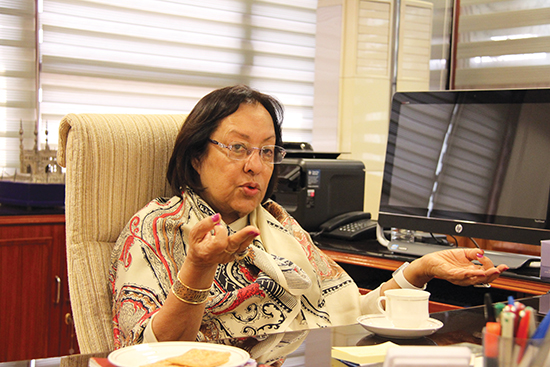
Dr Najma Heptulla: try and convince the leadership
Spending over an hour with the magazine at her office at Paryavaran Bhawan, the affable minister gave us insights into her personal life and the responsibilities she now shoulders, as also her experiences with members of the Parsi community. "I am very happy that the Prime Minister has given me this portfolio,” she said, reiterating that "every country’s democracy and relevance is judged by the way the majority treats its minorities.” Considerably involved with the six minorities which fall within the purview of her ministry, she mentioned that the little known second verse of Jana Gana Mana with the lines "Hindu, Jain, Sikh, Budh, Parsi/ Musalman, Christani” were sung by her as a child of seven, perched on a table over six decades earlier, at a school function in Bhopal in 1948.
Grand niece of prominent Indian freedom fighter Maulana Abul Kalam Azad, Heptulla has been involved with Indian politics since many years. A former general secretary of the Indian National Congress, she was a member of the Rajya Sabha from Maharashtra for four terms as Congress candidate and was deputy chairperson of the Rajya Sabha for 16 years. She was elected president of Inter-Parliamentary Union, a Geneva based international organization, for three years and was nominated by the United Nations Development Programme as its human development ambassador. Following differences with the Congress leadership, she joined the Bharatiya Janata Party in 2004, was made one its 13 vice presidents in 2010 and a cabinet minister in 2014.
"The six minorities with me are different — in numbers…and also their problems. For the Parsi community, the main problem is population… As the population diminishes, it is difficult to look after the properties” following the death of the owners and the migration of families. Having been told about "the illegal occupation of Parsi properties,” she showed an interest in addressing a meeting of punchayet and anjuman representatives.
Whilst the Central Waqf Council that safeguards Muslim properties (by holding them in trust for a charitable or religious cause) functions directly under her ministry, "I cannot directly interfere” in the property affairs of the Parsi community even though "it is a very serious problem. All punchayet leaders should put their heads together… Identify such properties that are not taken care of… Their values are rising day by day. Perhaps you can consider coastal tourism on these properties, or have schools or old people’s homes so that your name remains. My ministry can only give logistic support and advice,” she added.
"Every time a child is born under the Jiyo Parsi scheme, I get a message. I feel so happy.” Heptulla expressed her elation on learning of each addition to the community whose dwindling numbers seem to be a greater cause of disquietude for the Indian government than its own members. Two years ago the government sanctioned a sum of Rs 10 crores for the Jiyo Parsi program initiated by ParZor to finance the cost of fertility treatment and counseling for couples in the child bearing age group. "We are concerned that the Parsi population is dwindling. I don’t want the population to disappear,” stressed the minister, a zoologist by training. Offering the services of her son-in-law who is a geneticist, she pointed out "there is a scientific reason, a genetic problem of infertility.” With the high percentage of "inmarriage in the community, the genes are becoming weaker as there is no cross pollination,” she observed. (Some geneticists believe the Parsi gene pool is large enough. In addition around 37% marry outside the faith — editors)
 Although she did not want to intervene in the religious affairs of the community, she felt that if so many are marrying out of the community, their children should be permitted to visit the agiary. The next generation "may not remain white in skin,” she concedes, but considered it better that these children be allowed inside now rather than see these institutions be taken over by some other community at a later time. Hoping to witness "a rethink” among the community leadership, she recommended, "try and convince the Punchayet” so that all members can be assured of "a good education, a good future and a good life.”
In favor of giving freedom to children, to those contemplating intermarriage, the progressive minister had a word of advice: "There will always be a culture shock. Be prepared for it. If there is no opposition to the marriage, it will work… But if the inlaws don’t treat their daughter-in-law well, she will hate their food, their dress and their culture.” She recalled the opposition from the two families when she married Akbaralli Heptulla for although she was a Muslim like him, she was not a member of his Bohri sect. When he was summoned by the Syedna, for marrying outside his caste, it was Bobby Kooka (of Air India fame) who played mediator, she reminisced. In her early days of marriage she encountered a lot of difficulties but is happy that today the "Syedna is supporting me and I am supporting them” and she could even bring about a rapprochement within the factions of the Bohri community.
The position of women among minorities depends on their social and personal laws that govern marriage, divorce and inheritance. Among Muslims, marriage is not a sacrament but a contract which can be entered into by deciding in advance the mihr or price the groom’s family will pay to the bride’s parents. Women are well protected provided the community members follow the rules. In Islam, only one-third of the property can be bequeathed by will, two-third is distributed according to custom, she explained.
In a pluralistic society like India, the adoption of a uniform civil code becomes difficult when nearly 20% of the population that includes different religious communities and tribes are governed by separate customs and personal laws. "There should be consensus for one law to be implemented. To bring in a common civil law, the government would have to take everyone into consideration,” she stated.
Regarding reservation of seats in Parsi founded institutions, Heptulla assured, "I will discuss with those institutions. I will try and talk to them. I will recommend and don’t mind negotiating.” Just as the National Minorities Commission tries to function in an integrative manner, the "State Minorities Commissions should be positive and not only find fault,” stresses Heptulla. Since the official demographic figures for the Zoroastrian community have yet not been announced for the 2011 census, she said she would pursue the matter with the Registrar General of India.
Keenly involved in The Everlasting Flame International Programme and the launch of three exhibitions — showcasing the history and culture of the Parsi community that has made India its home — for which the Government of India has sanctioned Rs 14 crores, the minorities minister’s support was constantly alluded to by the curators. Her personal touch was evident at the inauguration of the three exhibitions: "The Everlasting Flame: Zoroastrianism in History and Imagination” running at the National Museum, "Painted Encounters” and "No Parsi is an Island” at the National Gallery of Modern Art, and "Threads of Continuity” at the Indira Gandhi National Centre for the Arts (see "Every Parsi is an institution,” Parsiana, April 7, 2016). Managing to converse in Gujarati laced with Hindi, she remembered going to Homi Tavadia’s Parsi plays like Taari bairi mane aap (give me your wife) in the company of her husband’s battery of Parsi friends!
"There is only one God,” affirms the minister. While the Parsis may say "O Khuda,” and the Muslims may say "Allah,” she is convinced "there is only one Supreme entity, whichever way you pray to him.” She briefly recited the salient lines in the Islam prayer which starts with "Bismillah-ir Rahman-ir Rahim (in the name of God, most gracious, most merciful).” Those who really follow the Quran should remember the words "Ihdi-nas-sirat-al-mustaqim. Sirat-allazina an’amta’alaihim gair-il maghdubi’ alaihim waladdaallin (Put me on the right path, the path of those on whom Thou hast bestowed Thy grace, those whose nature is not wrath, and who go not astray),” she recited. Each of us should remember that "my religion is for me; yours is for you. What you pray, do or don’t do is up to you…One thing is most important: What is your relationship with other human beings… You shouldn’t upset others’ sentiments.”
◆ ◆ ◆
From the archive