
Welfare
Concentrating on the Commission
With her appointment as member of the National Commission for Minorities, Dr Mehroo Bengalee will give due priority to education and conservation
"Whatever problems you are facing with regard to the development of our community…and any other matter(s) which you feel need to be referred to the central government for redressal and relief may kindly be forwarded to me…” wrote Dr Mehroo Bengalee on April 13, 2006 within two days of taking charge as the new Zoroastrian member of the National Commission for Minorities (NCM). Copies of her handwritten letter were sent to all the members of the Federation of Parsi Zoroastrian Anjumans of India (FPZAI) plus other Zoroastrian associations, welfare centers, youth bodies, eminent members of the community and leading Parsi owned industrial houses.
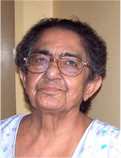
Dr Mehroo Bengalee: keep learning
From the nearly 65 recommendations that reportedly came in for the Minorities Commission seat following the demise of Lt Gen Adi Sethna, the central government chose to nominate Bengalee, former vice chancellor of the Bombay University and erstwhile member of the Maharashtra State Minorities Commission. She believes they must have considered the totality of her "experience and qualifications.” Previously a trustee of the Bombay Parsi Punchayet (BPP), she is also a founder member of the orthodox World Alliance of Parsi Irani Zarthoshtis (WAPIZ). Looking at the strength of this fifth statutory NCM constituted on March 3, 2006 under the chairmanship of Mohammad Hamid Ansari, Bengalee was happy to observe that there were at least three academicians. The others serving the seven-member Commission are M. Michael P. Pinto (vice chairman), Harcharan Singh Josh, Lama Chosphel Zotpa, Dr Dileep Padagaonkar and Prof Zoya Hasan.
Belying the fears that at 75 years of age she may not be able to do justice to her new appointment, when Parsiana interviewed her on April 26 we learnt that she had already attended three informal meetings of the Commission held every Wednesday in Delhi and was preparing for her first board meeting scheduled for the first Thursday of each month. She will also be expected to tour one region each month to assess the minority grievances in the area assigned to her. Thus besides voicing the concerns of Parsis throughout the country she is expected to be a conduit for the difficulties faced by other minority groups too in Maharashtra, Gujarat, Goa, Diu, Daman, Dadra and Nagar Haveli. "There are only seven Parsi families in Goa,” she reports.
Dissatisfaction over "acquisition of Parsi-owned lands (unused) by the state or municipality” has already been voiced to her by representatives of Thana and Belgaum. Concerted efforts will be made in every case for the assets to revert to the Parsis. "Let the funds come back to the community,” Bengalee plans to make a renewed plea to the finance ministry. In Calicut, there is encroachment on their anjuman property by a newspaper vendor, she has learnt. After the Aden fire was brought to the agiary in Lonavla, the government in Aden that took possession of the property there has allegedly not given any compensation to the family. Thus the Minorities Commission was approached and they will shortly be making a representation to the foreign ministry.
To allay the apprehension created over a recent Press report that the Government of Maharashtra has assigned the 15th Law Commission to formulate a draft bill to take over the management and regulation of temples and religious institutions, Bengalee notes, "There is a legal body in the Commission” to preempt any injustice or atrocities against minorities.
With piles of files and neatly stacked papers within easy reach, she was instantly able to tell us that all over India there are 17 colleges and 29 schools established and founded by Parsis. "My forte is education,” declares the former vice chancellor, adding, "I was asking for 10 percent reservation of seats for the community in Parsi founded colleges” but Minoo Shroff, chairman of the BPP and FPZAI president told her to settle for a more realistic three/four seats per college (in the past some reserved seats went a begging as there were no Parsi candidates). The gutsy lady has been advised to approach the governments of the respective states for this concession and considers this her priority.
"We have such resources and talent… We are unfortunately dwindling so we can’t start new colleges… Where are the children?” she asks before proceeding to answer her own question: "Most people do not realize that the best education is here. It has become a craze, a kind of madness to study abroad,” says the lady whose early education was at Bombay’s Gamadia Girls’ High School and St Teresa’s Convent (Girgaum) after which she completed her graduation and postgraduation from St Xavier’s College, having earned a fellowship. First appointed a lecturer at St Xavier’s Institute of Education in 1956, over 50 years ago, she is of the view that when there are so many colleges affiliated to foreign universities what is the need to spend lakhs to finance overseas studies and then stay back to pay off the debts? She realizes that "our (Parsi) children can’t compete and obtain the necessary scores at examinations which require mugging” so they seek admissions outside India. "Where are the Parsis in the National Defence Academy? In the Public Services examinations? Police force maa aavi nathi sakta (they cannot compete for entry to the police force),” she regrets.
Contrary to what many from the orthodox school of thought would like to believe that the community numbers are not depleting and there is just a redistribution of population, Bengalee opines, "Our number as such is definitely dwindling… whether it is due to migration or any other reason… it is a fact.”
She has a ready solution to fortify the dwindling community: Let the well-established Parsi industrial houses absorb the youngsters as apprentices after they have completed their higher secondary education. Whilst they are earning, the juniors should simultaneously pursue higher learning through distance education courses. This would be preferable to the present trend of completing education, then seeking employment of one’s choice which may or may not be available and only later considering marriage and children. With an increasing number of younger couples opting to live independently after marriage, the elders get affected and hence a greater need for senior citizens’ homes in recent times, observes the spinster who would like "Parsis to see the advantages of living in large families... But this is a problem we have to sort out (internally).”
Another area close to the conservative member’s heart is "preserving the sanctity of Udvada.” Along with Dinshaw Tamboly, managing trustee of the Foundation for Development of Udvada (FDU) she plans to visit Udvada. Does she support the FDU? "Definitely,” she replies. As per her discussion with FDU chairman Dastur Khurshed Dastoor she would like Udvada to be promoted as "a heritage center, not a tourist center which even the High Priest said we should, with the crore of rupees sanctioned by the center.” The financial grant from the center should help with the basic infrastructure. To control erosion of land by the sea water is of utmost importance as also to ensure that the sanctity of the Iranshah is not marred by any high-rise within a five km radius, she stresses. To learn firsthand the difficulties encountered by the residents in the neighboring pockets of Navsari, Bardoli, etc Bengalee will tour these areas too. Though she has been forewarned that Gujarat chief minister Narendra Modi may not be favorable to any representative of the Minorities Commission, she was optimistic about her plans.
The central government has already provided for seven centers of vulture breeding in different parts of India. But Bengalee has made an appeal for one more on the Doongerwadi grounds in Bombay so that the dakhmenashini tradition can continue. With funding and assistance from the central government, and the necessary expertise from the Bombay Natural History Society she believes the project can start moving once a few birds are imported to this region and their habitat fenced to ensure that no mischief is played. On whether bunglis at Doongerwadi should be available for use by those opting for alternate modes of disposing the dead, Bengalee maintains, "I am very conservative. I do not want to get involved in controversies. Let the religious priests decide on these issues (taking into consideration) the intent of the founders.”
On the subject of universal adult franchise to be introduced for electing the new BPP trustees the educationist states, "I am for it.” She can understand that "to appease the donors” they have been given two votes each but why should this inequality be permitted to continue whereby even new donors are entitled to two votes? she questions. "Then it’s not adult franchise. There will still be a body of aristocrats with a stronger hold. The feeling that ‘everyone matters’ will not be there...
"A leadership training program for Parsi children,” is a dream that is eluding the lady who says she joined WAPIZ hoping to see it through. "But somehow thatooch nathi (does not seem to happen)” with the mushrooming of so many associations and community programs and activities. The lady has "devoted her whole life to the cause of education of students in general and teachers’ training in particular. She has to her credit a doctorate degree in psychology, master of arts in economics, master of education in statistics and vocational guidance, postgraduate diploma in guidance and counseling, counselors trainers’ certificate from Michigan state and diplomate in professional counseling (from) International Academy of Professional Counselling and Psychotherapy, Kentucky, USA,” notes her bio data. Having served different advisory committees and management councils in the field of education she has also authored 12 books in English and Gujarati in her area of expertise.
"I am concerned,” admits the resident of Cusrow Baug when she sees young and old Parsi females stroll around in their spaghetti straps. "Nudity has become a byword for Parsi fashion. We keep saying ‘sudreh-kusti is your armor’ but where is it? I blame the mothers first. On the navjote day mai é sudreh nahi péhrélo hoi (the mother has not worn the sudreh). What can you expect? I am worried.” She is disappointed with the seniors too: "The khitpit, the infighting should stop. This is ruining our reputation.” The educationist’s credo seems to be — Life is a lesson, "continue learning...”
◆ ◆ ◆
From the archive