
Mandate for the minorities
Community leaders expess their concerns to the chairman of the National Commission for Minorities
He was addressing a select gathering that included the Zoroastrian representative on the NCM Dadi Mistry, the chairman and four trustees of the BPP, the presidents of the punchayets/anjumans of Surat, Ahmedabad, Valsad, Thana, Borivli, Ratlam, Iranian Zoroastrian Anjuman (IZA), plus representatives of different community institutions and housing colonies in Bombay.
Pointing out that "well reasoned advisories” from NCM "are being challenged in courts of law and they are being stayed,” Ahmad explained that although the NCM is an "important constituent of the Human Rights Enforcement mechanism in the country,” as per its mandate it can neither substitute for a court nor the government. It is expected to function as a watchdog. Whilst quarrels within a family or between two factions in a community or matters pending in court do not fall within the purview of the NCM, they do have the authority to intervene suo moto and not only on formal petitions made to them.
Observing community youngsters seeking "greener pastures and moving out of the country,” Ahmad remarked, "Left behind are the elders who are faced with the predicament of looking after themselves.” The decline in community numbers places "an added responsibility” on the law enforcers to ensure that their "genuine grievances are taken note of and redressed. If you ask for a time frame” within which the desired results will accrue, that will not be possible for it would "depend on the response from the responding authority.”
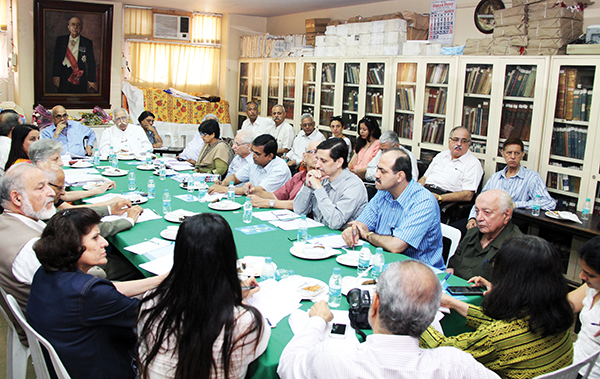
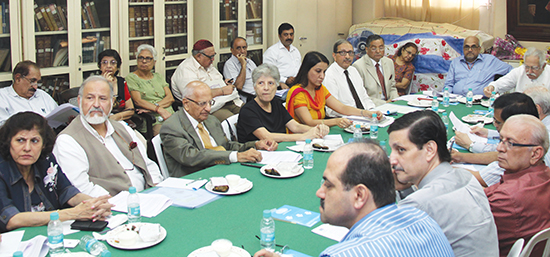
The meeting in progress
The morning’s master of ceremonies Farrokh Rustomji, joint honorary secretary of the Federation of the Parsi Zoroastrian Anjumans of India (FPZAI), raised the main issues on which the community sought NCM’s assistance. Foremost amongst these was a motorable road to a height of 1,800 feet to reach Bahrot Caves which once housed the sacred Iranshah. Although a protected site under the Archeological Survey of India, the approach road is only "a trekking pathway through the forest that is inaccessible for five months,” explained Dr Homi Dhalla, president of the World Zarathushti Cultural Foundation. According to Dhalla, the Forest Department is objecting to a motorable road through a forest. When Ahmad enquired, "What is the distance to be covered through the forest?” Dhalla replied, "approximately five to six kilometers.”
BPP chairman Dinshaw Mehta, who had served on the last State Minorities Commission of Maharashtra which has since been suspended with the formation of the new government, recalled the erstwhile chief minister of Maharashtra Prithviraj Chavan sanctioning funds for a motorable road leading up to the Caves but there has been no progress since.
Education was the next item on the list and as pointed out Rustomji, "With so many quotas, even the brightest of our children with 90% marks can’t get admission into engineering and medical colleges.” As Ahmad was reminded, the Indian Institute of Science, Bangalore, the Victoria Jubilee Technical Institute (since renamed Veermata Jijabai Technological Institute) , J. J. College, Grant Medical College and other colleges across India "have been either set up or heavily endowed by funding from Parsis. The time has come when we request endowment seats for Parsis in such institutions.” There is even the Byramjee Jeejeebhoy Medical College in Ahmedabad, pointed out Brig Jahangir Anklesaria, president of the Ahmedabad Parsee Panchayat who felt that the community’s progress depends on the education of its youngsters. He was also keen that educational text books in India have a chapter on Parsis because "it is unfortunate that despite the contribution of this great community not many know who’s a Parsi/Zoroastrian.” The Bangalore Parsee Zoroastrian Anjuman (BPZA) has in a written statement recommended that a seat be reserved for the Parsi community in medical and engineering institutions in Karnataka. BPP public relations officer Godrej Dotivala recalled the efforts made when Lt Gen Adi Sethna was the Zoroastrian representative on the NCM to prepare a list of educational establishments started by Parsis or which have benefitted from Parsi philanthropy.
Whilst keen to study this list, Ahmad warned that since this request to the government "could open a pandora’s box for other communities,” their response "will depend on the magnanimity and broadmindedness of the concerned government.”
Fali Poncha representing the Ness Baug Association referred to grievances regarding governmental intervention in minority run educational institutions. He believed the community has to face such high-handedness because of our "lack of numbers; we don’t count. We have given enormous contribution to the country’s repute. We need to be taken seriously.”
Under the auspices of the Parzor Foundation an application has been made to the Delhi Development Authority for allotment of land for the establishment of a Parsi Zoroastrian Museum in the capital. Following extensive correspondence with the office of the Lt Governor of Delhi they have now approached the ministry of art, culture and language requesting them to finance the activity. "We need help from the Ministry of Minorities Affairs to move forward,” said Rustomji. Ahmad suggested that sponsors be found from within the community and declared that the "cultural ministry would only give a small amount.” Rustomji felt "even a token amount would indicate government sanction. It’s like getting seed capital.”
In a recent speech by the Union Home Minister Rajnath Singh, he alluded to Parsis four times, recounted Mistry. Referring to the Parsi largesse of yore, former BPP chairman Minoo Shroff regretted that "we are losing out despite all our contributions being cosmopolitan” and Parsi charities having assisted the welfare of all communities in this country.
Another plea was made to offer courses in cultural studies on the Parsis, Avesta, Pahlavi and linguistic studies at the postgraduation and higher levels in Indian universities. According to the note that was circulated, "Parsi Gujarati is a unique linguistic dialect combining regal Pahlavi and tribal Gujarati. It is a dying dialect and needs research and support.” The institution of a chair in Avesta studies at the Bombay University was mooted by BPP trustee Khojeste Mistree.
Invitees at the meeting
Protection and representation
"Several hundred crores” of Parsi properties all over India being "misused/usurped/illegally occupied” has prompted the Defunct Anjumans Subcommittee of the FPZAI to take the initiative, under legal counsel Burjor Antia, to prepare a Bill which they would like to see introduced in the Rajya Sabha to protect trust properties of Parsis. A draft copy of the Bill along the lines of the Muslim Waqf Act was presented to Ahmad for his consideration. With the population dwindling in the mofussil areas "it is difficult to secure and protect community properties from encroachment,” said Mehta who felt the passing of an Act along with police protection would offer relief. Compounding these difficulties is the absence of documentation to prove property rights, mentioned Mistry.
Anklesaria referred to the local authorities shifting slums to the Parsi graveyard in Nadiad and similar encroachment in Khambhat. The Parsi Sanatorium in Ahmedabad is also threatened as it now falls under the Central Business District that the government is planning to develop and as a result of which a road cuts across their property. He was asked to send a formal petition to the Commission. Pareecheher Daviervala of Davier/Sanjan referred to village Dehari where 80% of the land belongs to Parsis. Realizing that the community is helpless, brokers are conveniently encroaching on the property, a recent instance being the construction of two small school buildings just outside the Doongerwadi gate. Surat Parsi Panchayat president Jamshed Dotivala had come armed with a file to show how the Town Planning Authority in Surat "has its eyes on our crucial Doongerwadi land.” They have already moved the High Court in this regard.
From its original 2,000 acre plot of land in Palghar, IZA is left with 963 acres, said Anjuman trustee Pervez Irani concerned that as per the information they have received, a portion of their property is being earmarked by the Oil and Natural Gas Corporation to set up a gas based thermal plant. When Ahmad suggested they move the Court, Irani informed him that the Court said it can only intervene after the IZA is served with a notice. Ahmad advised IZA to send a formal petition to the Commission but then clarified that "on land related issues, informal intervention from a body like ours will not make a difference. You will need to take legal recourse.”
As pointed out Pervez Bhesania of the Thana anjuman, although years ago they were able to get a Court order in their favor regarding 4,000 sq ft of their land encroached by the Shiv Sena, "we could not get back our property.”
Daviervala referred to the local administration in Sanjan planning to destroy the public library in Sanjan built by her family to make way for a public toilet. She further complained about the narrow approach road to the Sanjan Stambh being encroached by shops on either side. Promises by the district officials to widen the road by clearing the shops are conveniently reneged on and funds diverted towards concretization instead. Dhalla was dismayed that their efforts 10 years ago that resulted in the excavation of a 1,000-year-old dakhma have come to naught with the encroachment on the land.
Prior to this meet the Daviervala family had approached the Minorities Commission to pursue their concern regarding the proposed Mumbai-Vadodara Express Highway passing through their property in Talasari. They had requested that the route be marginally realigned to another section of their estate to save their over 175-year-old fertile, fully irrigated multi crop land with 1,200 fruit bearing mango and chikoo trees and paddy fields. Earlier under the Maharashtra Agricultural Land Ceiling Act they had to surrender nearly 4,885 acres of their 5,000 acres, leaving them with only 115 acres. Since this issue "does not fall within the scope of the Commission’s mandate” Mistry was permitted to follow up in his individual capacity. On the intervention of Mistry, a meeting was held with Nitin Gadkari, minister for road transport and highways, on January 16, 2015 after which the project director and other team members revisited the site to explore alternative routes.
The BPZA honorary secretary Shereyar Vakil had earlier expressed the community’s disappointment at the location of a bus stand in front of the fire temple in Bangalore that is inconveniencing senior members who come to pray.
Convinced that "Parsis need more representation in Parliament,” the community is keen that the Government nominate two prominent Parsis to the Rajya Sabha. At the time of Independence Parsis had been offered two seats, asserted Poncha. But Sir Homi Mody had declined saying "Parsis can stand on their own feet,” recalled Dotivala. The need for a Minorities Commission in every state with a Zoroastrian representative was also impressed on the chairman. As explained Mehta, "Minorities is a state subject” so the central government has no say.
Poncha referred to his efforts over the last three years to convince the government to confer a posthumous Bharat Ratna award on Dr Homi Bhabha. He was of the impression that the government is not issuing the award although a clearance had been obtained from the President and Prime Minister because "we are too minuscule a community, half of which doesn’t even vote.” Recently a campaign has been initiated for the late Field Marshal Sam Manekshaw to be conferred the Bharat Ratna. Advised Mistry, "Some of you must come to Delhi and be in regular touch” with the concerned authorities. When former Delhi resident Rustomji assured Mistry of the community’s support, Ahmad commented, "It is not (a question of) how the community supports Dadi but how Dadi is supporting you.”
For the 1,700 Parsis in Pakistan, "getting a visa to India is very difficult,” stated Mistree who felt some system "should be institutionalized for this small community to continue with its religious (visits). Pakistan doesn’t have any cathedral (atash behram) fires like we have in India.” With community members usually approaching Mistry to expedite their visa applications, he commented, "Every time we have made a request to the Ministry of External Affairs, it has been granted but with the number of applications going to the Home Ministry increasing, people should allow for enough time” for processing.
Appreciating that the "community has done yeoman service to the country,” Ahmad continued, "You are Indians first and last. At the same time you are also followers of a faith… which is very dear to you… Your own welfare should be first.” Commenting that "the belligerent position adopted by certain communities is very sad,” Ahmad added, "To the extent possible we should have the courage to intervene... One should not be scared.” When asked whether the recent attack on churches came under the purview of NCM, Ahmad confirmed that it did before clarifying that whilst "we are still putting pressure, being a law and order issue this is a state subject.”
To ensure that the government machinery is sympathetic to the community, Ahmad recommended, "Pressure building should (continue) all the time.”