
Politics and Policy
Meeting the minorities minister
To protect Parsi assets and interests, assistance was discussed with the minister of minority affairs Salman Khurshid
Being so successful is the real problem for the Parsi community, observed the minister of minority affairs Salman Khurshid after he had given a patient hearing to the many issues concerning the community in India that were brought before him at a meeting on March 26, 2010. While offering his help on grievances that fell within the ambit of his ministry, reservation of seats, he felt, was a complicated and delicate matter, granted on considerations like economic and social backwardness.
This was the most constructive meeting he had had with a minority community, appreciated the minister but advised the community to sort out its leadership issues to enable it to speak with one voice. Twenty-six representatives of 11 anjumans and four Zoroastrian organizations in India availed of the invitation extended by the minister to attend a high-level meeting convened by him to express their concerns regarding demographic decline and some other pressing problems like reservation of seats, encroachment of anjuman properties, loans for housing in Bombay, support for preserving heritage structures, facilitating the visits of Pakistani Parsis to India and taking steps to ensure better coverage of Parsi Zoroastrians in the 2011 census of India.
"The purpose of the meeting was to have a dialog on the ‘Scheme for Containing Population Decline of Small Minority Community,’” noted the minutes of the meeting held at Paryavaran Bhavan as circulated by Ava Khullar, trustee of the Delhi Parsi Anjuman (DPA). The government sanction earlier this year of one crore rupees for a fertility scheme to stem the population decline in the community had been considered inconsequential by community leaders. But as explained Vivek Mehrotra, secretary of the ministry of minority affairs, this token allocation confirmed the ministry’s intent and interest to help the Parsis. It was a technical requirement to get clearance through a vote of Parliament for a future budgetary allowance to initiate the proposed scheme. This does not mean that the government will only allocate one crore rupees. The government is determined to assist the Parsis in improving their demographic profile and is willing to spend whatever is needed to complete this task, he conveyed. A note was circulated on the scheme envisaged by the ministry and feedback sought from those present.
Raising the fertility rate of Parsi women from 0.9 to 2.4 would stem the tide, pointed out Dr Behramgore Anklesaria, a leading gynecologist from Ahmedabad. Modern treatments including IVF (in vitro fertilization) could help improve Parsi fertility rates but for IVF to be effective, up to four cycles may be required, each cycle costing Rs 1.5 lakhs. Since this becomes prohibitive even for those with reasonably good income it was reinforced that 100 percent central funding would be ideal as versus a 90:10 ratio between the central government and the implementing organization. As Parsi medical practitioners and researchers would be giving free services, this may be considered as the community’s contribution, stated Dr Shernaz Cama, director of Parzor. While among other communities women seeking IVF treatment ranged in age from 24 to 40, among Parsis it went up to age 49, revealed Anklesaria.
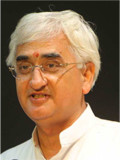
Salman Khur-shid: invites feedback
For young Parsi couples to marry and raise a family, homes are required, stressed Bombay Parsi Punchayet (BPP) chairman Dinshaw Mehta, seeking government loans to enable the BPP to undertake massive housing projects for the community to accommodate all Bombay Parsis in baugs/colonies. While Noshir Tankariwala, president of the Calcutta Zoroastrian Community’s Religious and Charity Fund felt monetary help would serve as an incentive to couples to have children, Kersee and Vispy Wadia of the Association for Revival of Zoroastrianism opined that the demographic decline needed to be viewed in the larger perspective of the community’s attitudes towards mixed marriages, adoption, etc. With Mehta threatening to walk out if this matter was discussed further, it was agreed that contentious issues should be sorted out at the community level and not be brought up at such forums.
Another proposal that could not be explored was the suggestion by Gev Avari, former Member of Parliament, that vultures be bred in the forest cover around Nagpur. Khurshid explained that breeding vultures was an environmental issue and beyond the purview of the ministry of minority affairs.
Some of Dahanu’s present woes too emanate on account of environmental factors. Following the notification of Dahanu as an eco fragile zone, introduction of new RED category (hazardous/noxious/heavy and large industries as classified by the Central Pollution Control Board) industries are not permitted in the region. Due to a clause stating "no change of land use” the farmers of Dahanu, most of whom are Zoroastrians, are unable to supplement their falling horticultural income with activities like tourism, or setting up of residential or educational institutes. It was therefore urged that the minority ministry put in a recommendation to the ministry of environment that certain concessions by way of non-polluting development be permitted in Dahanu to slow down or reverse migratory trends. It was further pointed out that the prevailing Scheduled Caste and Scheduled Tribe (Prevention of Atrocities) Act is misused in the Dahanu area. Fearing victimization under the Act, the police refuse to lodge complaints against tribal offenders for agricultural thefts or encroachment of land.
The inability of Parsis to get admission into Indian institutions has led to a brain drain with some of our best talent leaving the country, mentioned Dinshaw Tamboly, chairman of The WZO Trust. He was reinforcing the need for reservation of seats for Parsis in educational institutes endowed by Parsi benefactors, as advocated by DPA president Dadi Mistry. Avari added that the government could consider reserving one or two percent of the minority slot for Parsis.
Cama referred to the successful efforts of Noshir Sabavalla of Gherda College in obtaining a notification from the Gujarat Government regarding seat allocation in Parsi founded educational institutions. She hoped this would set a precedent that could be explored on an all India basis and was asked to furnish details of this to the ministry. Dr Niloufer Shroff mentioned how reservation of one or two seats was granted by certain professional institutions but the facility lapsed when there were no Parsis applying for a couple of years.
Reservation of seats for Parsi representatives was also necessary in the Lok Sabha, Rajya Sabha, State Assemblies and even municipal corporations and zilla parishads, recommended Avari who sought the ministry’s help in this regard. The government should make it mandatory for every state to appoint a minorities commission with constitutional status on which a Parsi should be appointed, suggested Bomi Hirjee, president of the Indore Anjuman.
Looking at community assets including temples of worship, burial grounds, community properties being encroached due to want of Parsis in many small towns Hirjee suggested the need for legislation to ensure that usurped property reverts to the community that has endowed it.
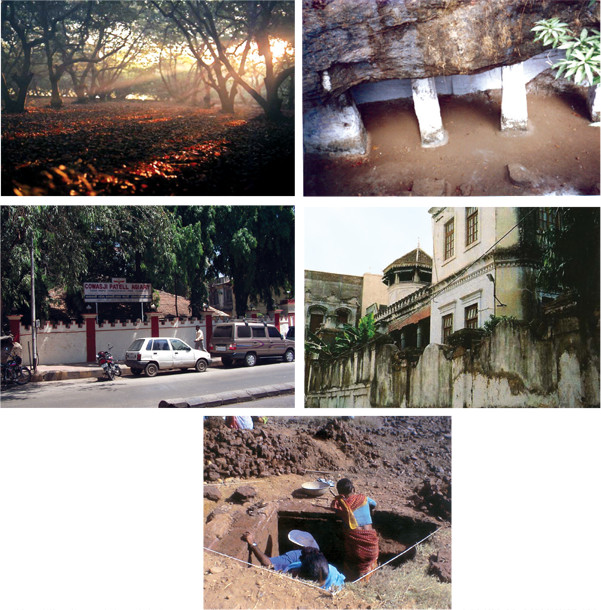
Clockwise from top left: Dahanu orchard, Bahrot Caves, Homawalla Agiary in Bharuch, excavation in Sanjan and Cowasji Patell Agiary in Thana
The Thana Anjuman that is fighting encroachment on their 230-year-old agiary and other trust lands due to the political muscle power of the usurpers sought the minister’s intervention to retrieve the anjuman property. Thana Anjuman trustee Parvez Bhesania was asked to send the details to the ministry as was Jamshed Sadri of Kanpur who too complained of their anjuman property being encroached by Dalits and the difficulty in evicting them. Farzan Mazda of Dahanu was likewise instructed to send a note to the ministry on the travails faced by the community there.
When DPA secretary Adil Nargolwala requested assistance in getting municipal clearance for the additional rooms being constructed at the Delhi dharamshala, the minister regretted his inability to help as it was beyond the purview of his ministry. However, Bharuch’s Sarosh Ginwala earned an encouraging response when he requested support for the renovation/restoration of their 250-year-old agiary. The minister declared that although the minority affairs ministry would not be able to help, the agiary could be restored as a heritage site for which he would put in a word with the concerned ministry.
Bahrot Caves, also being a heritage site, Dr Homi Dhalla, president of the World Zarathushti Cultural Foundation (WZCF) was asked to submit a note on the support he requested for the construction of a road through the forest area leading to the Caves where the Iranshah was ensconced for several years. He requested the minister to expedite conservation of the Caves as more and more damange is being caused during each monsoon. He also complained of encroachment on the site of an old dakhma near Sanjan which was under excavation by the WZCF. As both Bahrot and Sanjan are important historical and cultural landmarks, Dhalla said it is imperative that they should be preserved for posterity.
The difficulties of travel between India and Pakistan were expressed by BPP trustee Khojeste Mistree. Family connections and visits to pilgrimage sites bring Parsis to India, however the single point entry restricts movement elsewhere. Of the barely 1,500 Parsis left in Pakistan, not more than 50-100 would seek visas in a year, he mentioned and perhaps three-four families may wish to settle in India. He was asked to submit a note to the ministry on this subject but the next topic he broached of the need for subsidized sandalwood being made available to the community was not discussed as there was no consensus on this issue.
Although being numerically minuscule, Parsis should not be clubbed under "other religions” in the 2011 census of India, recommended Hirjee. In view of their precarious demographic situation, specific information should be analyzed for the Parsi community as a special case, he stated. Khullar was directed to follow up this matter with the ministry.
At this meeting the ministry of minority affairs was represented by the minister Khurshid with senior officials of the ministry including secretary Mehrotra, joint secretaries Upendra Tripathy and Amesing Luikham, and officer on special duty Nuzhat Hassan. The Zoroastrian delegation included representatives from Bombay, Delhi, Calcutta, Kanpur, Bharuch, Nagpur, Ahmedabad, Indore, Thana, Poona, Dahanu, UNESCO-Parzor, Association for Revival of Zoroastrianism, World Zarathushti Cultural Foundation and World Zoroastrian Organisation.
◆ ◆ ◆
From the archive