
“Every Parsi is an institution”
Union ministers extolled the Parsis at the inauguration of three exhibitions in Delhi showcasing Zoroastrian heritage

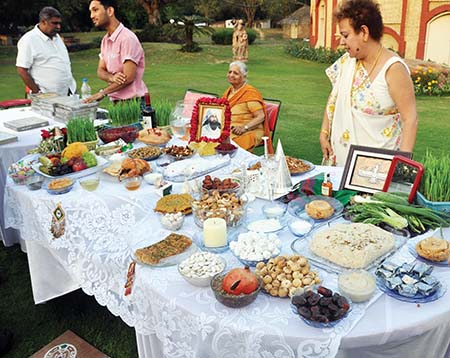
Navroz haft seen tables
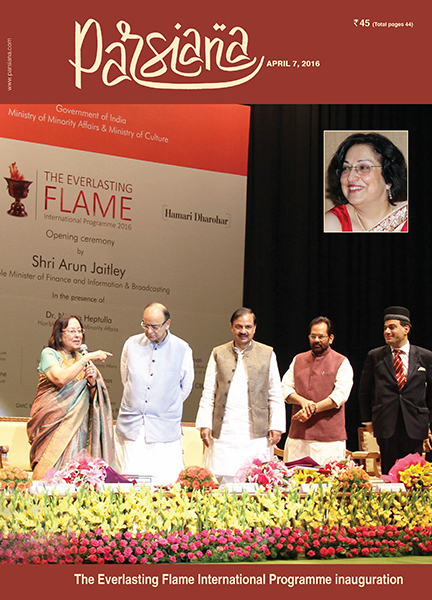
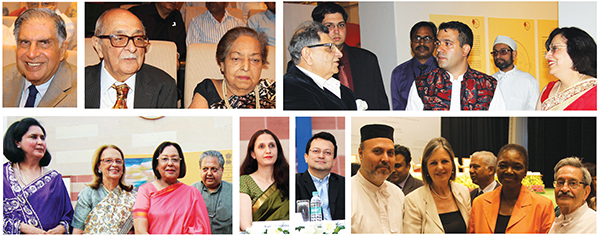
By 9.45 a.m., the lower level of the Auditorium was packed to capacity with leading community icons like Ratan Tata and Fali Nariman in the front rows. Thereafter even some VIP guests who arrived just in time for the launch of The Everlasting Flame International Programme that was scheduled for 10 a.m. on March 19, 2016 had to be redirected to the balcony.
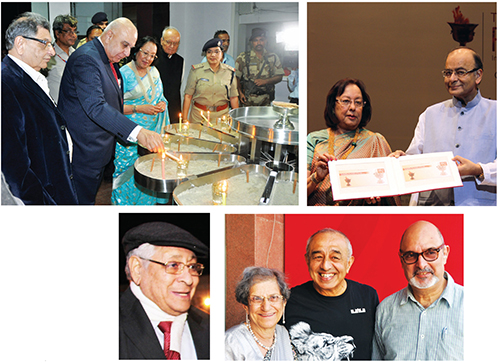
Presiding over the Programme under the joint auspices of the Ministry of Minority Affairs and Ministry of Culture, Government of India was Arun Jaitley, minister of finance and information and broadcasting. Also on the dais was Dr Najma Heptulla, minister of minority affairs, who had taken the lead in commemorating and celebrating the contribution of Zoroastrians and Parsis to world culture, philosophy and art under the ministry’s "Hamari Dharohar” (Our heritage) scheme. Other ministers in attendance were Dr Mahesh Sharma, minister of state for culture and tourism (I/C) and civil aviation, Mukhtar Abbas Naqvi, minister of state for minority affairs and parliamentary affairs, and Dr Ali Jannati, minister of Islamic Culture and guidance of the Islamic Republic of Iran. From London, gracing the function were Baroness Tessa Blackstone, chairperson, The British Library Trust and Baroness Valerie Ann Amos, director, School of Oriental and African Studies (SOAS), University of London. L. N. Sharma, chief post master, Delhi Circle who facilitated the release of the special postal cover to mark the occasion was also on stage. The only Zoroastrian seated on the dais that morning was Lord Karan Bilimoria of Chelsea, UK who was dressed in a suit with a pheta atop his head.
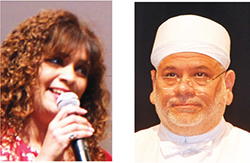
Penaz Masani and Dastur Khurshed Dastoor
After the lighting of the ceremonial lamp and a benediction for peace and harmony by Dastur Khurshed Dastoor of Udvada who prayed in Avestan as also Sanskrit and gave a brief explanation in English, the audience was treated to the melodious voice of ghazal queen Penaz Masani whose rendition of Karu Chhu O Dadgar gave a new sound effect to the traditional monajat.
Welcoming Zoroastrians who had come from all parts of India as also Iran, Pakistan, Central Asia, UK, USA, Canada, Australia, New Zealand with a "warm sahebji,” Heptulla commended the "peace loving Parsis…(who) have integrated themselves in India,” and reiterated the Government’s commitment to preserve the "multicultural heritage of India.” Referring to the "shared commonalities between Zoroastrianism and the Rig Veda,” respect for the eternal flame, known as "agni by the Hindus and atash by the Zoroastrians,” she was impressed by Zarathushtra’s key message that "asked followers to attain happiness by making others happy.” She lauded the "tiny community that stands out among billions… has excelled in all walks of life… left its impact in every domain… As business barons they have created wealth and helped wealth move forward” by creating institutions like the Tata Institute of Fundamental Research, Tata Institute of Social Sciences and the National Centre for the Performing Arts. "The new benchmarks they have set, their extraordinary leadership, the fire they brought has fuelled efforts in nation building,” she remarked.
"As mediators” Parsis have played an important role, from Dadabhai Naoroji who "could bridge both the worlds,” to Bilimoria, the current Zoroastrian in the British Parliament. Whilst appreciative of "young Zoroastrians who have the making of global citizens,” she added, "India needs you as much as you need the affection of India.” The results of the government supported Jiyo Parsi scheme to "stabilize and increase the Parsi population in India… have been encouraging,” said Heptulla who hoped "to see more success in the days to come” although throughout her life she has been advocating that India needs less children.
"Some communities are not measured by their numbers but by the impact they have had on others,” commented Jaitley who commended the Parsis for having "lived in dignity with their head held high and also becoming role models for many in India.” It was in his budget speech in 2015 that Jaitley had announced a government grant of Rs 14 crores to support the mounting of The Everlasting Flame exhibition in India. Reportedly four crores from this amount were spent on improving the infrastructure facilities at the museum. Considering himself privileged for having participated in two mega events concerning the community within the last three months, he mentioned that when returning after the Iranshah Udvada Utsav where he saw "some of the loveliest old buildings, though not in the best of condition,” he felt the place "has a huge potential for becoming a global cultural center. This is the right time for the Government of India, the state government and the community to develop a master plan for a grand cultural center. The history and culture of the township deserves to be preserved.”
Having enjoyed the "privilege of being associated with members of the community…and learnt a lot from all my Parsi colleagues,” he remarked, "Every Parsi is an institution by himself. No two Parsis are alike. They are large-hearted, enjoy laughing at themselves… strive for excellence, aspire for top position within that fraternity, they have an ability to create and lead institutions, they (follow) their own ethical conscience, values, principles they profess…” Convinced that "the community will leave footprints on Indian history, heritage,” he pointed out that whilst there is a Parsi in the UK Parliament, "It’s a pity there is no Parsi in the Indian Parliament. If there was one, I would await his comments when any one jumps into the well.”
The four Zoroastrians who have served in the British Parliament have espoused different schools of thought: Dadabhai Naoroji was a liberal, Mancherjee Bhownaggree was a conservative, Shapurji Saklatvala was from the Labour Group and Bilimoria is an independent. "No two Parsis are alike,” reaffirmed Bilimoria who has formed the Zoroastrian All Party Parliamentary Group in the UK and thanked the ministers on the dais "for what you have done for our community. We are so grateful.” Rhetorically enquiring "What is so special about the Parsi community?” Bilimoria proceeded to answer, "We are confident, ambitious but not arrogant.” He coined a new word to describe the humble yet ambitious Parsi as "humbitious.” The community being known for its integrity, which comes from the word integer meaning wholeness, Bilimoria stressed that "you cannot practice integrity unless you are whole and complete.”
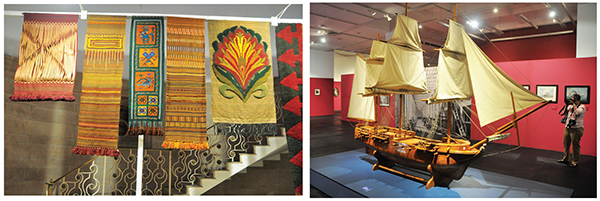
(Above) Exhibits at "No Parsi is an Island" (left); "Painted Encounters: Parsi Traders and the Community;"
.JPG)
"Threads of Continuity"
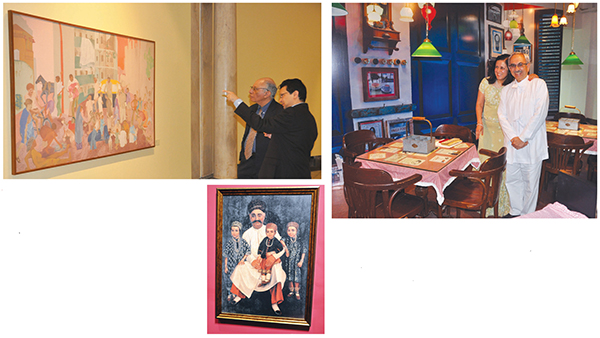
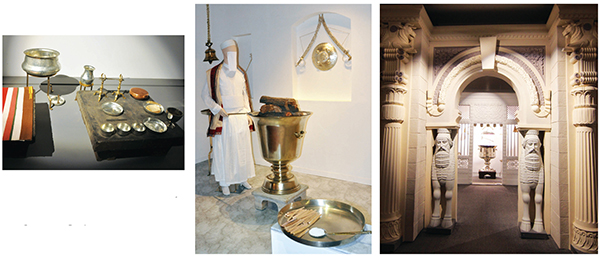
Displays at the exhibitions
The community can boast of "many stars.” Appreciating that the per capita achievement in the Parsi community is very high, Bilimoria conceded, "None of this would have been possible without the Indian community which has allowed us to do so.” He alluded to his recent experience of installing Mahatma Gandhi’s statue in Parliament Square in London and recalled Gandhi’s words that one should nurture beliefs knowing that they will ultimately "determine your destiny… Our destiny is one of partnership with India.” Bilimoria reminded the gathering of the maxim, "If you want to go fast, go alone; if you want to go far, go together” and ended with the words, "I hope India and the Zoroastrian community will go far together.”
On behalf of the Ministry of Minority Affairs (MOMA), secretary Rakesh Garg thanked the ministers who had supported the Programme, especially Heptulla who had guided the team since the conception of the event, the Department of Posts who had arranged for the release of a Special Cover at the morning function, ambassadors and embassies of countries, museums, institutions and individuals who had loaned their artefacts for the exhibitions, Dr Shernaz Cama and Nilufer Shroff of ParZor who were the nodal points of contact for members of the community, the ministries, the exhibition curators and the media.
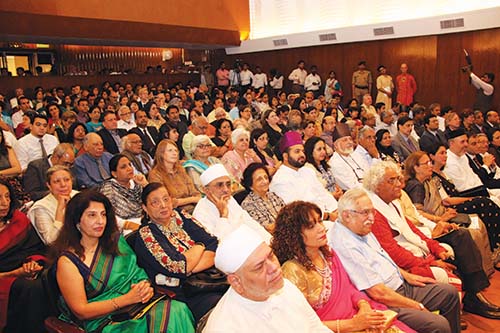
Audience at the inauguration of "The Everlasting Flame: Zoroastrianism in History and Imagination"
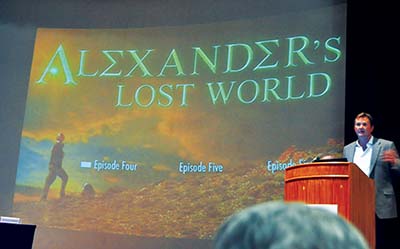
David Adams at the launch of the film festival
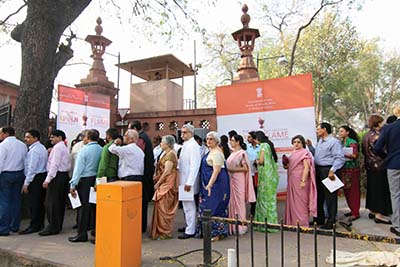
An exhibition a day
As part of The Everlasting Flame program, three mega exhibitions are concurrently on view at three venues at the capital until May 29, 2016: "The Everlasting Flame: Zoroastrianism in History and Imagination” at the National Museum; "Painted Encounters: Parsi Traders and the Community” with "No Parsi is an Island” at the National Gallery of Modern Art (NGMA); and "Threads of Continuity: Zoroastrian Life and Culture” at the Indira Gandhi National Centre for the Arts (IGNCA). Three other exhibitions will run for a shorter duration of a week each: "Ferdowsi’s Shahnameh” at IGNCA; "Udvada – A Photographic Exhibition” and "My Family and Other Parsis: Photographic Exhibition” at the India International Centre. A glimpse into the history of the religion, the distinctive culture and traditions of the Iranians and Parsis, as also the talent of Zoroastrian artists is on display at the exhibitions.
"The rich culture of the Parsi community is an important and integral part of the country’s invaluable heritage. The Parsi community has made significant contributions in the country’s different, important spheres. I hope this exhibition will make people aware about historical works done by Parsis for national unity and development,” noted a message from the Prime Minister of India Narendra Modi who was unable to attend the proceedings.
The first exhibition to be inaugurated in Delhi on March 19 was "The Everlasting Flame: Zoroastrianism in History and Imagination” that traveled from SOAS which is in its centenary year. The first of its major centenary events, this is also the first time that a SOAS exhibition has been taken on tour. Supplementing "The Everlasting Flame” exhibition at SOAS that had been curated in 2013, the one in Delhi three years later has 70 new exhibits, many of which had been brought from Iran for the first time. As revealed Heptulla, the home minister Rajnath Singh opened a cell in his office to clear the items that had been sent from UK, Iran, Azerbaijan. The minister for external affairs made special provisions to fast track the visas.
Key national and international partners in the project included SOAS, British Library, British Museum, Victoria and Albert Museum, Ancient India and Iran Trust, UK, The State Hermitage Museum, Russia, National Museum of Iran, Tehran, Chhatrapati Shivaji Maharaj Vastu Sangrahalaya (Prince of Wales Museum), Bombay, Tata Central Archives and the Alpaiwala Museum. Ninety private lenders entrusted their rare artefacts to the curators with the British Library loaning 29 items that have come to India for the first time.
The exhibition takes the visitor on a journey from the earliest days of Zoroastrianism, through its emergence as the foremost religion of imperial Iran, the arrival of Zoroastrians in India, their growth under British rule in India and the later expansions. The narrative is divided into 10 sections: The Ancient World, Sacred Texts, The Silk Road, Central Asia and China, The Judeo-Christian World, Imperial and Post-Imperial Iran, Post Arab Conquest, Journey and Early Settlement in India, Parsi Salon and Fire Temple.
"We didn’t realize the Programme would be so successful that we would see people standing in the aisles,” stated Heptulla at the inauguration of the exhibition at the Museum auditorium. Just as well the venue selected was indoors for the sudden showers that evening could have dampened the spirits of the community and the organizers.
The following evening was an outdoor function on the lawns of the NGMA to herald another exhibition, presented in two different buildings but seen as a continuum. "Painted Encounters” showed the wealth of portraiture with a juxtaposition of carved furniture, porcelain, silks and embroidered textiles to depict the influence of European art on rising Parsi traders, similar to the exhibition "Across Oceans and Flowing Silks: From Canton to Bombay 18th-20th centuries” that had been installed at the NGMA in Bombay at the time of the 10th World Zoroastrian Congress in 2013. "No Parsi is an Island” that retained the name of its 2013 avatar brought together the work of 14 Parsi artists across 150 years, from Pestonji Bomanji and M. F. Pithawalla to Gieve Patel and Mehlli Gobhai.
"The Parsi community is an integral and important part of our national history and identity. Unfortunately, time and again, they have been regarded as ‘others’ by many. This exhibition is crucial in highlighting that they are…not isolated entities functioning in a secluded environment but as involved and integrated with the Indian sensibility as any other Indian,” stressed NGMA director Prof (Dr) Rajeev Lochan.
The common curatorial thread running through the NGMA exhibitions was Pheroza Godrej who expressed, "It’s like a family feeling. We are one big happy Indian family.” She then took Heptulla by surprise stating, "Najma has today declared herself to be an honorary Parsi!” On seeing the minister respond with a smile, Godrej continued, "The genesis of these exhibitions started two decades ago in 1996 when Firoza (Punthakey Mistree) and I were thinking of how to transform Zoroastrian ideology into art and culture, how to make it into a tapestry.”
The exhibition was officially inaugurated by Naqvi who in his brief speech in Hindi saluted the contributions and sacrifices made by the Parsi community that has spread fragrance in India. In favor of Heptulla’s endeavors to better acquaint the nation with the Parsi culture he referred to the Government’s generous grant that has never been extended for such a project in the past.
On March 21, a day traditionally celebrated as Navroz, there were treats on offer at the IGNCA. Besides the falooda, gaz, dry fruits and other delicacies that could be sampled at the four haft seen tables was the exhibition "Threads of Continuity” that sought to depict a "living culture” with installations and video recordings representing spiritual as well as environmental practices in a faith that is viewed as holistic. Starting from its origins in Central Asia, the geographical and chronological narrative stretches to India with a special emphasis on Gujarat and the Deccan, and reflects on the contribution of the community to the making of modern India.
The pivotal reef knot binding together the strands of The Everlasting Flame Programme was ParZor director Cama who was happy that the occasion enabled them "to build relationships with other institutions.” She thanked Heptulla who "stood by us and helped our dream come true,” and also recorded her appreciation of Dr Cyrus Poonawalla, chairman of the Serum Institute of India, who had financed "Threads of Continuity” as also the Navroz dinner when 80 staff members of Joss were brought to Delhi from Bombay to cater for a traditional lagan nu patru. "It is very good that the Modi government has gone out of its way to encourage this festival,” observed Poonawalla who hoped the exhibitions will help others "understand our culture.” He reminded the gathering that he is "dedicating this event to my late wife Villoo who devoted a lot of time to go to Udvada and help the priests.”
Before the sit-down dinner the guests enjoyed a dance program by Astad Deboo and his troupe of North Eastern dancers who performed Elemental Divine. Starting with the Yatha Ahu Vairyo prayer, the performance picked up pace as the agile dancers with their percussion instruments did their cartwheels and pirouettes on stage whilst Deboo maintaining perfect equilibrium, served as the central rotating pivot completing over 750 chakkars non-stop.
As a participative exhibition, "Threads of Continuity” had promised to bring to the audience multiple interactive events at IGNCA as well as a film festival. The film festival was launched the next day at the National Museum as part of the two-day seminar on "Zoroastrianism in the New Millennium” with the screening of Alexander’s Lost World. On the Fasli Khordad Saal there was another twin treat in store: "Spenta — Magical Manifestations” with a puppet theater performance by Dadi Pudumjee and The Ishara Puppet Theatre Trust; and a fashion show by Ashdeen Lilaowala and Wendell Rodricks.
Forthcoming issues of Parsiana will carry detailed reports on the exhibitions, the seminar and ancillary programs.