
Politics and Policy
Dialog in Delhi
A delegation of 13 office bearers and other Parsis met the Union Minister for Minority Affairs to voice their concerns on issues faced by the community
"Mané maaf karjo (please forgive me),” stated Dr Najma Heptulla, Union Minister for Minority Affairs referring to the 90-minute delay in attending a meeting with a delegation of 13 eminent Parsis from all over India gathered at her office in New Delhi on July 14, 2014.
A three-line whip had been issued by her party, the Bharatiya Janata Party (BJP), instructing all parliamentarians to be present in the House, but officials from the ministry conversed with the delegates over delicacies and tea, writes Delhi Parsi Anjuman (DPA) trustee and secretary Adil Nargolwala in a detailed note to Parsiana on the meet.
A three-line whip had been issued by her party, the Bharatiya Janata Party (BJP), instructing all parliamentarians to be present in the House, but officials from the ministry conversed with the delegates over delicacies and tea, writes Delhi Parsi Anjuman (DPA) trustee and secretary Adil Nargolwala in a detailed note to Parsiana on the meet.
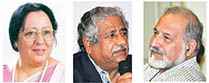
Dr Najma Heptulla, Dinshaw Mehta and Khojeste Mistree;
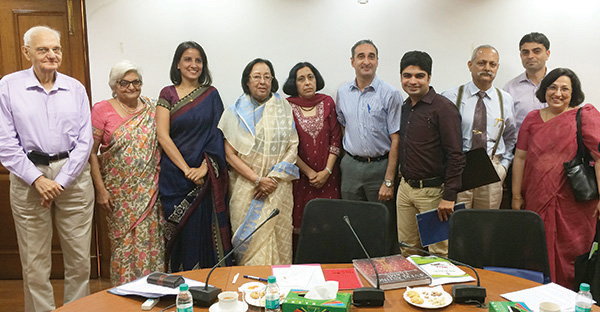
Yezad Kapadia, Homai Engineer, Paricheher Daviervala, Heptulla, Niloufer Shroff, Adil Nargolwala, Farzan Mazda,
Brig Jahangir Anklesaria... (extreme right) Dr Shernaz Cama
Heptulla spoke of her great affection for the Parsis — the outcome of her marriage to a Bohra Muslim and her shifting residence to Bombay. "Her husband had a great many Parsi friends and together they all watched plays by Adi Marzban and Homi Tavadia,” writes Nargolwala. "She spoke about attending lectures and music programs at the Khareghat Colony Hall along with her husband.”
The minister said that the Parsis are the smallest of the six communities in the Minorities Commission. But their contribution is great. She talked about institutions started by Parsis through their generosity and endowments. There should be reservations for the community in these institutions founded by the community largely in Bombay and Gujarat, she conceded.
She said the youth should get married at a young age and have children and asked why is it that if a Parsi man marries a non-Parsi woman the children are considered Parsis but if a Parsi woman marries a non-Parsi male, the children are excluded?
Nargolwala informed her that the DPA makes no discrimination and allows all children of interfaith marriages to be initiated into the religion and enter the fire temple. In addition non-Parsi spouses can become members of DPA.
Bombay Parsi Punchayet (BPP) trustee Khojeste Mistree stated the community followed the patriarchal system and in order to maintain racial purity, the father had to be a Parsi. He claimed statistics show that children of Parsi mothers married to non-Parsis tend to marry outside the faith. (No such scientific survey has been done on the subject — editors)
While noting the genetic infirmities that inbreeding causes, Heptulla joked that inbreeding may preserve the fair complexion and features of the Parsis.
Actor Aamir Khan is her nephew and she could involve him in the Jiyo Parsi program, she mentioned. When she had informed him that the program has resulted in eight babies being born, he was surprised that one couple could have eight together! She clarified that it was six couples.
Actor Boman Irani has agreed to be the Ministry of Minority Affairs (MOMA) ambassador for the Jiyo Parsi schemes, states an introductory note prepared for the minister. The film being made and the advertisement campaign by Sam Balsara’s Madison Advertising backed by the BPP and Parzor will soon both be ready for release.
When BPP chairman Dinshaw Mehta spoke about setting up a body along the lines of the Wakf Boards through which the Federation of the Parsi Zoroastrian Anjumans of India could manage old and defunct properties, Heptulla replied she was in agreement. Defunct agiaries and burial grounds can be managed by such an institution. She would examine the Wakf Board legislation and see what could be done.
Former National Minorities Commission member Keki Daruwala spoke about extending financial assistance to the Meherjirana Library in Navsari where the sanads from the time of Abu al-Fazal are kept. Sanads are documents, warrants or letters having the force of an edict or ordinance. Fazal was Emperor Akbar’s vazir and a writer. Mistree spoke about supporting the BPP’s Alpaiwala Museum in Khareghat Colony. Daruwala stated that in Parsi endowed institutions seats should be reserved for Parsis. "Parsi youth today are going abroad as they cannot get college admission due to reservations for others.”
A note from former BPP trustee and World Zoroastrian Trust Funds managing trustee Dinshaw Tamboly, who could not be present for the meeting, listed the various Parsi founded institutions. These include: (from Bombay) Grant Medical College, 1845, Sir J. J. School of Arts, 1857, Elphinstone College, 1866, Victoria Jubilee Technical Institute, 1888, Royal Institute of Science, 1917, Tata Institute of Social Sciences, 1936 (not included in the list of institutions at Bombay are Patuck College of Commerce and B. J. P. C. College of Commerce where Parsi students do not face problems for admission); (from Poona) Government College of Engineering, 1863, Deccan College, 1868, Byramjee Jeejeebhoy Medical College, 1878, Nowrosjee Wadia College of Arts and Science, 1936, Cusrow Wadia College of Engineering and Technology, 1939, N. M. Wadia Institute of Cardiology, 1966, Ness Wadia College of Commerce, 1969, Neville Wadia Institute of Management Studies and Research, Jehangir Hospital and Medical Centre, 1946; (from Bangalore) Indian Institute of Science, 1909, National Institute of Advanced Studies; (from Gujarat) Byramjee Jeejeebhoy Medical College, Ahmedabad, 1879, Sarosh Sorabji Gandhi Engineering College, Surat, 1956, Zal Faramroz Wadia Women’s College, Surat, 1959, Arts, Science and Technical College, Valsad (not included in the Gujarat list are three colleges at Navsari — S. B. Garda College of Arts, B. P. Baria Institute of Science and Dinshaw Daboo Law College — where Parsi students do not face problems for admission).
"We can give a list that provides background details of the other educational institutions where Parsi students do not get admissions in spite of the fact that Parsi philanthropists endowed/ established/ founded/ funded these institutions of higher learning,” stated Tamboly. "What the Parsi community is requesting for is reinstatement of facilities that were earlier available in the above institutions.
"Whilst ‘reservations’ do require an act of Parliament/ state legislatures, reinstatement of the facilities requested should hopefully be within the scope of the executive,” Tamboly observed.
Gool Chenoy, president of the Parsi Zoroastrian Anjuman of Secunderabad and Hyderabad requested "firm reservation for the Zoroastrian students in engineering and medical colleges of the state capitals of the country.”
The introductory note also emphasized the need for "cultural studies on the Parsis, Avesta, Pahlavi and linguistic studies at the Masters and higher levels. Parsi Gujarati is a unique linguistic dialect … and needs research and support.”
Paricheher Daviervala whose family organizes the Sanjan Day celebrations every year, and others spoke about encroachments on trust and private properties. She alleged that in south Gujarat and districts of Maharashtra bordering Gujarat, gram panchayats encourage Adivasis to encroach on land. False powers of attorney and wills are often resorted to. The road leading to the Sanjan Stambh and the famous walking mango tree is encroached upon. Though there is a High Court order to clear the encroachments, nothing is being done. She talked about the trees being cut overnight in orchards and huts built on orchard lands in the Talasari taluka. Eighty per cent of Parsis have emigrated. They cannot enjoy their lands, she said.
Dr Shernaz Cama of the Parzor Foundation spoke about complaints of encroachment from Baroda, Poona, Surat and Udvada. Land grabbing posed a risk to the elderly living on their properties in the villages. Nargolwala stated that the DPA was looking after Parsi properties in north India but "funds as well as man power” remained problematic.
The minister asked for a list of properties. She said a complete survey needs to be done by the anjumans and punchayets. The ministry can then find a way to work with the law ministry to resolve issues through legislation. Mehta said that he had a list and would send a copy to Heptulla.
The introductory note prepared for the minister also noted the erosion caused to Udvada’s coast by the sea. "There is urgent need to rebuild a modern protective wall” and technology to save the village wherein the sacred Iranshah fire is located.
President of the Ahmedabad Parsi Panchayat (APP) Brigadier Jahangir Anklesaria (Retd) spoke of the Ahmedabad Municipal Corporation (AMC) taking over 10,000 plus square yards of the APP land for road widening 25 years ago and in turn allotting a plot belonging to one Narayan Bharwad to the trust. Bharwad, however, refuses to hand over the land despite clear orders from the AMC and Ahmedabad collector, averred Anklesaria. The civic administrative authorities have yet to hand over "vacant peaceful possession” of this plot. The state revenue authorities should be questioned regarding the disregard for a minority community’s rights. Heptulla asked for details saying she would take up the issue by writing a personal letter to the chief minister of Gujarat.
Farzan Mazda spoke of Dahanu taluka being declared an ecologically fragile, green zone to protect the area from polluting industries. The ban has preserved the local environment. But farming is no longer viable due to high land rates and non-availability of labor. He wanted the minister to intervene with the Ministry of Environment and Forests (MOEF) to allow tourism, education centers, etc. Modify the notification for clean development, Mazda urged. Heptulla said that she will send a note to the MOEF.
The introductory note points out Parsis are "known for introducing and extensively cultivating the chikoo crop in the Taluka of Dahanu in Western Maharashtra. The Parsis of this belt thrived until recently. With a steady decline in crop yields due to the commissioning of a coal based power plant in 1989 on one hand and the notifying of Dahanu as an Ecologically Sensitive Area (ESA) in 1991 leading to a blanket ban on construction on the other, estate owners constituting mainly the Parsis find themselves to be economic refugees. No longer having an option to sustain on horticulture or to develop their lands, they are steadily migrating. While it remains crucial to conserve Dahanu’s rich natural and cultural heritage through the implementation of its ESA notification, there is an urgent need to re-examine clauses within the said notification, which pose as deterrents even to clean development. It is only when the aspirations of local inhabitants are secure that their trust in the cause of conservation can be won.”
Daruwala and Mazda referred to the promised road to the Bahrot Caves not yet having materialized. Mazda mentioned the Prevention of Atrocities Act and how the Adivasis and other castes are allegedly misusing the Act against Parsis. The families are reticent to assert their rights as the local police are unhelpful, he claimed.
A Parzor note titled "Zoroastrian Heritage” mentions a planned exhibition by the School of Oriental and African Studies (SOAS) around June 2016 to commemorate the college’s 100th anniversary. SOAS received its Royal Charter in June 5, 1916 "through the efforts of Lord (John) Morley, secretary of state for India.”
The institute would "like to commemorate its centenary by beginning a long term collaboration with India.” It is planned to bring (the) Everlasting Flame (exhibition) along with the other exhibitions to Delhi in 2016 to create a complete program to preserve Parsi heritage.
SOAS has recently established an institute for South Asia within the School… and hopes to create study centers linked with Indian universities like Jawaharlal Nehru University, Jamia Millia Islamia, Dr B. R. Ambedkar University and the Tata Institute of Social Sciences.
In summing, Heptulla said the ministry wants to have an inclusive and interactive dialog with minority communities. Her grandfather Maulana Abdul Kalam Azad said that in India’s destiny many caravans passed through and settled here. We must preserve their culture, she observed.
Yezad Kapadia, president of DPA invited the minister and officials present to the New Year function on August 18 at the Anjuman premises in Delhi.
Others present included Ministry for Minority Affairs office bearers Lalit Panwar, secretary; Preeti Madan, joint secretary; Anurag Bajpai, director; Alkesh Tyagi, deputy director and media officer; and Zoroastrian representatives Dr Niloufer Shroff, trustee DPA; Homai Engineer, member DPA; Percy Harver, resident of Bombay and Sanjan; and Ratan Postwala, resident of Calcutta.
◆ ◆ ◆
From the archive