
In Memoriam
Ethical and exacting
"Do the right (thing). Rest leave to God. We judges can’t change the world. If you do your duty and dispense justice, you have done your job,” the former Chief Justice of India (CJI) Sarosh Homi Kapadia had stated at a farewell function organized in Delhi on his last day in office in September 2012. On another occasion he had commented, "Dispensation of justice is a spiritual function. There is a vast difference and yet there is no difference between ethical morality and constitutional morality.”
After his retirement three years ago, he chose not to head any enquiry commission in Delhi but opted to return to Bombay and use his legal expertise to settle arbitration matters. Nearly two decades ago he had undergone an angioplasty but continued to work tirelessly, succumbing to cardiac arrest at 68 years of age on January 5, 2016. "A fine legal mind who enriched our judiciary… Kapadia’s contribution will always be remembered. Pained by his demise,” Prime Minister Narendra Modi expressed his condolences on Twitter.
After his retirement three years ago, he chose not to head any enquiry commission in Delhi but opted to return to Bombay and use his legal expertise to settle arbitration matters. Nearly two decades ago he had undergone an angioplasty but continued to work tirelessly, succumbing to cardiac arrest at 68 years of age on January 5, 2016. "A fine legal mind who enriched our judiciary… Kapadia’s contribution will always be remembered. Pained by his demise,” Prime Minister Narendra Modi expressed his condolences on Twitter.
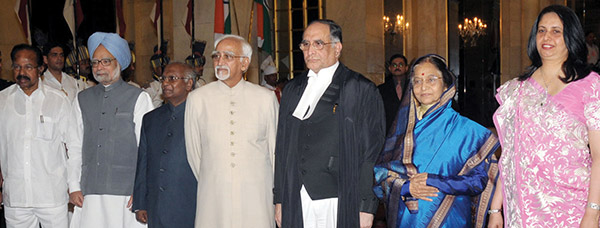
At the swearing-in ceremony (from left) Dr M. Veerappa Moily, Dr Manmohan Singh,
K. G. Balakrishnan, Mohd Hamid Ansari, Sarosh Kapadia, Pratibha Patil, Shernaaz Kapadia
Photo: Press Information Bureau, Government of India
"I am told that he was working (the day prior to his death), conducting arbitration proceedings, and was said to be perfectly healthy. It is a great loss for the legal fraternity,” senior counsel Iqbal Chagla was quoted in the Mumbai Mirror of January 6. "His integrity was unimpeachable and his dedication to his work came at a personal cost. He avoided social gatherings and was often misunderstood,” former advocate general of Maharashtra Darius Khambata told The Indian Express of January 6.
"He even said in a speech that judges and lawyers should work like a horse and live like a hermit…In his pursuit of flawless integrity, Kapadia has hermetically sealed himself,” commented Forbes India magazine of August 21, 2012. "I am a difficult person to deal with,” Kapadia had confessed. Whilst some considered him reclusive and others viewed him as reticent, all were agreed that he was an icon of righteousness.
Describing him as "one of the most revered CJIs,” the Bar&Bench magazine noted that Kapadia "exhibited a no-nonsense approach to corruption throughout his tenure, coming down heavily on politicians and authorities in the wrong. As a Supreme Court judge, he adjudicated on a vast variety of matters, and his expertise in the field of tax law was par excellence.” The judgment he will perhaps be most remembered for is the one in Vodafone International Holdings vs Union of India where he held that Indian authorities did not have territorial jurisdiction to tax offshore transactions.
Senior lawyer Harish Salve who represented Vodafone in the landmark tax case was quoted in Mint, January 6, "Not only well versed with constitutional law, he was known particularly for his interest in developing commercial law in India and bringing it up to speed with global standards.” He believed that if India wants to stop arbitration and commercial contract disputes from moving out to foreign soil, the legal fraternity needed to work hard to improve their knowledge base in international trade and commerce.
A scrupulous stickler of the law book, during his tenure he ensured that the Supreme Court registry did not show any favors. "Kapadia fixed this through sheer force of personality and hard work, poring over the list of the next day’s hearings with a fine tooth comb…” it was recounted on the blog Legally India, commending his determination to tackle "India’s sprawling court system that comes loaded with more than three crore pending cases and the baggage of institutional and historical inefficiencies.”
Highly respected for his statistical acumen, one much quoted instance was during a Law Day function when the then Supreme Court Bar Association president and senior advocate P. H. Parekh complained of lack of space for lawyers in the Supreme Court complex. In response, Kapadia reeled out statistics of how lawyers used up a total of 168,000 sq ft on the Supreme Court premises while the Supreme Court judiciary and their staff were left with just 2,000 sq ft of space!
Known to have proudly proclaimed that "the only asset I possess is integrity,” Kapadia had no qualms about disclosing his personal wealth at over Rs 60 lakh when judges of the apex court were required to post their assets on the Supreme Court’s website. Having risen from poverty, after his graduation in economics Kapadia had first worked as a Class IV employee in the office of Nanabhoy Jeejeebhoy and a clerk at Gagrat and Company, surviving on roasted peanuts for lunch. Following his law graduation he worked for the noted labor lawyer Feroze Damania.
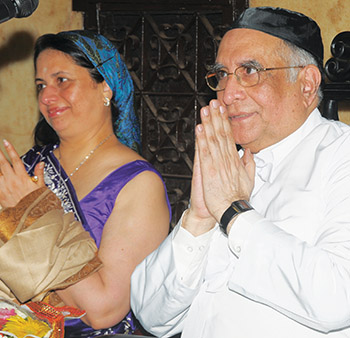
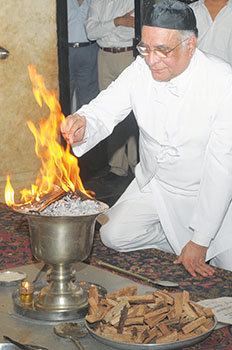
Shernaaz and Sarosh Kapadia; Chief Justice offering loban at Karani Agiary Photos: Sarosh Daruwalla
Kapadia became an advocate in the Bombay High Court (BHC) in 1974, was appointed additional judge of the BHC in 1991 and made a permanent judge two years later. In 2003 he was appointed Chief Justice of the Uttarakhand High Court and within four months was appointed judge of the Supreme Court. "His humble beginnings are reflected in his outlook and judgments,’’ former attorney general Soli Sorabjee was quoted in the Fortune India write-up. Added Sorabjee, "A litigant may feel disappointed if he loses the case but no litigant goes back (from Kapadia’s court) feeling he was not fairly or fully heard.’’
When Parsiana had featured Kapadia on the cover of our July 7, 2010 issue, his Delhi office had called asking for two copies of the issue which we offered to send gratis. His representative though insisted that two copies would be collected against payment from our office. "My father (Homi) taught me not to accept obligations from anyone, and my mother (Katy) taught me the ethical morality of life,’’ Kapadia acknowledged the role of his parents in his life.
"Daddy always told me to pray two Yathas and one Ashem before starting anything,” Kapadia informed the gathering when he was felicitated as CJI by the Bombay Parsi Punchayet at the Jamshed Bhabha Auditorium in 2010. He further referred to his visits to Dastur Khurshed Daboo and the lectures by Ervad (Dr) Minocher Karkhanawalla and Dastur Nowrooz Minochehr-Homji that he attended during his school days at St Mary’s. Grateful for the divine help he received from Dastur Jamshed Kookadaru, Kapadia mentioned that he regularly visited atash behrams in Bombay, the Dadysett Atash Behram being his favorite.
"We need to revive faith in the religion and adoration of the prophet,” Kapadia had impressed at another community function. To the youth he advised, "You must respect your high priests. The way you do not question the wisdom of your doctor and lawyer, though you seek a second opinion, you have to go to dasturjis in order to seek advice in religious matters.” Disappointed that he does not find "many young people at community functions,” he suggested, "There should be more interaction between people at the top and the younger generation… We need good leadership. Without it and a common platform we will not succeed.”
Whilst known to be a strict Parsi Zoroastrian, Kapadia had commented, "I also believe that exclusion is not justified. There are role models in other communities too.” He studied Buddhist and Hindu philosophies, especially the teachings of Ramana Maharishi, Swami Vivekananda and Ramakrishna Paramahansa and learnt meditation techniques at the Belur Math on the banks of the Hooghly in Calcutta. He also made time to study theoretical physics.
Religion is "a matter of personal belief and should be kept at home,” Kapadia had stated on Human Rights Day in 2009. "I am a follower of Advaita (a Hindu school of philosophy that believes in non-dualism). I believe the main problem which generates terror is duality… If a religion is based on concepts like fear, greed, heaven, hell – all these fears will eventually be exploited by certain entities or persons. And finally this will lead to terror acts.” The solution, according to the judge lay in "quality education.”
The respected jurist is survived by his father Homi, mother Katy, wife Shernaaz, son Hoshnar, daughter Tenaaz Jehangir Press and brother Kurush.
◆ ◆ ◆
From the archive