
In Memoriam
Pragmatic and principled
Died: Rustom Sorabji Gae, 98, authority on constitutional and fiscal laws who was chief legal advisor and permanent law secretary to the Government of India; on March 19, 2014 in Delhi.
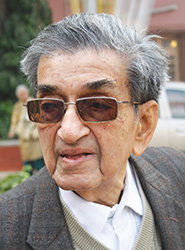 "He was one of the finest law secretaries to the Government of India that I have come across. He contributed erudite articles on legal topics and made incisive analysis of Supreme Court judgments, especially the judgment in the Bank Nationalization case. Above all, his impeccable integrity and spiritual sense of values made him special,” noted a tribute from former attorney general of India Soli Sorabjee.
"He was one of the finest law secretaries to the Government of India that I have come across. He contributed erudite articles on legal topics and made incisive analysis of Supreme Court judgments, especially the judgment in the Bank Nationalization case. Above all, his impeccable integrity and spiritual sense of values made him special,” noted a tribute from former attorney general of India Soli Sorabjee.He was in close association with Indira Gandhi, Morarji Desai, L. K. Advani and other political leaders who consulted him on legal and constitutional matters. During his years in government service he represented India and presented papers at several international conferences held by agencies of the United Nations and the World Bank on subjects pertaining to international law, fiscal laws, etc.
"He was known to be an upright and fearless officer. He would at times disagree with his minister or even a group of ministers when he felt that they were wrong and did not bother about what effect this might have on his future prospects after retirement,” observed B. Sen who was legal advisor to the ministry of external affairs when Gae was a joint secretary in the ministry of law. "Many big names in the legal field owed their rise to the help they had received from Gae during his tenure in the law ministry as joint secretary and later as secretary.”
Considering him "a pocket battleship,” author Murad Ali Baig commented, "Although he was gentle and soft-spoken, he was a man of great energy and determination who was usually able to easily persuade others to do what he wanted. He had great value for knowledge and was an avid reader and student till his last day…”
"He was known to be an upright and fearless officer. He would at times disagree with his minister or even a group of ministers when he felt that they were wrong and did not bother about what effect this might have on his future prospects after retirement,” observed B. Sen who was legal advisor to the ministry of external affairs when Gae was a joint secretary in the ministry of law. "Many big names in the legal field owed their rise to the help they had received from Gae during his tenure in the law ministry as joint secretary and later as secretary.”
Considering him "a pocket battleship,” author Murad Ali Baig commented, "Although he was gentle and soft-spoken, he was a man of great energy and determination who was usually able to easily persuade others to do what he wanted. He had great value for knowledge and was an avid reader and student till his last day…”
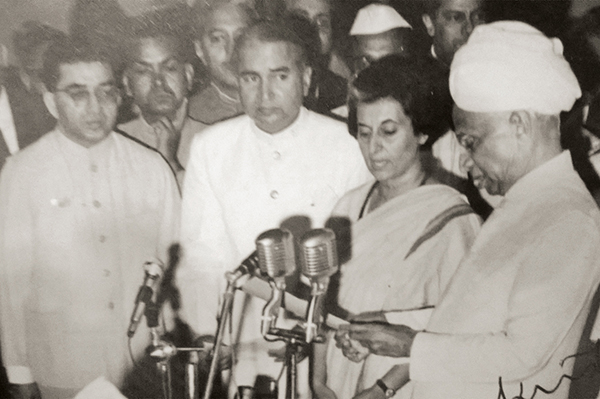
Rustom Gae (above and far left) as Indira Gandhi takes
her oath before Dr Sarvepalli Radhakrishnan
After he retired from government service in 1973, Gae resumed his practice as a senior advocate in the Supreme Court of India, advising big corporates on company law and taxation issues. For nine years he served as legal advisor to the British government in respect of all foreign loans granted by the British banks to companies in India. Along with former Chief Justice of India S. M. Sikri he founded the India International Law Foundation with the objective of promoting study and dissemination of international law. To improve the quality of law teaching in India he persuaded the International Law Association (India Branch) to sponsor seminars for law teachers.
Until the age of 94 he served as an arbitrator. As recalled his assistant Satya Pal, "He was active even in his nineties…remarkable and full of zeal towards life…I was amazed by his clarity of thought, his philanthropic nature, his unbreakable faith in the Almighty. His whole life has been an inspiration to me and many others and the most remarkable trait of his character was his utmost honesty…He never compromised on his principles.” His favorite blessing was "Ushta té (may happiness be unto you).”
His expertise on legal issues was internationally recognized and he was frequently invited to give lectures by the universities of Malaysia and Singapore. A prolific writer he regularly contributed articles to legal journals. He was the author of four reputed books on the constitution and fiscal laws of India.
Besides law, he was equally well read on religion and other subjects that interested him. He made time too for his social, philanthropic and cultural activities. Till the age of 90 he was a regular at Lodhi Gardens where he was fondly known as "the walking and praying priest.” Among his "garden” friends was Dr Rajan Anand who valued Gae’s "sound advice and that too in the guise of Persian and Gujarati proverbs.” With his "profound wisdom” Gae counselled Krishna Singh, who respected him as a substitute father, to read the Bhagvad Gita and chant Sanskrit slokas. Yet another admirer was Mahima Kaur, director, Dreaming Child Production, who stated, "Just observing him inspired me to stand by my values, lead a life of discipline…”
He played a stellar role at the 100-bed multispecialty Deepak Memorial Hospital where he served as president. As notes a message from the Hospital, Gae "was the driving force of the Hospital to which he gave invaluable advice… We will miss his smiling face and reassuring presence.”
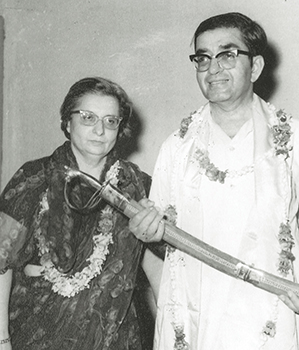
Gae being honored with the Guru sword at the
Golden Temple in Amritsar
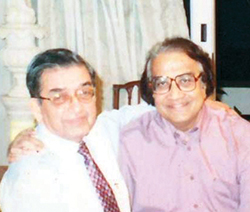
Gae with Rajgopal Dhoot
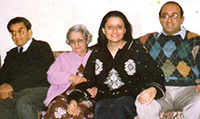
Gae with Maneck, Tehmina and Soli
His sister Perin Daruwala noted that his "deep faith in God and charitable disposition were truly inspiring. (His) sound advice helped us through many a dark patch in our life.” To his son Soli, "Dad was the most positive and disciplined man I have ever met. He ascribed his success in life to the following principles: pray for at least two hours, twice a day; work hard till the end of your life; always interact with people, especially younger people and exchange ideas with them…His law minister once said ‘Gae’s like an iron pillar. You cannot bend him six inches to the right or to the left.’” According to his daughter Tehmina, "Our home was like a sanctuary for all lost souls… (with) Mummy’s very warm and generous nature…and Dad (being) a seeker of truth and light… It is rare to see such purity of thought, dutiful action and humility together. He always used to cheer us all by saying, ‘there is a silver lining behind every cloud.’ That sunny attitude towards life kept him ticking till the last.” Until the age of 95 he would accompany his children on their holidays. He died just eight days prior to his 99th birthday.
Rising from the ranks of poverty, Gae was born and completed his schooling from Navsari where his father was a teacher. He then came to Bombay to study at St Xavier’s College and would give tuitions in maths to finance his college studies while his brother Barjor, a maths professor, tutored Rustom in English to facilitate his transition from the Gujarati medium of instruction. Rustom later worked as an assistant in the law firm of Mulla and Mulla and Craigie Blunt and Caroe under stalwarts like Nadirshah Mulla, N. K. Suntoke and P. L. Pariker. He shifted to Delhi in 1945 after he got an opening in the law ministry.
Former vice president of the Delhi Parsi Anjuman (DPA), he had played a key role in the establishment of the Kaikhushru Pallonji Katrak Dar-e-Meher in Delhi in 1961. "He was a highly respected member of the DPA and had made several useful contributions to its well-being… He was a liberal minded Zoroastrian who always stood for a broader outlook for the community,” stated DPA president Yezad Kapadia. Former DPA president Dadi Mistry remembered Gae invariably "taking the front row seat at all our DPA annual general meetings,” ready with "a word of advice and criticism that was always very constructive.” Mistry expressed his delight at having his grandsons’ navjotes performed by Gae, an ordained navar from Navsari, after which the learned priest had explained the significance of the ceremony. "His keen, analytical mind helped in resolving several matters of importance,” noted a write-up by sports commentator and author Novy Kapadia.
A regular contributor to Parsiana, in his articles at the turn of the century he would stress on the need for the community to revise its archaic laws concerning adoption and divorce, express his apprehension regarding mounting deficit at Doongerwadi in Bombay… In "Amending the marriage law” (Parsiana, September 2001) he wrote, "It may unequivocally be emphasized here that just as children of a non-Parsi woman married to a Parsi are considered as Parsis on performance of their navjote ceremony, similarly children of a Parsi woman married to a non-Parsi should also be considered as Parsis on performance of their navjote ceremony with the consent of the parents. This is the sine qua non for the survival of the minuscule community of Parsis in India… After all, customs are not eternal and ancient customs in a modern society are fast changing.”
At the funeral of Feroze Gandhi, Gae was invited to the all religion prayer meet by then Prime Minister Jawaharlal Nehru. Gae had also performed marriage ceremonies for some interfaith couples. Several of them commended his virtues. Valuing his "guidance and blessings,” Sandeep and Parizad Chandna referred to his "unmatched qualities of nobility, dedication, loyalty and sincerity.” Equally appreciative was Anita Tanwar who recalled his "love, generosity, kindness and strength…towards all humanity.”
To Rajgopal and Rohit Dhoot, Gae was their "pious friend. We had deep faith in his sincere prayers.” Other family friends, Nilanjana and Kalpana Sinha viewed him as an "extraordinary person who led a simple and an extremely disciplined life working for one and all till the end. He and Maneck Aunty loved meeting people, listening to their problems” and offering guidance. Keki Marker remembered his "parents’ best friend and confidante…as a man of great courage and conscience.” Freyan Desai, whose industrialist father Jamshed of Kelvinator fame had a long-standing friendship with Gae, appreciated that any issue, "whether business or personal, he would…think through it with utter sincerity before coming up with a solution.”
The admirable advocate is survived by his daughter Tehmina, son Soli and sister Perin Daruwala.
◆ ◆ ◆
From the archive