
Cover Story
The door is “slightly ajar”
Working within the law, progressive anjumans may permit outmarried Parsi women and their offspring to enter fire temples
June 5, 2015 marked the birth centennial of the late Shiavax Nargolwala, who led the Delhi Parsi Anjuman (DPA) for 25 years. His sudden demise in a road accident on August 6, 1986 left all bereft of his distinguished services as a civil servant, chartered accountant and a social worker.
In his memory the Federation of Parsi Zoroastrian Anjumans of India instituted the Shiavax Nargolwala Fund to benefit women and children along with a community service award to be given annually to a Parsi contributing the maximum to social service. This was an eternal tribute to "the man who put service to the community above self.”
Nargolwala instituted the practice in Delhi of non-Parsis paying their last respects to the departed. He made a determined effort to keep the members within the community by welcoming cordial relations with their non-Parsi spouses which comprise over 30% of the Parsi families in Delhi.
In his memory the Federation of Parsi Zoroastrian Anjumans of India instituted the Shiavax Nargolwala Fund to benefit women and children along with a community service award to be given annually to a Parsi contributing the maximum to social service. This was an eternal tribute to "the man who put service to the community above self.”
Nargolwala instituted the practice in Delhi of non-Parsis paying their last respects to the departed. He made a determined effort to keep the members within the community by welcoming cordial relations with their non-Parsi spouses which comprise over 30% of the Parsi families in Delhi.
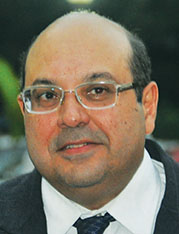
Justice Rohinton Nariman
Nargolwala was deeply religious despite his non-orthodox views. In reverence and commemoration of this great stalwart who dedicated his life to uplift the Parsi community, the DPA invited Supreme Court Justice Rohinton F. Nariman, to deliver the inaugural address of the Late Shiavax Nargolwala Lecture Series instituted in the centenary year.
Nariman began his talk on "Parsi Law applicable to Interfaith marriages” on November 22, 2015 at the DPA’s Phirozshah Hall by referring to two important aspects of Nargolwala. Stressing "self-made” and "progressive,” Nariman said, "My talk is based on the latter aspect.”
"Who is a Parsi? Who is a Zoroastrian? To which community do we belong?” Nariman asked in his extempore talk. "These are questions asked through the ages and first we need to get rid of a few cobwebs,” noted the jurist who is an ordained priest and known for his proficiency in religious matters.
"The promises made to King Jadi Rana did not include non conversion.” Dastur Darab Sanjana had stated in 1599, in the Qisse-i Sanjan that the Zoroastrian community in India had been made to give five promises: that they would marry after sunset, adopt the Gujarati language, that their women would wear the sari, that they would not bear arms and that they would fend for themselves and till the soil.
"Yet another tradition recorded in the 18th century in Gujarat was of 16 Sanskrit shlokas learnt by our high priest and repeated to Brahmin priests on the shores of this great country to which we came in the eighth century AD,” recounted Nariman. "We were able to communicate through 16 shlokas, none of which speak of conversion.”
"The important point to be gleaned here is that unfortunately the beautiful milk in the cup story does not seem to have come down by any written records. In fact, this is directly contrary to the belief that said that we would be able to communicate because milk in the cup with sugar added implied we could not communicate!
"Now that a few cobwebs are out of the way -- of there being no pledge not to convert -- let us dwell on what the Zoroastrian religion says on this. Prophet Zarathushtra existed before 600 BC and preached that his religion is universal for all mankind. He divided mankind into two parts – those who follow the path of truth and those who don’t. The religion stressed that all should come together to make the world a better place. This message of the Prophet was spread in Persia (through 238 hymns of the Gathas that have come down to us).
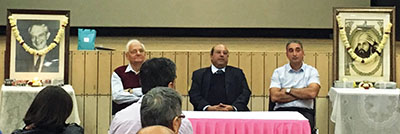
(From left): Yezad Kapadia, Rohinton Nariman and Adil Nargolwala
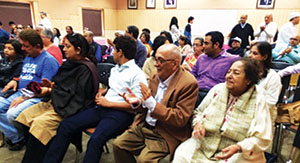
A view of the audience
"In the recorded history of the three great Persian empires – Achemenian, Parthian and Sasanian, all could come into the faith,” stressed Nariman. "Zoroastrianism is a proselytizing faith which believes in conversion. However, has anyone been converted on Indian soil and what was the community’s reaction?”
He referred to the judgment of 1908 of a division bench of the Bombay High Court and the judgment of 1925 of the Privy Council to examine whether it is possible to work within the law as far as interfaith marriages are concerned.
The Bombay judgment arose out of the conversion of a French lady, the mother of J. R. D. Tata, married to R. D. Tata, a leading industrialist, who wished to have her navjote performed in Bombay. Writer and biographer Russi Lala chronicles that 60 priests attended the navjote presided over by Dastur JamaspAsa, the High Priest of the Anjuman Atash Behram in Bombay. Sooni Tata, as a practising Zoroastrian, was brought to the family agiary in Bandra. The chief priest refused to admit her as she was a juddin (of a different faith). Her husband contested this rejection in a court of law. The court concluded there were two ingredients for being admitted into the fire temple: to be born of a Parsi father, and to be navjoted. This conclusion was arrived at by the judges asking themselves the question as to whether the 28 founders of charitable trusts would have included non-ethnic Zoroastrians to the benefit of the trusts which should be enjoyed by the Zoroastrian community in Bombay.
Both judges, Dinshaw Davar and Frank Beaman, ruled that the beneficiaries of such trusts should be ethnic Parsis. Most of the Parsi priests who were witnesses began by saying that conversion was not permitted in our religion. Later on, during cross-examination, they admitted to "Zoroastrianism being a proselytizing religion, believing in conversion.” The second important factor in the case was the three known examples of conversion on Indian soil – of the pundits in the 11th century, of the community’s jubilation when Emperor Akbar donned the sudreh and kusti, and of the "Mazgaon converts.”
The judges arrived at divergent conclusions. The Parsi Judge, Davar, felt there was insufficient evidence to accept that the three conversions had taken place. The English judge, Beaman, felt that the evidence revealed that the conversions could have taken place.
Davar elaborated that though conversion was permitted in the Zoroastrian religion, there was a negative custom in India as no conversion had taken place on Indian soil. He referred to child marriages that took place in India, due to the Parsi customary law in India, though they were prohibited in Persia.
Beaman strongly denied that there was a negative custom in Parsi law and reiterated that the "idea of conversion was ever present among the community in its sojourn in India.” Beaman stressed that by adopting the ways of the majority community in India, the Zoroastrians in India had become a "caste” of ethnic versus non-ethnic people. He further stated that had he been a Zoroastrian founder of a community trust, he would decide on access to its benefits based on three categories — the progeny of the original settlers in India, the Iranian Zoroastrians who came to India in the recent past, and Parsi Zoroastrian children born of a Parsi father.
Nariman mentioned that "the first Rivayat of Nariman Hoshang, sent from India to the chief priest in Yazd in 1478 AD had two questions – on whether a slave boy/girl (servant) serving Zoroastrians could be admitted to the religion; and whether a Zoroastrian who had left the fold and wished to return could be re-admitted? The answer was an unequivocal ‘yes’ from the chief priest to both questions.”
Building his case, Nariman spoke of the Rivayat of 1599 AD when Kaus Mahiar was sent to Persia with the question whether persons of other faiths, i.e. grave diggers, corpse burners, could be converted to Zoroastrianism. The response, as per the Rivayat was positive, provided no harm came to practising behdins from their inclusion into the faith.
The Rivayat of 1773 AD queried whether servants converted to the Zoroastrian faith could be consigned to the tower of silence. The response was that it would be a sin not to do so.
Nariman concluded that "the Rivayats as a body of customary law may not be followed in India but do point towards conversion with the caveat of not harming the refugee community in India.”
He drew the audience’s attention to four significant dates — 1903 when Sooni Tata was converted to Zoroastrianism; 1905 when a meeting of Parsi elders denied the right of admittance into the community of children born of non-Parsi mothers; 1906 when the suit was filed; and 1908 when the judgment was delivered by the Bombay High Court.
Sooni Tata was considered a person belonging to a higher class as she was European and married to a prominent businessman in 1903, revealed Nariman. Had the judges asked themselves the question as to whether the founders of the 28 trusts would have accepted her as a beneficiary after her navjote, the answer may well have been yes. "How do you accept children of Parsi fathers and alien mothers when the community has rejected them only four years earlier? One can do this only by applying forward looking community standards, which is why the judgment of 1908 was progressive when it was delivered,” he said.
As a cosmopolitan city of the world with a huge diaspora, Bombay has experienced an increase in interfaith marriages. "Thus two important points from Beaman’s judgment are the formulation of a community standard test to take in what is required by the felt need of the times and the convening of a committee of elders to decide on a case-by-case basis to accept spouses of persons married outside,” Nariman explained.
As a fallout of the 1908 judgment, the Parsi father and his children are accepted by the community while the alien mother is kept out. The Parsi girl who marries outside the community and her children are also excluded. "The net result of this double whammy is that almost all children of interfaith married couples are lost to the community.”
Another way out of this dilemma could be the judgment of the Privy Council which arose from the Rangoon case which concerned "Bella, born to a Goan father and an allegedly Parsi mother. The child was brought up by one Shapurji Cowasji as a Parsi in Rangoon, and was navjoted by chief priest Kekobad Dastur of Poona who visited Rangoon. Three members of the Parsi community filed a suit opposing her admittance into the Rangoon agiary.”
Lord Phillimore, citing the Davar-Beaman judgment of the Bombay High Court, emphasized the dual ethnic and religious qualification of a Parsi Zoroastrian, and sought to highlight the distinction between the right of worship and the right to property. While trustees of an individual institution in their discretion may admit children of non-Parsi fathers to agiaries as Zoroastrians exercising their right of worship, the judgment expressly rejected the plea that Bella’s visit to a fire temple would cause desecration of the temple.
Nariman explained that "the door was not shut, but kept slightly ajar, so that forward looking anjumans could permit children of Parsi girls who have married outside the community to visit the fire temple.”
In conclusion, Nariman stated that the judgments he had cited were not unconstitutional. He suggested that one can work within them, and recommended the setting up of an institution for all Zoroastrians, ethnic and others, by philanthropists who believe in the larger Zoroastrian cause and specify this in the trust deeds. He also recommended a committee of elders who could work on a case-by-case basis to decide on admittance of a non-Zoroastrian spouse into the community and for progressive anjumans (like the DPA) to ensure that Parsi girls who marry out and their navjoted children are enabled to enter the fire temple.
Referring to girls who marry out and adopt or allegedly adopt their husband’s religion, Nariman cited another case. "Neville Wadia, though born in the Anglican faith, was navjoted at the age of 83 years. This proves that a child born of a Parsi father can be admitted into the Zoroastrian faith at any time. It is easy to bring back Parsi girls to the Zoroastrian mainstream through an affidavit affirming that she has never left the religion or that she genuinely wishes to come back to the Zoroastrian faith, together with a second navjote ceremony to obviate all difficulties.
"I hope the community looks forward and not backward. The law was progressive in 1908 and 1925. Let us work within it and be as progressive as the judgments were in the early 20th century,” Nariman concluded.
Nariman’s talk as well as the series of Gatha lectures delivered by him under the auspices of DPA can be viewed on YouTube.
◆ ◆ ◆
From the archive