
Comment
Lessons for living
Many valuable guidelines for youth were provided by Chief Justice Sarosh Kapadia in his address to the community
June 19, 2010 was a memorable day in the history of the Parsi community as the Bombay Parsi Punchayet (BPP) organized a function at the Jamshed Bhabha Auditorium to honor an illustrious son of the community on attaining the highest judicial office, Chief Justice of India. All the speakers made excellent speeches with wit and wisdom. Chief Justice Sarosh Kapadia stole the show with an inspiring address on the saga of his life, and what contributed to his attaining from a humble beginning the highest position in the judiciary.
In his speech the Chief Justice laid emphasis on many important facets of his life, including the support that he received from his family (his mother’s presence at an advanced age to see her son receiving such accolades added further value to the occasion). Kapadia then spoke of his mentors in the profession including his then senior at the Bombay Bar, Firoze Damania, as also the support and guidance that he received from that doyen of solicitors, Rustam Gagrat. But what impressed me most was his abiding faith in our religion and traditions which uphold the principles of good thoughts, good words and good deeds, the fundamental tenets of our religion which he scrupulously follows in his daily life, so much so that he begins his day with prayers before attending to any task.
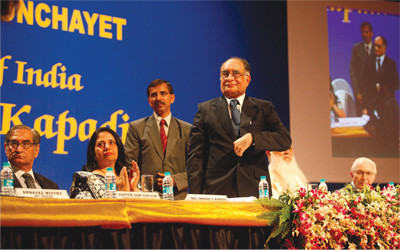
From left: Justice (Retd) Sam Variava, Shernaz and Chief Justice Sarosh Kapadia, Dastur Firoze Kotwal (partly visible) and Tehmtan Andhyaruji Photo: Kainaz Amaria
His advancement in life teaches us that one should not lose hope, that diligence is the mother of good fortune. One cannot gain victory in a day. Over and over again, one may be worsted and have to give ground, but one should not yield but instead resolve never to be driven back. As Edward Gibbon said, the winds and waves are always on the side of the ablest navigator.
More than 60 years ago, soon after Independence, when we were in school and college there was not so much competition as there is today. Life is harder and faster today. It was much slower and more pleasant then in the field of educational and intellectual advancement of the youth. In those days, 60 percent marks were good enough to portend that you could be a good professional like Fali Nariman or Soli Sorabjee and even hold the highest post in the judiciary, like Kapadia. Seventy percent marks were good enough to get admission in a medical college to become a doctor like Dr Farokh Udwadia. Today even 95 percent marks are not good enough to secure admission in a medical or engineering college or to be an architect like Hafeez Contractor. In the good old days we could deal with a matter at comparative leisure, and not rush through with it as one must today. People’s expectations have grown today. They expect attention be given to a matter not soon after the receipt of a letter but "yesterday.” To match this, today’s youth, with advancement of technology through computers, mobile phones and television, learn very fast and become more knowledgeable, smarter, bolder and more pushing than what used to be the case in the past.
The other lesson which the youth can imbibe is that religion plays a great role. Which reminds me of a conversation between a teacher and a student. The teacher asked a student, "What is salt, Johnny?” Johnny replied, "Salt is what spoils a potato if you leave it out.” The teacher then asked, "What is religion?” Johnny replied, "Religion is what spoils life if you leave it out.”
Kahlil Gibran defined religion as a way of life which should be a sum total of all experiences, social, political, economic, cultural, each important in its own way. For a Zoroastrian to say that religion is one thing, and professional, social and personal life is another, negates the essence of our religion which demands harmonious integration of religion with social and moral obligations. Our forefathers embodied these principles to a remarkable degree by actual precept and practice. Today we are the beneficiaries of their noble deeds, their acts of generosity and their social performance. Let us emulate them so that those who follow us may benefit likewise.
Character building is another laudable message for youth. One must guard one’s character as one would guard one’s mistress. It was Shakespeare who said, "One who steals my purse steals trash. But he who filcheth away from me my good name, robs me of that which enriches him not, but makes him poor indeed.” If the parched field of our community has to become green and grow, we need the monsoon of purity in the character of our youth. Every man ought to aim at eminence not by pulling others down but by raising himself. We must do our best by upholding the principles of integrity, fair play and justice, the path of Asha and the doctrine of good thoughts, good words and good deeds which our community is so well known for not only in India but also in the rest of the world.
Education in the formative years plays a very important role in life and what one becomes tomorrow depends on what is sown today. What sculpture is to a block of marble, education is to the human soul. It is the prime responsibility of parents to build up the moral code of their children in the precincts of their home, where there should be free air to breathe and a running stream, not stagnant waters. It is mainly in the confines of the home that the child’s moral code is absorbed, almost as naturally as air is breathed. Stones flung into the quieter waters of childhood will go on making ripples for decades to come. The education of youth should be like a gradual moonrise, perceptible not in progress, but in the result. Like a full moon we would like our youth to have a well rounded personality so that they can be better individuals of the community and better citizens of the country, making both proud.
The companions we choose are also of paramount importance. He that walketh with the wise men shall be wise but a companion of fools shall be destroyed. It is better to have one friend of great value than many friends who are good for nothing.
Let us therefore lead a life of honor and values.

Former chairman of the Bombay Parsi Punchayet and a senior partner of Mulla and Mulla and Cragie, Blunt and Caroe, Eruch B. Desai is a director of around 15 companies and trustee of the General Electoral Trust formed by the House of Birlas and some other trusts. He has also made representations before the authorities for amendments to the Indian Companies Act and the Monopolies and Restrictive Trade Practices Act. He mainly attends to corporate matters including mergers and acquisitions.
◆ ◆ ◆
From the archive