
Cover Story
The supreme judge
The challenges that beckon Chief Justice of India Sarosh Kapadia promise him a place in legal history
"Everyday I seek Ahura Mazda’s help (and) I am sure I will be able to meet all the challenges which may come in the next two years,” noted the 38th Chief Justice of India (CJI) Sarosh Homi Kapadia in the course of his response to the felicitations proffered by the Zoroastrian community under the aegis of the Bombay Parsi Punchayet (BPP) at Bombay’s Jamshed Bhabha Auditorium on June 19, 2010. Widely respected for his knowledge, skill and integrity, Kapadia is known to be a religious man with strong spiritual leanings.
As CJI he heads "the largest judiciary in the world, one reputed to have the largest judicial powers. It is an enormous task to lay down the law of the land along with his colleagues in the Supreme Court (SC) as also in the other courts. He deals with appointments, transfers, disciplining, maintaining the standards of the judiciary.” Senior SC counsel and former solicitor general of India Tehmtan Andhyarujina sought to educate the audience on Kapadia’s enormous responsibilities.
"The SC and the judiciary have expanded in ways controversial to my mind… Every political question becomes a legal question in the US. It is also happening here. The framers of the Constitution never thought the SC would have this enormous jurisdiction — supervising petty municipalities to passing orders which become like legislative measures.”
Kapadia’s early ambition to be a judge was referred to by Andhyarujina who recalled his comment then: "You sirs refuse judgeship because the rewards are so meager compared to your earnings as lawyers.” Praising Kapadia for displaying the same hard work on the Bench as on the Bar and his eagerness to learn, the counsel recalled Kapadia’s appointment as Chief Justice of the Uttaranchal High Court. "Few people would relish being shunted to such an insignificant high court. But Kapadia worked sincerely and thanks to his luck was appointed to the SC within a few months.”
Alluding to the media vans lined up outside the SC every day, Andhyarujina noted, "It’s not like the old times or what happens in any other country.” He further commented on Kapadia’s inflexible honesty and integrity, sincerity of purpose and determination to do the right thing, his extraordinary capacity for hard work and industry "We begin at 10.30, he is in at 8 a.m. With good luck, he will become an outstanding chief justice.”
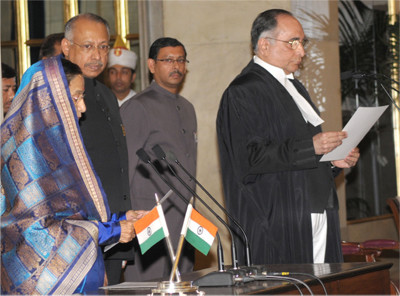
President Pratibha Patil and Sarosh Kapadia swearing-in ceremony at Rashtrapati Bhavan, New Delhi on May 12, 2010. Photo: Press Information Bureau, Government of India
Retired SC Judge Sam Variava who was still on the Bombay High Court when Kapadia was appointed to the Bench recalled that Kapadia "would be in his chamber latest by 9.30 a.m. He read everything apart from court work. He even read Marathi newspapers to improve his Marathi.” In the SC "he had read each and every matter and was ready not only with the facts but the law on the case. And he took over the burden of writing the judgment promptly.
"My only grouse is that he is a workaholic and forgets everything else,” rued the outdoors minded Variava. "His only relaxation is long walks in Nehru Park. I hope the security will permit him to continue. As CJI there will be lots of challenges and it won’t be easy. But in Sarosh Kapadia we have the right man at the right time.” Variava also conveyed former CJI Sam Bharucha’s regret at being out of town for work and hence unable to attend the function.
Noted solicitor and former BPP trustee Burjor Antia who had frequently briefed Kapadia when he was still a part of the Bombay High Court Bar noted, "Sarosh Kapadia was the only lawyer about whom there was no doubt he would become a judge.”
He extolled Kapadia’s performance on the Bombay High Court Bench: "He delivered justice expeditiously, to everyone’s satisfaction, interpreted the law according to the wording of the Act, did not tolerate nonsense from any counsel.” In the disposal of Harshad Mehta’s shares (the cases involving the big-time scamster had absorbed the time and energy of Variava initially and, after Variava’s transfer as Chief Justice of the Delhi High Court, that of Kapadia) Antia attested that even small time investors got their money back.
Antia also spoke of Kapadia’s "landmark decisions on environmental law” on the constitutional bench of the SC and praised the "simple, unassuming man… of impeccable character, integrity and intelligence who idealizes Swami Vivekanada and Albert Einstein” who is guided by his "conscience or inner voice. May you be the conscience keeper of the SC and may our judiciary become more strong and independent under you.”
BPP chairman Dinshaw Mehta read out the maanpatra (scroll of honor), recording Kapadia’s rise to the highest office in the profession from an underprivileged home in Khetwadi, his concern for the underdog and his enduring courage to uphold the right regardless of consequences, before presenting it in a silver holder to the CJI. BPP trustee Yazdi Desai presented a shawl while BPP trustees Armaity Tirandaz and Arnavaz Mistry respectively presented a floral tribute to the CJI’s wife Shernaz and a shawl to his 86-year old mother Katy (his father, Homi, was too incapacitated to attend). After all the on-stage floral tributes were complete, BPP trustee and master of ceremony Khojeste Mistree summoned the vivacious Parizad Kolah-Marshall to introduce the various anjumans and associations who had lined up to present mementoes and tributes to the legal eagle.
Responding to the accolades Kapadia jested, "Presently I am not worried about the burden of office but how to take home the mementoes!” But he was obviously touched that so many had come from all over to felicitate him: "I must have done something good in my past birth.” Explaining his spiritual bent he recalled his visits to Dastur Khurshed Daboo and the lectures by Ervad (Dr) Minocher Karkhanawalla and Dastur Navrooze Minochehr-Homji that he had imbibed during his school days at St Mary’s. "Daddy always told me to pray two Yathas and one Ashem before starting anything… While I was in Bombay I always visited the atash behram — the Dadysett Atash Behram is my favorite.” He also mentioned the divine help he received from Dastur Kookadaru and declared himself to be strictly Parsi Zoroastrian but added in passing, "I also believe that exclusion is not justified. There are role models in other communities also.”
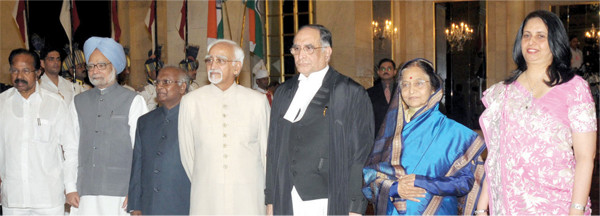
At swearing-in ceremony (from left) Minister for Law & Justice, Dr M. Veerappa Moily, Prime Minister, Dr Manmohan Singh,outgoing Chief Justice of India, K. G. Balakrishnan, Vice President, Mohd. Hamid Ansari, Chief Justice of India, Justice Sarosh Kapadia, President Pratibha Patil and Shernaz Kapadia Photo: Press Information Bureau, Government of India
Agreeing that he is a "workaholic,” Kapadia explained why: "My parents’ sacrifice has always remained before me. Daddy was born in Surat and lived in the orphanage. I know what humiliation he suffered. He had admired the respect given to the sessions court judge and always wished I’d be a district court judge.” He added with a measure of satisfaction, "Dad saw the ceremony and oath I was administered (as CJI)… He taught me never to accept any obligation from anyone. My mother used to cook and cater for her brothers who used to give an amount every month. From that we got our daily meals,” Kapadia noted frankly, adding, "Hormusji Seervai was my ideal. He emphasized constitutional morality. But my mother always emphasized ethical morality.
"Fali and Bapsy Nariman have told me, ‘Aajé tun jé bi chhè té taari bairi né lidhé chhè (whatever you are today is thanks to your wife)’” Kapadia continued and acknowledged the support of his wife and children and their spouses. Nor did he forget his brother — "who has looked after our parents because without that it would have been impossible for me to work outside Bombay. Even today he is looking after daddy.”
Recalling the humiliation he suffered when applying for charity, Kapadia opted to take on a lowly job in the office of Nanabhoy Jeejeebhoy instead, earning Rs 20. "Nanabhoy’s huge tracts of land between Andheri and Jogeshwari were embroiled in litigation. He had engaged two retired collectors over 70 years old as consultants and the hearings were at the mamlatdar’s office in the suburbs. I used to carry the files for them and once when the consultant could not come and no extension was granted, I argued. I was an inter arts student then,” related Kapadia.
Jeejeebhoy’s solicitor was Rustam Gagrat. When he heard of the incident, he sent for Kapadia and counseled him to go into the legal profession. "I am not related to him. But what I am today is because of him… On Saturday afternoons he would sit with me for an hour. How he came up inspired me. He also told Nanabhoy to give me a raise and make me assistant secretary… In 1974 Rustam had just come out of hospital after a mild heart attack. He suggested I join his firm and become a solicitor. When I told him I wanted to become an advocate, he was upset but next Monday he called me to say he would introduce me to a senior counsel. He recommended noted labor lawyer Firoze Damania and came walking all the way to Lion’s Gate to introduce me to Damania, telling him, ‘You look after him in labor and I will help him in all other fields.’ On his 100th birthday I was invited to the party not as a high court judge but as a son. When Rustam passed away Jangoo gave me his pen. I have signed important warrants with the same pen.”
["God offers every man a choice between truth and repose. Take which you will, you cannot have both. Truth is uncomfortable, repose is based on security... Ordinary men oscillate. Rustamji never oscillated. He stood for values like courage, dedication,” Kapadia had paid his tribute at the condolence meeting on Gagrat’s death. Kapadia had also pointedly observed at the condolence meeting as also in a tribute in Jam-e-Jamshed Weekly, "Rustamji had Parsi sethias as his clients but Rustamji did not agree with certain creeds and dogmas and had the courage to express his views that (they) were irrelevant today…” (see "The Gagrat era,” In Memoriam, Parsiana, June 2002). The comments cast an oblique light on Kapadia’s own thinking.]
Kapadia went on to praise the late Damania who encouraged him "to do all kinds of law” and gave him the full payment for his work unlike other seniors who never gave their juniors much money. "Because the office was crowded with juniors he gave me the keys so I could attend early in the morning and on weekends.” Kapadia remembered Farokh Kaka, a colleague from Jai Hind College, who introduced him to Bharat Petroleum and Hindustan Petroleum. "Overnight I could earn well. The boy who could not afford to commute was able to go to Scotland!”
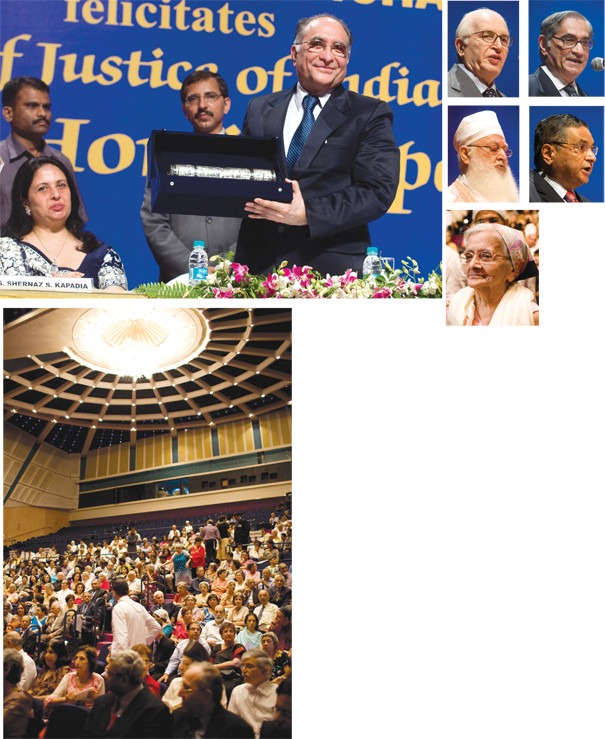
(Left): Shernaz and Sarosh Kapadia with the maanpatra and (below) the audience (All photographs on this page: Kainaz Amaria); Clockwise from below left: Tehmtan Andhyarujina, Sam Variava, Burjor Antia, Katy Kapadia and Dastur (Dr) Firoze Kotwal
While he was still in Jeejeebhoy’s office he would go to the High Court during his lunch break to enjoy the arguments of Nariman, Andhyarujina, Seervai. He recalled his role models, the hardworking Justices V. D. Tulzapurkar and M. L. Pendse. "If you have some role models you will definitely achieve the desired goal.”
As for Variava, "he is one of the finest human beings I have come across,” noted Kapadia gratefully recalling how Sam and his wife Dilnawaz had offered him the hospitality of their home in Delhi for four months until his own official residence was accorded to him. He also professed "great admiration for Sam Bharucha. He was straight as a needle. You need guts to stand up for what you believe to be true and correct… The day he retired even he did not expect the standing ovation he got from the entire SC Bar.”
Claiming to have experienced no adverse discrimination in India, Kapadia urged the many Parsis settled abroad to return. "It is wrong to say there are no opportunities in India… It is better to be a first class citizen here than a second class citizen anywhere else.” As for the younger generation, he urged them to "be with God,” prompting the youngest member of the BPP board of trustees, Jimmy Mistry, to thank him for his inspiring message.
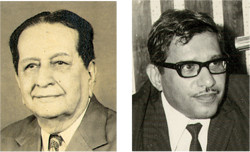
From left mentors Rustam Gagrat and Firoze Damania
"Picked by providence”
Inheriting a judiciary in some disarray there are fervent expectations from Kapadia’s swift, no-nonsense style of functioning as reflected in the national Press.
"Low profile Kapadia is expected to usher in an era of clean-up in the judiciary,” anticipated Maneesh Chhibber in The Indian Express (IE) of May 3, 2010.
"Starting with the battle over disclosure of judges’ assets under the Right to Information Act that saw the apex court put itself above the very law of which it is a custodian… to the steady increase in the number of pending cases before the courts (more than 30 million at last count… cases still drag on for decades and the apex court is often dragged into what can best be called frivolous litigation), there is much that needs to be set right with our judicial system,” the editorial in The Economic Times of May 6, 2010 spelt out some of the issues at stake, adding, "A democracy that is not able to deliver speedy justice to its citizens is a democracy only in name… There are few areas more critical to a country that aspires to be a global economic power than a well-functioning legal system… The new CJI has his hands full.”
Reporting on Kapadia’s first day in office as CJI in The Times of India (TOI) (May 13, 2010) Dhananjay Mahapatra wrote, "Within hours of assuming office, CJI Kapadia virtually stunned a crowd of advocates who had queued up before a three-judge bench led by him for mentioning petitions and applications for urgent listing, a long-standing practice, by bluntly telling them that henceforth there would be no mentioning out of turn in the morning. The silence that followed was audible… But what followed the silencing of the usually vociferous advocates… was equally stunning. There were 37 petitions listed for hearing before the bench led by the CJI comprising Justices Radhakrishnan and Swatanter Kumar. The preliminary hearing in all of them was over in just 29 minutes. Many a lawyer who had work in other courts was seen inquiring whether the CJI’s court was yet to sit. But when told that the day’s business in the CJI’s court was over, there was disbelief writ large on their faces.
"During the hearing the CJI made clear his no-nonsense fast-track approach: ‘No more frivolous PILs (public interest litigations). This is the first day, so we are not imposing costs. But from Thursday, costs would be imposed on such PILs.’” The TOI further quotes the Bench to report that the fine amount "will be used for improving the infrastructure of the judiciary.”
He sacrificed his two-month summer vacation beginning May 17 to sort out the problems faced by the court staff and to streamline the court’s functioning, noted Rakesh Bhatnagar in Daily News and Analysis (DNA) (May 11, 2010). "I assure you I understand your problems. I also worked as a class III employee in a small office in Mumbai before joining the legal profession. I will not go on a summer vacation this year and will visit your offices to know first hand the problems you are facing,” he told the cheering staff which considers itself exploited and denied fair treatment, notes Bhatnagar, referring to the decision as a "record of sorts.”
Implementing his blueprints quietly, away from media glare, a major portion was "devoted to improving the pitiable working condition of trial court judges fighting the menace of nearly 2.8 crore pending cases,” noted Mahapatra in TOI, May 1, 2010, quoting Kapadia’s statement made a few days prior: "My heart goes out to the trial court judges who in remote areas are working even without a fan in this scorching summer.”
As R. Prasannan noted in The Week (May 23, 2010), "Taxation cases in the Supreme Court have been notoriously slow in getting settled through litigation, one reason being there haven’t been enough judges who understand the world of finance.” He says an estimated one lakh crore rupees (one trillion) could be tied up in taxation litigation at the SC without counting the many lakh crores in various other tribunals which could end up as appeals to the SC. He goes on to describe Kapadia as "a man of figures… businesslike, matter-of-fact and to-the-point,” titling him "Wizard of taxes.” As Mahapatra noted in TOI, May 1, 2010, "There is hardly a lawyer who could get away spinning economic or financial jargon in a taxation matter before Justice Kapadia who… for the last several years has mainly concentrated on deciding such cases.”
Kapadia, who served as Judge of the Special Court dealing with offences relating to transactions in securities which included investment schemes, valuation and disposal of shares and much else dealing with finance in the Bombay High Court from 1999 until his transfer as Chief Justice of the Uttaranchal High Court in 2003, seems to have been picked by providence to sort out some of the problems that beset the Indian judicial system. With a keen interest in economics, public finance, theoretical physics and Hindu and Buddhist philosophies, as per his bio data on the Bombay High Court website forwarded to Parsiana by Jehangir Bisney of Hyderabad, the "reformist judge” is quoted to have said, "In the past, and rightly so, it was believed that judges should only know law. But today my view is they should know concepts of economics, politics and commerce as well.” And he took senior lawyers to task for not attending important conferences on legal education and reform: "Could they not have spared half an hour’s time? Are they so busy?”
"It is easy to be popular but to be correct is difficult… I want a proactive Bar, not a reactive Bar,” Kapadia’s comments at a function were quoted in the DNA of May 13.
"Even as a SC judge I have used my knowledge of accounts and economics for the welfare of the downtrodden,” Kapadia was quoted in the Mumbai Mirror of May 13, 2010. His humanitarian approach also came across as he observed in a labor dispute case that "Whatsoever be the case, the workers should not lose their jobs,” reported IE, May 13.
Kapadia says he "speaks through (his) judgments.” But he also has an intellectual defense for his self-imposed bar on granting interviews to the Press (reminiscent of former CJI Sam Bharucha) as notes Mahapatra (TOI, May 14). Decrying any unwonted pressure that a CJI’s opinion could exert, Kapadia noted, "I am against a CJI giving his views on either social issues or pending cases… which on most occasions land up with the judiciary for adjudication… These cases may reach the SC one day.”
The editors’ note
Though the function to honor Kapadia was open to the public, invitations were sent out selectively. Real or imagined critics of the BPP were not invited and Parsiana’s request for photographs of the event was turned down.
◆ ◆ ◆
From the archive