
Law
Palkhivala’s principles
Delivering The Ninth Nani A. Palkhivala Memorial Lecture, Chief Justice of India Sarosh Kapadia declared that judicial integrity is more important than judicial independence
"Nani Palkhivala was an institution… Clarity of thought, robust common sense and commitment in what he believed to be true made him achieve what he in fact did achieve,” remarked the Chief Justice of India Sarosh Kapadia when delivering The Ninth Nani A. Palkhivala Memorial Lecture on January 14, 2012 at Bombay’s Tata Theatre. His acquaintance with Palkhivala being restricted to his writings, Kapadia commented on how various judges and advocates who appeared with him and against him in Kesavananda Bharati’s case "are even today filled with admiration for the genius of the great lawyer in whom the creative spirit is revealed. He always showed respect and courtesy to the judges which is nowadays a rare commodity…A man of conviction, he believed in the principles of fair play and justice. To him these principles were sacrosanct…”
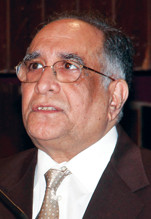
Whilst agreeing with other descriptions of Palkhivala as "a lawyer par excellence, a brilliant economist and a visionary,” Kapadia noted, "his arguments were not ‘arguments of fear,’ they were ‘arguments of reality’…The doctrine of ‘basic structure’ propounded by him in Kesav-ananda Bharati’s case has today become an axiom. The future generation would be eternally grateful to him for making the Supreme Court accept the said doctrine which has kept the structure of our constitution intact, without getting dissipated. Nani was too vast and multifaceted a personality to be pigeonholed in one category…
Giving Palkhivala credit for "creating intergenerational equity — an asset for the future” by inspiring a battery of lawyers and judges, the Chief Justice noted, "In the next 100 years we may not have a lawyer (like him)…Above all he was a great human being with a sound spiritual base. He had no ill will or jealousy. His philosophy was simple: ‘Believe in humanity and forget the rest’…He believed in the revealed truth. He believed in the unity of all religions. He was a strong critic of intellectual dishonesty.”
In many ways Kapadia resembles Palkhivala, remarked Yezdi H. Malegam, chairman of the Nani A. Palkhivala Memorial Trust (NAPMT) that organized the morning function conjointly with the Bombay Bar Association, Bombay Chartered Accountants’ Society, Bombay Incorporated Law Society and Forum of Free Enterprise. The meet, sponsored by ACC Limited, included the Palkhivala Memorial Lecture, the presentation of the Palkhivala Memorial Award for Protection and Preservation of Civil Liberties in India, and the release of the book Palkhivala – The Courtroom Genius authored by Soli J. Sorabjee and Arvind Datar. Born to middle-class parents, like Palkhivala, Kapadia’s "wealth is his integrity,” said Malegam commending him for being "fearless and outspoken when necessary.” He also appreciated that the "judiciary today is pushing the frontiers of the constitution” and is serving as "a sobering influence on unbridled enthusiasm.”
Kapadia’s tribute to Palkhivala was followed by a spirited speech on "The Tails Side of the Judicial Independence — Judicial Accountability Coin.” Responding to the question "What is judicial independence?” Kapadia asserted, "It is independence from politics. It is independence not only from the legislators and the executive but also from the pressures of organized interest groups and popular sentiments. It must be borne in mind that love for justice is rare — what most people seek is justice which favors them.”
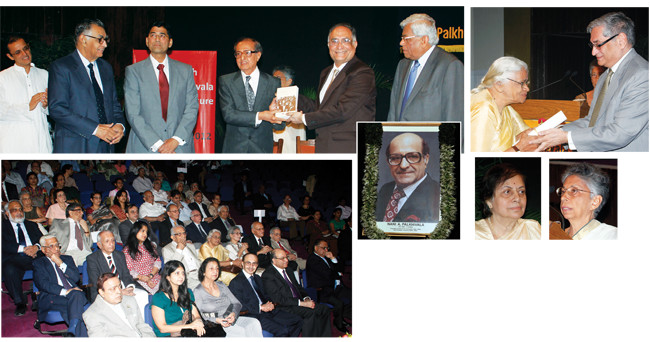
Top: Chief Justice Sarosh Kapadia; First row (from left) Jehangir Palkhivala, Yezdi Malegam, Arvind Datar, Behram Palkhivala, Kapadia, Deepak Parekh; Prabha Deshmukh and Justice Sam Variava; (second row) a section of the audience, portrait of Nani Palkhi-vala, Justice Sujata Manohar and Shirin Bharucha
Reiterating Palkhivala’s view that independence of the judiciary is the cardinal principle of our constitution, Kapadia added, "Courts need discretionary powers to make meaningful decisions... Courts cannot be made instruments of state rule…Judges in every legal system need discretion to reconcile the gap between legislative rhetoric and reality. Statutes alone cannot provide solutions to every problem. We must keep in mind that courts, particularly the higher courts in India, under our constitution, are often required to enforce counter-majoritarian views… Judicial independence enables judges to follow facts and law without fear or favor so as to uphold the rule of law, preserve the separation of powers and promote the principle of reasonableness…
The present "call for greater accountability by democratic institutions,” Kapadia believes has arisen from "a profound cynicism about our institutions.” Wary of the "over pessimism” that is frequently voiced, Kapadia made a plea, "Don’t paint every institution as corrupt. It will ruin the economy and democracy... Loopholes are there but there are more loopholes in our character. These cannot be solved by the Parliament making or amending laws…Whilst the Parliament makes law, the contours of law have to be decided by the judiciary…
"Institutions including business, government and the judiciary are expected to carry out their roles and responsibilities with integrity and efficiency in the public service.” Accountability being a "context driven concept,” whilst corporate directors are responsible to their shareholders, employees, creditors, consumers and the public generally, members of parliament or the legislative assembly are accountable to the people who elect them. "The same holds true for the judiciary. The question is accountability to whom? So much of the criticism directed at judges and courts these days is predicated on a distorted concept of accountability. Well funded and organized interest groups are campaigning to convince the public that judiciary is no different from the political branches of the government…Judgments create losers. Attacks on courts are therefore inevitable…
"Judges are accountable to the people. Public and media criticism of the judges and their judgments is a common feature today throughout the common law world. Like all other public institutions, the judiciary must be subject to a studied fair criticism. But, what I am concerned with is a response to criticism which is irresponsible and illegitimate… The legal profession cannot stand by passively while others co-opt the concept of judicial accountability and define it for their own narrow purpose… (With) checks and balances… we must select the best possible mechanism of accountability keeping in mind one basic principle — there is no wisdom in the choice of the path unless we know where it will lead.”
Recommending an accountability mechanism that would "not only develop highly ethical and professional standards but also generate social legitimacy,” Kapadia declared, "To my mind, judicial integrity is more important than judicial independence.”
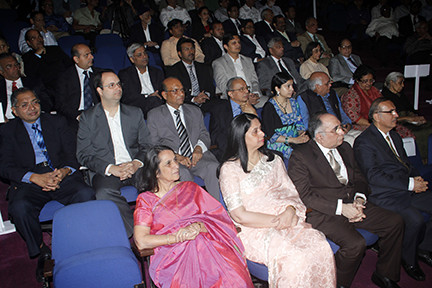
Chief Justice Sarosh Kapadia (in 1st row) with wife Shernaz and Dilnavaz Variava
An amazing jurist
The first part of the morning function was devoted to the presentation of The Seventh Nani A. Palkhivala Memorial Award for Protection and Preservation of Civil Liberties in India. On behalf of the panel of judges that included retired jurists, chairman Justice M. N. Venkatachaliah, Justice Sam Variava and herself, Justice Sujata Manohar announced that the honor this year posthumously goes to B. G. Deshmukh "who functioned within the system and yet above it and whose presence inspired many nongovernmental organizations during and after his death.”
As noted the citation read by NAPMT trustee Shirin Bharucha, Deshmukh was "a bureaucrat with a difference.” An Indian Administrative Service officer who served as cabinet secretary under three prime ministers he was a supporter of "good governance, honesty and accountability in public organizations (and) lent his name and stature to different causes.” The award that carried a monetary prize of Rs 2.5 lakhs was to be donated to the B. G. Deshmukh Memorial Fund as per the decision of his family, announced his sister Prabha Deshmukh who requested the Fund chairman, former police commissioner Julio Ribeiro, to receive the cheque.
Winners of the Nani Palkhivala Gold Medal were Sunil Zalmi and Dnyaneshwar Wagh who were felicitated for topping the LLM examination of the Bombay University in 2010 and 2011 respectively.
The second part of the morning function was devoted to Kapadia’s speech as also the release of the book Palkhivala – The Courtroom Genius. This book is meant to be "a companion volume” to the biography of Palkhivala authored by M. V. Kamath in 2007. In their labor of love the authors were assisted by Palkhivala’s brother Behram and hence the first copy of the book, released at the hands of Kapadia, was presented to Behram Palkhivala.
Unlike legal minds of yore, "today’s books do not contribute to the development of law. I don’t find that contribution from India,” observed Kapadia, appreciating that Datar "is an exception; he has really contributed.” Rather than see "judges fall back on foreign jurisprudence” he hoped the NAPMT would be able to encourage publication of valuable books.
When chronicling Palkhivala’s 52-year legal journey which necessitated the authors interview High Court and Supreme Court judges, lawyers and chartered accountants who instructed him, they realized that there is "more to a case than two sides; more to a judgment than just the verdict,” stated Datar ending with "Palkhivala has left a lofty example which all of us can try and emulate in our daily life.”
Remembering Palkhivala as "an orator, ambassador, legal expert, and defender of the constitution known for his humility, integrity, wit and compassion,” NAPMT trustee Deepak Parekh who proposed a vote of thanks added, "When he spoke he had the audience spellbound.” Thanking the authors of the new book Parekh stated, "The book is a fine tribute to an amazing individual.” Appreciating Kapadia’s presence, Parekh gave the Chief Justice credit for speedy justice stating 2011 has seen the highest number of cases disposed in recent years.
◆ ◆ ◆
From the archive