
Religion
“Dispensation of justice is a spiritual function”
Chief Justice of India Sarosh Kapadia shares his views on religion and the community at the 75th anniversary of Cusrow Baug’s Karani Agiary
"We need good leadership. Without it and a common platform, we will not succeed… I don’t find many young people at community functions. There should be more interaction between people at the top and the younger generation. We need to revive faith in the religion and adoration of the prophet.”
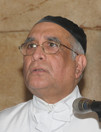
Chief Justice of India (CJI) Sarosh Kapadia shared his thoughts and his passionate faith in the religion with the audience in the Guzder Hall of Cusrow Baug’s Seth Nusserwanji Hirji Karani Agiary on June 6, 2011. Demurely dressed in a dagli, a black skull cap firmly on his head, he had entered unceremoniously with his wife Shernaaz, ushered in by the Agiary’s managing trustee Bomi Hansotia, and seated himself in the first row just as the jashan commemorating the fire temple’s 75th anniversary began. It being roz Govad, mah Dae — the baj (death anniversary) of Homaji Jamshedji Bharucha, the saintly behdin ordered to the gallows by a British court in a misdirection of justice by summary trial in 1783 and remembered by the community with religious ceremonies ever since in all agairies in India — was, he said, one of the reasons which had induced him to accept the joint invitation from the Agiary and the Dasturji Jamshedji Kookadaru Trust.
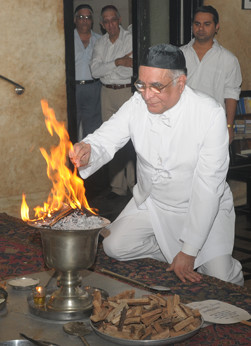
CJI Sarosh Kapadia (top and above) offering loban after the jashan
Kapadia began by expressing his "indebtedness” to all those "who made it possible for me to be here this evening,” beginning with Ahura Mazda ("who has helped me throughout my career and in these troubled times; thank Him for all His blessing which I have so richly enjoyed”), Zarathushtra and Dastur Kookadaru ("in whom I have great faith. This Agiary has spread knowledge about him”). He was also appreciative of the late Dasturs Khurshed Dabu and Navrooz Minochehr-Homji and the late Ervad Nadersha Aibara, former panthaky of the Karani Agiary who used to invoke Kookadaru’s spiritual aid in helping to resolve the problems of community members.
According to the man who has risen to the highest law office in the land from very humble beginnings, "Prayer is a mental act of dependence on God when an individual realizes his own impotence and opens up his heart. Atha zamyad yatha afrinami, hun jèm dooa maangoo tèm thai (may it be as I ask). Nothing we seek can ever come to pass unless it (is based on) principles and comes with grace. Let Thy will be done is the principle of wisdom cum grace.”
Kapadia went on to illustrate this concept with examples from his own life. His family had no legal connections, yet things fell into place for him. Upto the High Court level one may rise by seniority; but the Supreme Court appointment is complicated with such a detailed procedure that it is only His grace, not one’s own efforts, that ensures the final outcome, he noted, adding that our problem in today’s world is the ego — the concept of my efforts, my abilities, etc. "My duty is to fulfill whatever is expected of me by Ahura Mazda… discharge the work given to me with the utmost care so that nobody’s rights are affected. Justice has to be done according to the law…
"Dispensation of justice is a spiritual function. There is a vast difference and yet there is no difference between ethical morality and constitutional morality. In the 19th century, the first Indian judge in Madras was Muthuswami Iyer.” Referring to Iyer’s statue in that city Kapadia noted that it depicted him in bare feet. Why? "The judge treated the court as a temple of justice and when you enter a temple you will not wear slippers. Many from the south still follow these traditions, these values and support system. You have to take the (process of) judgment as a spiritual function, where all philosophies converge.”
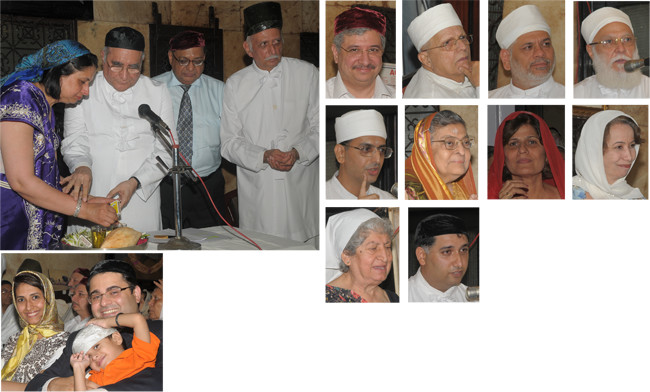
Top left: Lighting the divo with wife Shernaaz as Homi Ranina and Bomi Hansotia look on (below) Daughter Tinaz with husband Jehangir Press and son Rehaan; (Right) L to R (1st row) Justice Shahrukh Kathawalla, Dastur (Dr) Kaikhusroo JamaspAsa, Dastur Khurshed Dastoor, Erv Asphandiar Dadachanji; (2nd row) Erv Yazdi Aibara, Ratoo Dastur, Arnavaz Mistry, Mahrukh Noble; (below) Mani Vajifdar and Viraf Hansotia
Explaining the prolonged wait for court decisions after a trial, Kapadia emphasized the judge’s mental labor as "all circumstances need to be taken into account. This takes a lot of time.” He contrasted this procedure with the summary injustice meted out to this great saintly person, Homaji, adding, "Mere allegation cannot be the basis of conviction.”
As recounted by Karani Agiary panthanky Ervad Yazdi Aibara later in the evening, the story goes that a pregnant woman in Bharuch suffered a miscarriage and it was alleged that Homaji had kicked her in the stomach. Despite his protestations to the contrary, Homaji, known to be a saintly man, was tried first in Bharuch, then in Surat and finally in Bombay, the court sentencing him to be hanged. Before being taken to the gallows, the death row convict was routinely asked his last wish. Homaji is said to have asked for a bath and leave to say his prayers. "Shortly after his prayers he died of heart failure. He was not hanged,” said Aibara. But earlier he had predicted that the false witness would die on the fourth day after his death, drowned in the toilet. And so it reportedly came to pass!
Speaking of Kookadaru’s commitment to the religion, Kapadia recalled how our forebears had come to India to preserve it and that the consecration of Iranshah was a natural outcome as "the religion would be incomplete otherwise. Our priests who have preserved all our holy fires deserve our gratitude.” He referred to the community’s "heritage of mind, so profound, so complete” and made an impassioned plea for "intergenerational equity” by which he meant that the assets of our forefathers must be delivered to our children. "Tradition is a sacred trust. We must pass it on to future generations.”
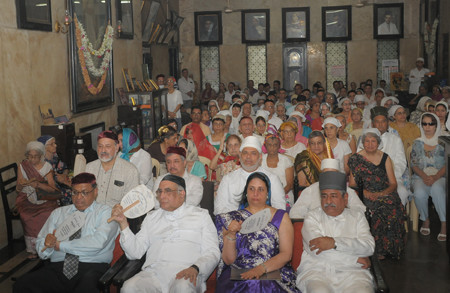
The audience silently witnessing the jashan
However, Kapadia admitted that "somewhere we are missing the bus. We can’t just live on past glory.” We need to take into account the holistic challenge facing us. "Philosophy is not a concept. It is a way of living to discern true values: to live as true Zoroastrians.” Referring to the triad of good thoughts, good words, good deeds, he noted that the religion gives equal importance to godliness, to the performance of deeds in a "righteous” manner even without going into mysticism or deep philosophy. He had learned this from the lectures delivered by Dabu, MinochehrHomji and Ervad (Dr) Minocher Karkhanawala which he had attended in his youth. "Today’s youngsters ask for explanations. They want to understand the underlying principles.” Praising the good work of Bombay High Court judge Shahrukh Kathawalla and senior solicitor Burjor Antia who were attending the function as invitees, Kapadia urged them and others to arrange for the publication of past lectures and articles, duly translated from Gujarati into English, for the benefit of the youths.
"When our forefathers were commercially successful… they built agiaries in thanksgiving. We don’t find these values any more. Our generation is to blame: we have not imparted these values. The younger generation is not aware of the Iranshah’s travels for which the community sacrificed so much…
"Loyalty does not mean exclusion. I respect the writings and ideas of all,” said the judge referring to great Indian thinkers like Vivekananda, Gandhiji and others and the concept of "judicial reticence” which is the principle of neutrality practiced by the bench.
Turning from the religious to socioeconomic aspects, Kapadia voiced an observation made repeatedly: Parsi girls are doing well, but the boys are not. "What is the reason? We need to introspect. Instead we find controversies that the interpretation of XYZ is wrong and that of ABC is right. This won’t revitalize the community… We have veered away from our faith. Parsis in all fields are ready to admit that they don’t know, do not understand other fields of activity. But in the matter of religion everyone claims to know. You cannot challenge everything on rationality alone… Courts are not arbiters of scriptural writings.”
Referring to the Indian Constitution’s emphasis on morality, institutional integrity and human rights, Kapadia spoke of the equality of opportunity in the country which enabled a Parsi to be chief justice and other minorities to become presidents and prime ministers. "We must be proud of our country and serve it to the best of our ability, keeping in mind that here we are first class citizens…”
In his introductory address recounting Kapadia’s rise and rise in the Indian judiciary, well-known lawyer and Agiary trustee Homi Ranina noted that as CJI he had "laid new standards of integrity and honesty” in judicial administration. "When he retires on September 29, 2012 on completion of 65 years of age, he will have left an indelible mark on the judicial system.” Kapadia had sacrificed his summer vacation last year to solve the problems and provide facilities to the judicial staff in order to speed up judicial work and avoid corruption, maintained Ranina. Welcoming him "not only as CJI but as a great Zoroastrian,” Ranina said he had been aware of Kapadia’s love and respect for Dastur Kookadaru and had taken this opportunity to formally invite him to the Agiary.
In a brief address Ervad Asphandiar Dadachanji, sportsman and panthaky of the Modi Sorabji Vatchha Gandhi Agiary at Hughes Road, differentiated between the inner and outer liturgies of the Zoroastrian faith and the attention to minute details that go into them, especially the inner or pav mahal ceremonies. As an example he recounted how the long and intricate nirangdin ceremony they had performed in memory of Jamsetji Tata in Nagpur was drawing to a close when a dog walked into the sanctified area and they had to begin the ceremony all over again.
Happy that both judges, Kapadia and Kathawalla, had honored the Agiary’s invitation, Hansotia noted that they had not only reached great professional heights but were also known to be deeply religious, as was Ranina who, he said, attends the Agiary every day without fail. "May we have the good fortune to invite you when you become governor or president of India,” he said to Kapadia, earning an embarrassed smile.
Viraf Hansotia gave the formal vote of thanks and Aibara led the gathering in a final humbandagi. The function ended with the Parsi and national anthems.
◆ ◆ ◆
From the archive