
Minocher-Homji melodies
Two sisters helped pioneer the entry of women into the film music industry
Even though theater was dominated by Parsi stalwarts in the late 19th and early 20th centuries, the conservative Parsi community was reluctant to let Minocher-Homji, who was born in 1912, join the glamorous but tainted world of cinema. It is recounted on the website powerpolitics.in that once some overzealous Parsis tried to stop Rai’s car and attempted to ‘rescue’ Devi who was riding in it. They managed to escape.
Trouble, however, did not stop there. The BT board had four Parsi directors who gave an ultimatum to Rai that he must desist from his designs of signing up Parsi ladies. He placated two of them and the other two fell in line on condition that Khorshed take the pseudonym of Saraswati Devi and her sister Manek become Chandraprabha, we learn from an article by Sharad Dutt in the June 2013 issue of Power Politics.
Considering that Kaikhasroo Kabraji had established the first ever music school in Bombay in 1871, this protestation comes as a surprise. His school in fact set the trend away from the concept of gharanas (Indian classical music schools) to the more popular music form. The two sisters featured monthly on the radio as the Minocher-Homji sisters in the late ’20s. The program was said to be very popular, Wikipedia states.
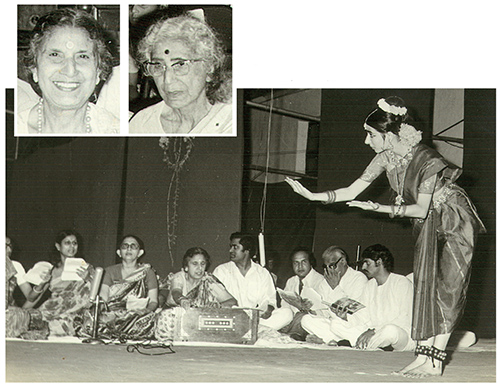
Devi found her employ with BT suited her well as she had freedom to do whatever she wished, Dutt mentions in his article. She invested in new musical instruments and had new music rooms constructed. She also invited a select group of experienced musicians. Known for her mastery over the percussive instrument jaltarang, she won accolades for her musical abilities. This joint venture with BT saw her compose songs for 19 films.
Born in a wealthy business family, both sisters entered the world of entertainment but never married. Their mother worked at the Parsi Gayan Uttejak Mandali (Parsi Music Promotion Society) promoting Indian and western music. "This was among the first public institutions in India to teach Hindustani music otherwise guarded by gharanas,” the article "Unlikely Devi” on the website womenonrecord.com details.
Vishnu Bhatkhande, associated with the institute, developed a system of Indian notation still widely used. Devi picked this up with ease and excelled in the dhrupad and dhamar styles. Her talent was initially recognized by their father and then her mentor Bhatkhande who recommended that Devi go to the Marris College of Hindustani Music in Lucknow, now named after him as the Bhatkhande Sangit Vidyalaya, where she studied with his pupil Krishna Ratanjankar.
She held the title of Sangeet Snatak (Bachelor of Music), we are informed by Dr Aban Mistry in her book The Parsis and Indian classical music. "Her film songs were infused with strains of folk music, they had a classical base. The simplistic style, sweet melody and magnetic appeal of her songs have made them immortal,” adds Mistry. She then goes on to inform us, "Besides lending her expertise to film music, she has also composed beautifully many geet-bhajans (devotional songs) for dance-ballets and either sung them herself or got (them) rendered by her disciples and other professional playback singers.”
"Her enthusiasm was infectious,” recalls journalist Parinaz Gandhi who had participated in some of the dance ballets and performed solo Bharat Natyam items for which the music had been composed by Devi and the choreography done by Khurshid Chavda. In preparation for one of these programs, "Homage to Nine Planets,” Gandhi recalls Devi "playing the harmonium at the final rehearsals when she would take full control and even suggest changes in choreography! Always wearing a smile on her face, she would invariably manage to convince the performers to repeatedly go through their paces in her quest for perfection.”
Pioneering performers
At the height of Devi’s career as music director in the ’30s and ’40s, social commentary in movies propelled films to move from conventional raag based music to ‘song’ and lighter compositions. Devi was the first to plunge into these uncharted waters with the popular song Main ban ki chidiya (I am a bird of the forest) rendered by Ashok Kumar and Rani in the film Achhut Kanya (The untouchable young girl) which was her first major success. The hindilyrics.net website talks of Devi taking to music while sister Chandraprabha decided to become an actor.
Devi had to teach the actors to sing, her compositions which were simple, tried to accommodate the range and tenor of voices she was composing for. At times she even had to simplify the tunes and cover some areas with music instead of song, as there were no pre-recordings or few actors who were able to sing. Playback singing was still not introduced. Her song Kit gayé ko kewan haar (Why have you abandoned me, O Lord) from JKH was pre-recorded by transferring technology and facilities from Calcutta as it was not available in Bombay those days. Having got the equipment from the east, the song was to be recorded by sister Chandraprabha. However, Chandraprabha landed with a sore throat on the day of the recording. Rai suggested that Devi sing the song with Chandraprabha moving her lips appropriately. A new trend was born of this necessity! Once again Bombay took second place after Calcutta as Rai Chand Boral had already accomplished playback singing at the New Theaters in the city of joy in the film Dhoop Chhaon, hindilyrics.net informs us.
Devi’s catchy tune Jai jai pyari janmabhoomi maata (Victory to our beloved motherland) from the film Janmabhoomi, sung by her with a chorus, became the signature tune for the British Broadcasting Corporation’s Indian News Service, adds hindilyrics.net. She surpassed Jaddan bai — mother of actress Nargis Dutt — in fame as the first lady music director of Bollywood.
The peppy dance number during that age Main delhi se dulhan laaya re babu ji’ (Hey, I brought a bride from Delhi), also composed by Devi for the film Jhoola, was an instant hit among the masses.
His Master’s Voice label invited Devi in the early ’50s to judge a music competition. The winner was none other than Habib Wali Muhammad, the Pakistani ghazal singer. Devi composed two ghazals (two-line metered poetry) for this maestro which shot him to fame. This narration is gleaned from hindilyrics.net.
Devi composed classical film songs for several noted artistes of the time. Usha Haran was her last popular film in 1949 where she had composed 12 songs, of which two were sung by Lata Mangeshkar. The composer used her favorite raag Maand beautifully (a light melody which sounds natural but is difficult in rendition) for many of the films produced by BT. Her last film Babasa Ri Laadi, (The old man’s darling), a Rajasthani film in 1961, was the first in which the songs were shot in color. She paved way for younger artistes as soon as she realized that new-comers and new trends were in greater demand and the industry was changing at a pace she could not have galloped with.
The Minocher-Homji sisters adopted a Maharashtrian family of six children whom they educated and even found jobs for some. Being theosophists, they resided in a bungalow at Besant Colony in Juhu. It is stated on Sarkar’s site that the sisters were seen on the beach with children, who seemed to be their other addiction. In their last days Devi taught music at the J. B. Vachha High School for Parsi Girls and Chandraprabha became a librarian. She continued to give private lessons in music to those keen to learn and pursued her first love, music, till she met with an accident while alighting from a bus. With a hip fracture, mobility became severely restricted. Living all by herself, a neighbor was her only solace and assistance. She never fully recovered and died on August 10, 1980 at the age of 68.
For several years one of her protégés, Farokh Bardoliwalla, would organize annual programs to keep her music alive in public memory.