
Tuning in to music makers
Since its inception 11 years ago the Swar Aalap award acknowledges the contribution of four Parsi purcussionists of the Indian film industry
Three other Parsi musicians — Homi Mullan, and the brothers Kersi and Burjor (Buji) Lord — were also acclaimed with the Swar Aalap award in the last 10 years. The Lord brothers are sons of the renowned Indian music percussionist, the late Cawas Lord who is said to be one of the first to play in talkie films. In the Hindi film industry 40-50 years ago, there were also the late Vistasp Balsara, known for his refined, classical touch and the late Godrej (Goody) Seervai, the popular music entertainer known to wear a cap with a bird atop when he played the Cuckoo Waltz from the television serial of the same name. Seervai was an accountant by profession but a musician by choice!
As reveals the Swar Aalap website, "Music arrangers, singers and instrumentalists would often be stationed under a tree where instruments would be played and the playback singers would sing.”
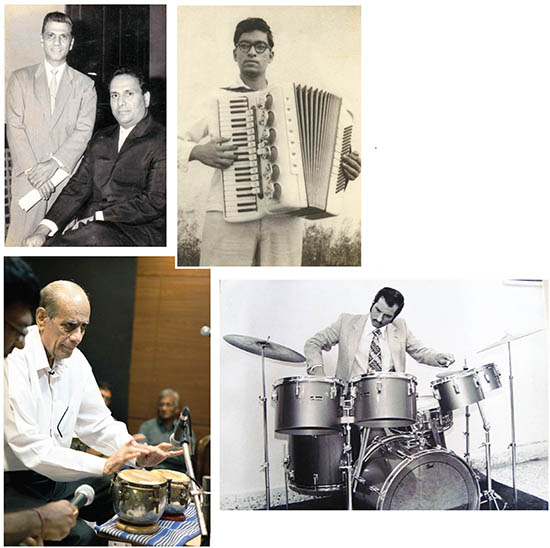
The nonagenarian Nanji
"Most songs of the 1940s and ’50s in Hindi cinema that required an ethereal background had Nanji at the organ keyboard,” stated Manek Premchand, an author and journalist focusing on Hindi film music. When the pipe organ was played after a gap of 26 years at the National Centre for the Performing Arts in a concert this year, Premchand "mentally raised a toast to this extraordinary musician (Nanji),” who was the only performer on the pipe organ in the indigenous film industry.
There were several songs between 1947 and 1960 in which Nanji struck a harmonious chord at a dramatic moment to create that just so moment, recalls Premchand who assisted Parsiana in researching the subject. Nanji was accompanist to numerous musicians including Pankaj Mullick, Manna Dey, Mohamad Rafi and several others. Rafi often specifically asked for Nanji. Among his several songs are one with Rafi O duniya ke rakhwaale (You are the redeemer), another with Dey Tu pyar ka sagar hai (You are my ocean of love), and one with Mubarak Begum Badal rahi hai zindagi (Life is a-changing). Nanji is also remembered specifically for lending his voice to Dekhoji baat suno (Come listen to my story) and Tumné pyaar sikhaaya mujhko (You taught me how to love), amongst several others.
Having worked with most of the stalwarts of his time, he also accompanied the Carnatic singer M. S. Subbulakshmi for bhajans. In fact, for the Meera bhajan Main Hari charnan ki daaasi (I am your eternal devotee) Subbulakshmi sought Nanji specifically at the organ. He is credited with arranging Lata Mangeshkar’s very popular Marathi song for voice and instrumentation, Majhyaa Saaranga (my Lord).
Besides his talent at instrumental and vocal music, this leading music player was adept at the western music staff and the Indian sargam (both systems of music notation), and copied a score as per the performing musician’s familiarity with the staff or sargam. Thus, the resolute musician copied or re-wrote the notations for each part, "sometimes as much as 50 times… as copying the part by hand remained the only option” in the days before instant photocopying, Premchand explains.
Also, being a gifted sketch artist and portrait painter, Nanji fashioned banners and posters for fellow Parsi Sohrab Modi’s company, both for theater and films.
The eager lad was initiated at the age of 10 into Indian music by his older sister Dhun who was already learning vocal music from her husband Sorab Fitter. Nanji started with singing and went on to learn musical instruments by himself. When he was in his 30s, he joined the recording company His Master’s Voice under the late Balsara who too was familiar with both the Indian and western systems of notation. When beckoned to Calcutta for an assignment, Balsara fell in love with the city of Rabindra Sangeet (Tagore songs), and never returned to Bombay. Both he and Nanji played with classical Indian musicians like the late tabla ustad Dr Aban Mistry. With Balsara on the piano and Mistry on the tabla "a wondrous jugalbandi (duet)” would ensue, Rupa Sethna, joint honorary secretary of Swar Sadhna Samiti reminisces.
Music continues to keep Nanji in the major key of exhilaration. When the nonagenarian is by himself at home in Bombay, he listens to the strains of Johann Bach or Ludwig van Beethoven. Well-wishers, who habitually drop in to keep him company marvel at the breadth of his taste. He still loves strumming the mandolin, when not seated at the harmonium. Despite missing the companionship of his late wife Dhun, he prefers to stay independently instead of with his son Hoshang and family so as to make music whenever the impulse beckons, Premchand informs us.
"I was this stepny: whenever people would be missing for recordings, I had to play their part,” recounts 73-year-old Mullan who plays about 20 instruments — most of which are percussive: including kalimba (an African thumb piano), Afroco harp (made of wood and umbrella spokes), all sorts of drums, vibro slaps (donkey jaws), kokiro (a string instrument which looks like the spine of an alligator), reso reso (a hollow bamboo played with a comb) and several others including castanets and kabbas made with cowries or ghungroos with pads.
His friend Rahul Dev Burman (affectionately called Pancham), was so taken with his skill that he composed to highlight that instrument which Mullan was going to perform on. Pancham and Kaka Lord (Cawas) were always there to look out for the beginner, avers Mullan who too was acquainted with both the Western and Indian music mediums. A piano was gifted to him by his grandmother which was taught to him by Balsara. His "mother played musical instruments,” as he puts it and his masi (maternal aunt) was well-versed in the Bengali songs of Calcutta.
At a seminar conducted on what goes beyond melody and moving images, "The Sounds of Music,” on May 2, 2014, Mullan read a paper wherein he demonstrated sound effects created in various films by unfamiliar instruments collected over decades — most of these having been played originally by him, detailed Mullan to Parsiana.
Born and schooled in Calcutta, at St Lawrence, the peripatetic musician was later resident of Delhi, Madras and then Bombay, where he married Mithoo and parented Villoo and Burjees. Villoo has been in Canada for decades whilst Burjees runs his own transport business from Bombay.
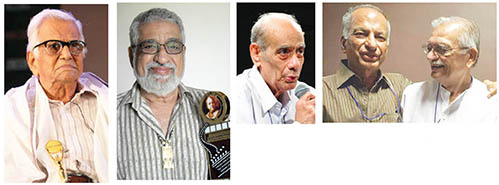
Left to right: Nanji, Kersi Lord, Mullan and Burjor Lord with poet-lyricist Gulzar
Lording it over Indian films
Known for his innovative rhythms and jazz drumming, playing the accordion and for introducing the percussive instrument glockenspiel to the film industry, Kersi Lord’s forte remained integrating Indian rhythms into any composition. He also introduced the Moog synthesizer (analog) three months after Moog marketed it in the USA. As known, the synthesizer is an electronic musical instrument, typically operated by a keyboard, producing a wide variety of sounds by generating and combining signals of different frequencies.
Kersi had joined his musician father Cawas at age 14 to become an intrinsic part of the film industry. "I had no identity of my own as I was ‘Lord’s ladka (son)’ for a long time,” he recounts on his website. "I was paid Rs 10 for a two-hour rehearsal and Rs 62.50 for a recording,” sometimes skipping school to play for recordings of composer Naushad Ali. During his musical career, Kersi was also the principal percussionist of the Bombay Chamber Orchestra until paucity of time made him quit.
His lifetime contribution to Indian cinema earned Kersi the Dadasaheb Phalke Award in 2010. The Mirchi Music award in 2009 was another award presented to him. His website shows clips of interviews with Kersi in an informal setting at home — with a snooker table in the background, which is obviously one of his passions. His wife Rose and he begot three daughters — Zarine, Parizad and Jasmin — none of whom followed the 78-year-old musician into this profession. Kersi and his younger brother Buji are remembered even today by western music lovers in the city for their performance of Bela Bartok’s Sonata for two pianos and two percussions which the duo played in tandem.
Buji proudly says: "Because of my studies of Indian taals (rhythmic patterns) experimentally combined with my technique of jazz and Latin American percussion instruments along with mastery of mallet instruments like xylophone, vibraphone, etc, I created a unique style of my own to blend Western instruments in Indian style melodies which made me a leading percussionist in Bombay studios for more than 25 years.”
Pianoforte was the instrument young Buji started off with as a child and then learnt the mouth organ. This denoted the beginning of learning to play several musical instruments — maracas (handheld shells with dried beans), tambourine, reso reso; castanets, manjiras, kartal; drums (practiced on rubber pads) or bongos, congos and percussion keyboard instruments like glockenspiel, vibrophone and later the xylophone. Buji also played ghungroos and nagaras (bells and drums). For the Indian ballet Chandalika choreographed by Vyjayanthimala Bali with Pt. Ravi Shankar at the sitar, he did the synchronization for the ghungroo.
Buji recalls that as a young boy he was reluctantly dragged to Hindi movies as there was no caretaker at home. While leaving home, the unwilling youngster would pocket a handy torch and comic book to read during the song interludes. That was before Buji turned into an ardent friend from foe of Hindi films. As he was unable to pursue his desired career in the merchant navy, film musician father Cawas advised Buji to join him just as he had previously introduced older son Kersi to the profession.
Both siblings received accolades, travelling the world with their music — to the West Indies, East Africa, UK, Europe and USA. The only country the younger Buji refused to visit was South Africa which practiced apartheid at the time. As he told Parsiana, "I felt if they did not want non-whites why should I go?” and so he recommended a student instead. Buji’s proudest hour was when he undertook the collection of funds and entertained troops on the Indo-China border, he admits. "But undoubtedly the best defense show of my life would be my trip to Nathula (a pass in the Himalayas), just after the Chinese aggression in 1962. The troupe of film entertainers was the first group of film personalities to reach the height of nearly 15,000 feet to regale the jawans, within 200 yards of Chinese armed forces,” he recounts.
Both the Lord brothers are now retired. Buji preferred to do so while the going was good, to sidestep the query "why are you going rather than when are you going?” He was also disillusioned with the introduction of electronic gadgets that started substituting musicians. His "non-filmy” nature could not accept this. This is how singer Asha Bhosle labeled him when asked about his character. She was being quizzed about him by a marriage broker for his intended arranged marriage to Khorshed. Forty-four years later the couple lives a rural life, building eco-friendly homes in Nargol, Gujarat. Sons Aspi and Hormuz have not joined their parents, preferring to strike out their own paths, the father tells us.
Rudradeep Bhattacharjee made a self-funded film The Human Factor mostly on the Lord family which contributed to cinema from 1931 till the 2000s. It documents the late father Cawas playing the background score in the first talkie in India to their popularity where they played "For about 40 years (roughly the years 1947-87), every third song recorded for a Hindi film featured a Lord playing an instrument,” says Bhattacharjee, on the inlive site.