
Cover Story
Coomi and the Chorus
For over 50 years Coomi Wadia has been conducting the Paranjoti Academy Chorus
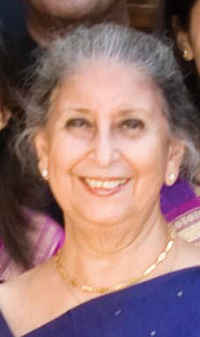
The lights in the auditorium dim and a hush descends on the audience as a group of elegantly dressed ladies in green and men in black suits walk in single file and take up their positions on the stage. Once they are all assembled, both audience and the Paranjoti Academy Chorus singers await the arrival of their conductor Coomi Wadia. A graceful, silver haired lady in a sari, perfectly groomed, glides onto the stage to take her place on the podium, a place she has occupied for the last 50 years.
 The choir has performed in almost 25 countries of Europe, Africa, Japan, USA, South Korea, Jerusalem, Lebanon to name a few, and they have also performed in the St Peter’s Basilica, Vatican City, in the presence of Pope Paul VI. The list of the festivals they have participated in and recordings for radio stations from Europe to Japan is endless. They have won several prizes in competitions in Europe, of which probably the most prestigious was the first prize for Overall Music Excellence at the IX International Choral Song Festival in Poland in 1974. And all this is a labor of love for music, as neither the members of the choir nor the conductor are paid. In spite of this, for many of the singers, the choir is a second home.
She wields the baton like a wand. The repertoire of the choir ranges from music from the 16th century to contemporary composers, spirituals and folk songs. Most of these are performed a capella (without instrumental accompaniment) and in 22 languages. The choir was invited to perform at the annual Monte Music Festival in Goa on February 5, 2011. The performance took place in an ancient chapel with perfect acoustics suitable for choral music. Cyril d’Cunha reported in Goa’s O Heraldo that they sang several Goan songs as well as the Hymn to St Francis Xavier arranged by the Chorus founder Victor Paranjoti and Kyrie Eleison composed by him. This touched the hearts of the audience: "The harmony of voices struck an immediate chord with the packed audience, which overflowed beyond the chapel’s doors.”
The choir has performed in almost 25 countries of Europe, Africa, Japan, USA, South Korea, Jerusalem, Lebanon to name a few, and they have also performed in the St Peter’s Basilica, Vatican City, in the presence of Pope Paul VI. The list of the festivals they have participated in and recordings for radio stations from Europe to Japan is endless. They have won several prizes in competitions in Europe, of which probably the most prestigious was the first prize for Overall Music Excellence at the IX International Choral Song Festival in Poland in 1974. And all this is a labor of love for music, as neither the members of the choir nor the conductor are paid. In spite of this, for many of the singers, the choir is a second home. She wields the baton like a wand. The repertoire of the choir ranges from music from the 16th century to contemporary composers, spirituals and folk songs. Most of these are performed a capella (without instrumental accompaniment) and in 22 languages. The choir was invited to perform at the annual Monte Music Festival in Goa on February 5, 2011. The performance took place in an ancient chapel with perfect acoustics suitable for choral music. Cyril d’Cunha reported in Goa’s O Heraldo that they sang several Goan songs as well as the Hymn to St Francis Xavier arranged by the Chorus founder Victor Paranjoti and Kyrie Eleison composed by him. This touched the hearts of the audience: "The harmony of voices struck an immediate chord with the packed audience, which overflowed beyond the chapel’s doors.”
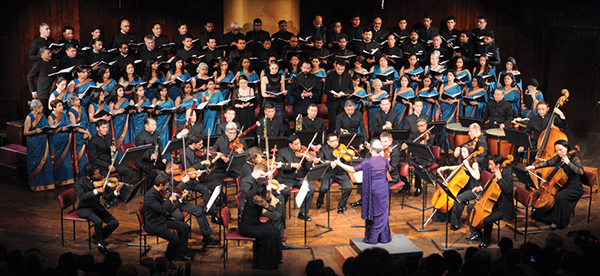
Coomi Wadia (top and above) at the Bombay performance in 2017: "brings out the best in the choir"
Photo: National Centre for the Performing Arts
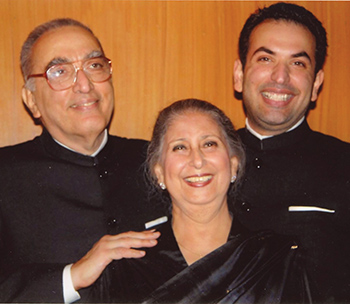
Coomi Wadia with Nariman (l) and Sorab Wadia
When asked if she had any special memorable concerts, she admitted that over the last 50 years and so many performances it was difficult to name a single one but, in 1981 at the "Sister Singers Festival at Stuttgart,” she was selected to conduct the final concert. There were 14 choirs and 700 singers: seven choirs from all over the world and seven who were hosting them. "To be selected from 14 conductors to conduct a choir of this size is a unique honor.”
However, all was not plain sailing. She had several obstacles to overcome to achieve the level of perfection she demands from her choir and the orchestra. Most aficionados of western classical music will agree that Johann Sebastian Bach’s Mass in B minor is the pinnacle of his work and probably one of the best masses ever to be written and Wadia was very keen on performing the piece, particularly since she had just attended the Bach master classes in 1979 in Stuttgart. This time it was the Rajneesh Ashram which provided her with 35 talented singers and a complete A-grade wind section. "I went to Poona every week. On Fridays, I rehearsed with the choir, on Saturdays, with the musicians and on Sundays at Bombay with the Paranjoti Chorus for three months from March to June 1980 when we finally performed the Mass. With the strings from Bombay and the winds from the Rajneesh Ashram, it was almost like a jigsaw puzzle with the pieces finally falling into place.”
Robert Clements, bass singer with the choir for 25 years says, "Coomi has the unique talent to understand the mood of the audience and can adapt accordingly. In a small town in Spain where we were due to perform at the town square, the band before us entertained the audience with their fast and popular music. Coomi felt the mood, changed the tempo and suddenly had the people applauding, swinging to the music and singing along with us!” Vispi Unwala, who has been with the choir for a long time feels, "Most people are aware that Coomi is extremely versatile in the range of her repertoire and her ability to conduct. That she has a deep insight in the music and brings out the best in the choir by drawing their attention to the finer musical points is a well-known fact. But few realize, that in spite of her strictness which is demanded for such a high level of perfection, she is an excellent teacher and if she notices a shy and diffident singer, she will help and encourage him or her to develop the vocal range to the maximum.”
Kamal Mulla, who has been with the choir for several decades observes: "Her passion and dedication to music and her commitment to bringing out the very best in her choir are an inspiration to all the singers. Her relentless demands for excellence and perfection can be exhausting, but the end product, the final performance, makes it all worthwhile.”
How does she manage such perfection? Is there any special way to look after one’s voice? "One only needs to take care of one’s vocal chords by not straining them,” she says. Some "members of the choir smoke and some do have iced drinks, but this is very subjective and differs from person to person. In fact, several of our choir members are in their 60s and still sing harmoniously.” The choir used to rehearse two evenings during the week but now with pressures of work and extended hours many of the singers find it difficult to attend during the week. "There are the usual absentees, but we rehearse every Saturday from 2.30 p.m. to 5.30 p.m.”
In addition to conducting, which in itself is hard work — "It is not merely standing in front of a choir and waving a baton” — there is a lot of administrative work as well. Finances are never enough but Wadia says that most of the financial support comes from advertisements in their brochures and from different donors who have come forward at moments of time to assist the Academy.
The founder
Victor Paranjoti started the Bombay Amateurs Light Opera Sabha (BALOS) in 1956 which became the Paranjoti Academy Chorus in 1960. They successfully completed their first international concert a year later.
In addition to his duties as the conductor of BALOS, Paranjoti was a music critic for newspapers. "He frequently had to attend concerts and file his review before midnight so that it could go to the press the following day,” said Wadia. "On such occasions, he would request me to take over the rehearsals in his place and this gave me a lot of training and confidence.” When Paranjoti died on February 1, 1967, Wadia, who was a young woman, took charge of the choir, a role she has been carrying out with perseverance and grace over the last 50 years. Did the choir members object? Not really. Just three of them left and Wadia got busy preparing a new piece for a concert to be held on May 24.
Victor Paranjoti started the Bombay Amateurs Light Opera Sabha (BALOS) in 1956 which became the Paranjoti Academy Chorus in 1960. They successfully completed their first international concert a year later.
In addition to his duties as the conductor of BALOS, Paranjoti was a music critic for newspapers. "He frequently had to attend concerts and file his review before midnight so that it could go to the press the following day,” said Wadia. "On such occasions, he would request me to take over the rehearsals in his place and this gave me a lot of training and confidence.” When Paranjoti died on February 1, 1967, Wadia, who was a young woman, took charge of the choir, a role she has been carrying out with perseverance and grace over the last 50 years. Did the choir members object? Not really. Just three of them left and Wadia got busy preparing a new piece for a concert to be held on May 24.
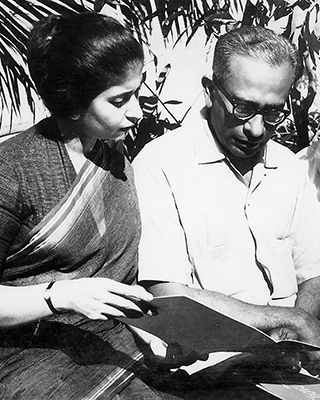
Coomi Wadia with Victor Paranjoti
"Things just fell into my lap,” she says modestly. After a concert in Germany, Royce Saltzman, the president of the American Choral Conductors Association invited her to attend a workshop for conductors which he was organizing along with Helmuth Rilling at the Bach Akademie in Stuttgart. "Since he recommended me, there was no question of an audition. Eighty-five conductors from all over the world attended but only 25 were actual participants (of whom I was one); the others were mere observers.” They worked for 15 days from eight in the morning to eight in the evening. "It was a marvelous experience,” she said. "We were each given, in advance, an original, unedited score of Bach cantatas (a medium-length narrative piece of music for voices with instrumental accompaniment) and we had to interpret the music. It was amazing how different conductors interpreted the same piece of music. We practiced separately with the choir and different sections of the orchestra, and the best interpretation was performed that evening in the cathedral.” She remembers having to conduct concerts without a score and made a striking impression with her professionalism and musicality which led the Deutche Welle to record one of her rehearsals and interview her for television.
Few people know that she is a graphic artist and worked with an advertising agency for 11 years. She personally designs the program for the recitals. An alumna of J. B. Petit School, the piano lessons given for free by Khorshed Screwvala helped Coomi (née Umrigar) to blossom as a pianist and obtain both the Associate and the Licentiate from the Trinity College of Music, London.
"I love going to Udvada. Being in the Iranshah alone at night, amidst the glow of the fire and the divas is an uplifting experience,” Wadia had conveyed to Parsiana (see "The world in their voice,” February 2002). Though staunchly in favor of wearing the sudreh-kusti, excessive rituals do not appeal to her.
Her husband Nariman Wadia was a jeweller by profession. "Our relationship was wonderfully complementary. I would help him with designing his publicity material. He, on the other hand, in addition to being the chairman of the Paranjoti Academy Chorus also sang in the choir till his health failed him. Nothing would have been possible without his help and his support. Even though he had no degree in music, he was a fine musician. He supported me through most of the last 50 years and his criticism has been of immense help.” The concert at the Tata Theatre on November 28, 2017 was a tribute to him and the choir sang Mozart’s Requiem and the Coronation Mass along with some of the members of the Symphony Orchestra of India to a full house. It was appropriate that their son, Sorab, who has grown up with music and singing and who has a master’s in piano and voice from the USA, was one of the soloists. The concert, as always, was close to perfection and reflected the highest standards which have become synonymous with her name.
Few people know that she is a graphic artist and worked with an advertising agency for 11 years. She personally designs the program for the recitals. An alumna of J. B. Petit School, the piano lessons given for free by Khorshed Screwvala helped Coomi (née Umrigar) to blossom as a pianist and obtain both the Associate and the Licentiate from the Trinity College of Music, London.
"I love going to Udvada. Being in the Iranshah alone at night, amidst the glow of the fire and the divas is an uplifting experience,” Wadia had conveyed to Parsiana (see "The world in their voice,” February 2002). Though staunchly in favor of wearing the sudreh-kusti, excessive rituals do not appeal to her.
Her husband Nariman Wadia was a jeweller by profession. "Our relationship was wonderfully complementary. I would help him with designing his publicity material. He, on the other hand, in addition to being the chairman of the Paranjoti Academy Chorus also sang in the choir till his health failed him. Nothing would have been possible without his help and his support. Even though he had no degree in music, he was a fine musician. He supported me through most of the last 50 years and his criticism has been of immense help.” The concert at the Tata Theatre on November 28, 2017 was a tribute to him and the choir sang Mozart’s Requiem and the Coronation Mass along with some of the members of the Symphony Orchestra of India to a full house. It was appropriate that their son, Sorab, who has grown up with music and singing and who has a master’s in piano and voice from the USA, was one of the soloists. The concert, as always, was close to perfection and reflected the highest standards which have become synonymous with her name.
◆ ◆ ◆
From the archive