
Interface of India’s influence - I
Countries in Southeast Asia borrowed from the Indian narrative in religion, culture and architecture
In the audience were several students from Ramnarain Ruia, Jai Hind, Wilson, St Xavier’s and K. K. Talreja Colleges who patiently heard the erudite speakers. They were pursuing subjects as varied as English, history and archeology.
"As eastern and southern India were being ‘Sanskritized,’ it is natural that this process extended across the Bay of Bengal to developing SEA societies,” stated Prof Pierre-Yves Manguin, emeritus professor at the Ecole Française d’Extrême-Orient, Paris in his inaugural address. "As people travelled back and forth, and products and technologies were transferred, shared vocabularies, codes, aesthetics and values developed… The cultural package included the use of a powerful language (Sanskrit), Indian scripts, the text based religions of Buddhism and Hinduism with all their ideological and material props and concepts of statehood and urbanization,” he added.
According to Manguin, Indianization implied the adoption of the Indian sastras (sacred scriptures) which formed the basis of an ethical platform in SEA that brought about a lot of change. He subscribes to the theory that convergence and sharing of cultural codes and vocabulary were in existence two or three centuries before the term Indianization was adopted in the fourth century. He held that stone and glass bead making were transferred from India to SEA.
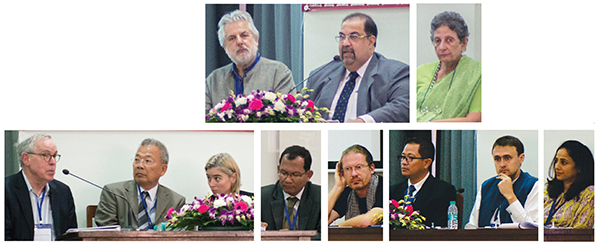
Photos: Devaki Dhuldhoya
The seminar had two of its five sessions on the first day. In the first session "Syncretic Traditions,” the main thrust was the transplanting of Buddhism in most of SEA, Hinduism in Bali and later Islam in SEA. Syncretism is the combining of different, often seemingly contradictory beliefs. These traditions were grafted onto the local beliefs, practices and then assimilated into the cultural and spiritual practices of each of the host countries.
In his paper on "Two Examples of Bridges Bringing India To Cambodia,” Prof Ang Choulean, Cambodian anthropologist teaching old Khmer epigraphy (the study and deciphering of ancient inscriptions), concluded that the Indian sivalinga (the phallic symbol for lord Shiva) did not enter Cambodia as an intruder but as having a native counterpart the mukhalinga — frequently associating a human face to a crude rock, as in Angkor Wat, Cambodia. Cremation was the second example he talked of. The scholar stated that cremation was imported into Cambodia from India with the difference that in Cambodia there is a double funeral – first a burial and then the bones are cremated after two-three years.
According to Sophearith Siyonn, archeology lecturer at the Cambodian University and a renowned iconographer (person who establishes meanings attached to images), cows in ancient Cambodia were indispensible, venerated and prosperity was measured in their ownership. He reiterated that cow veneration is reduced to ritualistic use of five cow products or panchagavya – milk, curd, clarified butter, urine and dung for daily rituals. In his talk on "Cows In Ancient Cambodia: A Reflection On Indians And Indian Tradition In Khmer Society,” he further explained that Cambodians have borrowed the Hindu concept of dharma (social order) symbolized as a bull. The bull represents the four yugas (cyclical ages). In each yuga the bull is depicted with one less leg – so in the current, fourth Kaliyuga, the dharma bull is depicted on one foot to show little stability and social order.
Dr Prof Hiram Woodward read his paper on "Image and Text in Eleventh Century Burma.” He has achieved academic excellence in writing, publishing, being a curator, art historian and professor. His treatise was on the ancient city of Bagan with its 1,000 stupas (dome shaped structures containing the Buddha’s relics) and temples in Burma. His paper addressed issues regarding the relative roles of foreign monastic communities in the formation of the culture of Bagan.
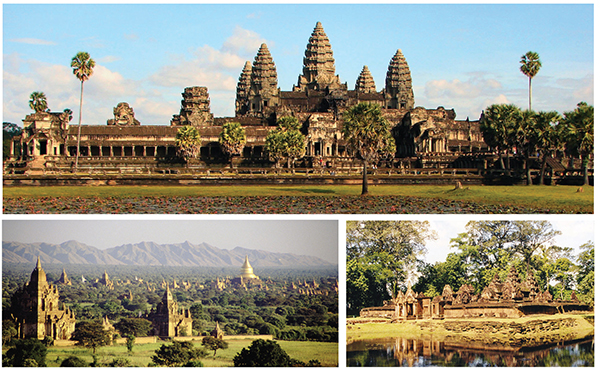
Top: Angkor Wat, Cambodia; below L to R: Bagan, Burma; Prasat Banteay Srei,Cambodia Photos Wikipedia
Connecting civilizations
The second session was on "Architecture: Sacred and Urban Spaces” where a study of the architectural traditions from India was scrutinized to gauge the subsequent transformative processes. Sculpture, painting, iconography, literature, performing arts were all covered.
Dr Olivier Cunin, an architectural historian, speculated regarding the identification of three missing images from the 10th century Cambodian temple dedicated to Lord Siva at Prasat Banteay Srei (the citadel of women). Cunin reiterated how several masterpieces are outside Cambodia in museums, especially the United States and France.
Im Sokrithy, archeologist and historian, focused on three villages situated on ancient infrastructure such as dykes, roads and water structure, representing the Royal Road in Siem Reap province. Two main roadways of a village east-west and north-south cross each other at the ‘navel.’ This spatial structure suggests planned urbanization of Indian or Chinese origin. Scholars veer more towards Indian influence due to the importance of the east-west direction and the presence of a central site, he believed.
Philip Friedrich, doctoral candidate at the Department of South Asia Studies, University of Pennsylvania, sailed to Sri Lanka (SL) and examined the hybrid religious structures called devalayas (places of worship) there. Devotees honored Buddhist and Hindu deities within a single ritual circuit. He talked of Hinduization of SL which was a catalyst to historic change.
Swati Chemburkar spoke on her expertise of "the development of stupa architecture in the Buddhist world based on a mandala (circumambulatory path) model.” Her paper emphasized links with Kesariya monument in India, Borobudur in Indonesia and Tabo in Indo-Tibet. The student of art, culture and architecture completed her Masters with distinction at the School of Oriental and African Studies and currently teaches Indian aesthetics at Jnanapravaha, Bombay. Jnanapravaha nurtures critical thinking and intellectual rigor as also global exchange of creative Indian thought.
Kesariya and Borobudur were built by Balaputra, establisher of the Nalanda University, we were informed. Both are built on a natural hill, hold a life sized Buddha statue and present themselves to the viewer as horizontally somewhat flattened whilst the stupa cannot be seen from the bottom. The upper three terraces of Borobudur provide a strong architectural prototype for a mandalic arrangement of deities.
Comparing Tabo and Borobudur, she expounded that "they share a common religious philosophy, sacred geometry and fusion of the mandala with an architectural space which is vertical in Borobudur and horizontal in case of Tabo.”
To be concluded