
Observation
Captivated by Cambodia — I
Visiting Angkor Wat and other intricately sculpted temples in the ancient kingdom of Kampuchea reveals how strong the influence of Hinduism was on the people of that country
Cambodia was not on our map of holiday destinations to do. Rather, it fell into our laps as a 50th wedding anniversary gift from our children! And what a beautiful store of sights, insights and experiences it gave us.
From the time we landed at the small and pretty Siem Reap (pronounced see-èm-ree-ep) Airport, till we crossed the border to Ho Chi Minh City in Vietnam, we were captivated by the country and more so by its people. Cambodians are very friendly and wherever you go the smiles are wide and the welcome warm.
From the time we landed at the small and pretty Siem Reap (pronounced see-èm-ree-ep) Airport, till we crossed the border to Ho Chi Minh City in Vietnam, we were captivated by the country and more so by its people. Cambodians are very friendly and wherever you go the smiles are wide and the welcome warm.
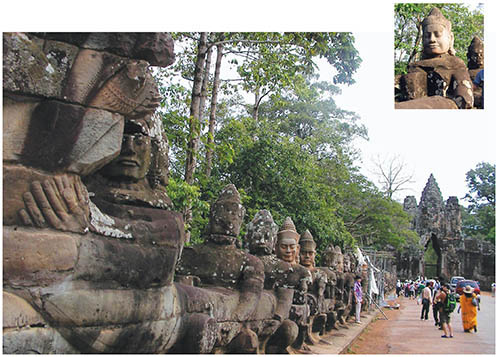
Temple at Ta Phrom. Inset: Entrance to Angkor Thom group of temples
For all its surface simplicity, Cambodia is a complex country. It has a history of a glorious past, set against the grisly Pol Pot era. Angkor Wat has the largest Hindu temple complex in the world, yet the main religious influence has been Buddhism. At different times in its history Cambodia has been ruled and ravaged by Japan, Thailand, Vietnam and France. In spite of all this, the people are happy, trusting and smiling and seem to bear no grudge against anyone.
Siem Reap is the tourist and culture capital of Cambodia and the base for visiting the Angkor temples. While Angkor Wat is the most well-known — it was declared a World Heritage Site in 1992 — there are many other equally beautiful and intricately sculpted temples within a few miles of each other.
We did the lesser known temples first, saving the best for the last. "If you see Angkor Wat first” advised a seasoned traveler, "the other temples will fall short of expectations.”
While in Siem Reap we stayed at a personalized and pretty boutique hotel called The Pavillon d’Orient. The hotel tariff included a good buffet breakfast, a basket of fresh fruit every day, an aromatic oil body massage with the compliments of the hotel and best of all, a tuk-tuk (very comfortable auto-rickshaw) and driver at our disposal from 7 a.m. to 10 p.m. to take us wherever we wanted to go, during the entire course of our stay.
On our first morning there, Sam, our tuk-tuk driver, was at the gate of the hotel at 7 a.m. with a winsome smile and the promise of a great day ahead. At the end of our four-day stay, Sam was more a friend than our tuk-tuk man, sharing the local folklore, fruit and wayside food with us.
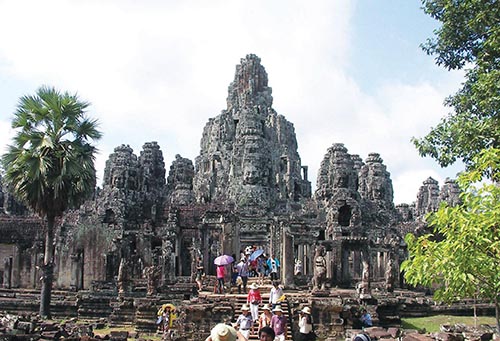
Angkor Wat: A world heritage site
On our first morning the immediate requirement was to go to the Temple Ticketing Office to buy our visiting passes: $ 20 for one day or $ 40 for three days. We opted for the latter. In spite of the large number of tourists, most of them from Australia, everything was very well organized. Without any shoving or pushing, visitors wait in queues, are photographed and within minutes handed a pass with a photo ID. This pass is punched at every temple complex one enters and is valid for the number of days paid for.
With passes in hand we head for the Angkor Thom group of temples that include Bayon, Baphuon, the Terrace of the Elephants from where the kings watched parades and the Gallery of the Leper Kings. Names of Hindu gods and episodes from Hindu mythology are mouthed by every guide — names and stories that are familiar to us. We nod our heads with knowledgeable pride and bask in the reflected glory of the ancient culture of our country. "We are from India,” we whisper to the American standing beside us. He looks at us with greater respect. The temple’s carvings are intricate and beautiful. The stone used is mostly laterite. Restoration work is in progress in parts of the temple.
After two hours of temple traversing we are hot and tired and happy to see smiling Sam waving at us from his waiting tuk-tuk at the pickup point. A 15-minute rest at a shady stall and a refreshing drink of coconut water revives us for the next saga in stone.
The Ta Phrom temple offers a tango between man and nature. Doors, domes and massive blocks of carved stone are held in tight embrace by the serpentine root system of kapok trees and strangler figs. The temples here have a sinister beauty of their own, as they struggle against being smothered and swallowed by the voracious jungle. Apart from a few supports and buttresses for blocks that might get dislodged, the temple has not been restored. It is a grim reminder that man-made marvels must to dust and decay fall, while nature stands tall.
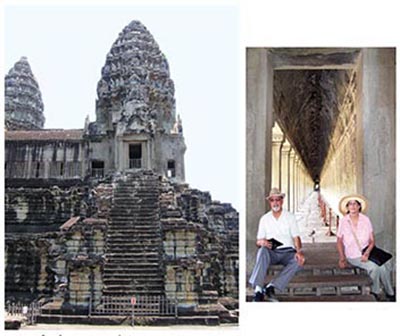
Angkor Wat (left). Author and husband at gallery in complex
Another of the smaller but more beautiful temples is Banteay Srei, discovered in 1914. It is sculpted from pink sandstone and stands out on account of its lovely color and delicate carving.
On the penultimate day of our stay in Siem Reap we went to see Angkor Wat, which literally translated means City of Temples. "Watching the sun rise over Angkor Wat is as beautiful and unforgettable as seeing the Taj Mahal by moonlight,” our effusive guide told us. Unfortunately, by the time we received this information, the sun was already high in the sky!
Immensity, art and architecture reach their culmination in Angkor Wat. The temple looks somewhat like the temples of South India but on a very, very large scale.
"It took 380,000 people, 40,000 elephants and 37 years to build this,” we are told. There are five towers surrounded by galleries and walls, the whole complex bordered by a moat. More poetically put by our guide, "Angkor Wat is like the beautiful closed bud of a lotus in a lake (the surrounding moat).” It was built sometime between 1113 and 1150 CE.
Traversing the length and breadth of Angkor Wat and then climbing the almost vertical incline to the central tower was a herculean effort, to say the least — but we did it!
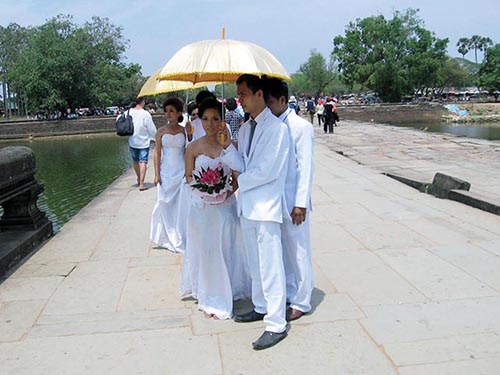
A newly married couple posing for a photo at Angkor Wat
Angkor Wat was originally built as a Hindu temple dedicated to Vishnu. Stories from the Ramayana and the Mahabharata are sculpted in stone and more than 1,500 alluring apsaras smile down at us from the walls. Angkor Wat’s orientation facing west instead of the traditional east is the subject of much curiosity and controversy. We became aware of this only when our daughter in USA who has studied architecture asked us to find out why this was so. The question baffled our $ 20-a-day guide but later our hotel desk manager Sebastien Ung made the effort to obtain an explanation from the Department of Tourism. "Monument was constructed to honor the God Vishnu, associated with the west side of the universe. Also it served as a temple when King Suryavarman II was alive and is the place where he was entombed when he died. Therefore it faces the west,” we were told.
It was interesting to learn how strongly Hinduism has influenced the people of Kampuchea (as Cambodia was then called). It was trade with India that gave the Khmers their first contact with the Indian religion and culture. Traders in spices and silks came from eastern India in sailing boats, guided by the south west monsoon winds. They stayed on for four months till the winds reversed direction to guide the ships back to Indian shores. The prosperity of these Indian traders was ascribed to divine protection and was instrumental, in part, for the Kampucheans building temples to Shiva and Vishnu.
The temple complexes are tourist magnets from sunrise to sundown. But come dusk, the international community in Siem Reap is drawn into the vortex of Pub Street, Old Market Place and the brightly lit Night Market. Pub Street is actually an area covered by many narrow streets, lined with pubs and eating places, spilling over onto the pavement. The cuisine in these restaurants is as varied as the people who enter them. One can dine on Khmer, Thai, Chinese, French, Italian, English, American and yes, even Indian food. The place is fun and friendly and one can share conversations and cocktails with people at any table with chairs to spare.
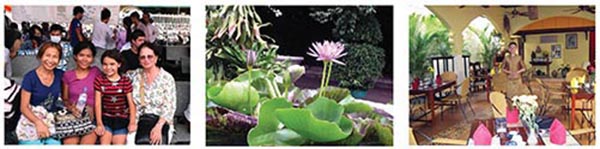
From left: Author meeting with locals; water lilies and dining area at The Pavillon d’Orient
A stay of four days seemed just right for Siem Reap, after which we proceeded to Phnom Penh, the capital city. One can go there by plane, boat or road. The railway system is not developed. Our first choice was to take the river boat, but in the month of April the water was low in the Mekong and river boats did not ply. A road trip was our next choice, as it gives one an opportunity to see the countryside and rub shoulders with the local people.
To be concluded
◆ ◆ ◆
From the archive