
Cover Story
The enabling educationist
Astad Parakh is making a difference to how English is taught in vernacular schools in Maharashtra as a means to empower job-seekers
"Why do we still have these distinctions of rich and poor, of English-medium student vs. a vernacular medium student?” enquires Astad Parakh who conceptualized the English E. Teach Project that today touches the lives of over 41,000 school children, covering 11,000 kids in 67 schools in Bombay and 30,000 in 1,118 schools over the Thana and Latur districts of Maharashtra. "Children from the poor strata of society who do not know English suffer from a major handicap; they are not job-worthy, even the cleverest of them,” points out the 78-year-old Bombay resident who regrets that although India has "fought and won so many wars since 1947, we have not won the war on non-inclusiveness.”
 Parakh’s tryst with voluntary work in the field of education began 15 years ago at a school at Awas near Alibaug, after mobilizing funds to build decent toilets for the schoolgirls there. Soon, he was bringing in teachers from Bombay to help out at the school. He was disillusioned with the non-sustainability of it all, he says. What was the use, he muses, "when a girl who scored 94% was going house to house cleaning utensils for the Bombay folk who had homes there?” There was also a boy who came back disheartened when he could not secure a job in Bombay despite scoring well. "‘We are wasting our time,’ was the common refrain from all the school toppers,” he recalls. The education system in the vernacular language (Marathi) was unable to prepare these bright school students for college or for a career.
In the Project he formed, the regular class teacher controls the teaching through the use of the TV and DVD "remote,” with no extra burden on his or her time. The animated lesson helps the teacher in explaining objects and phrases and the student is prompted to learn the correct diction. In the bargain, the teacher also gets kudos for imparting good quality teaching. In this win-win situation, the children enjoy the lessons and are delighted at the way they are taught; the parents don’t need to undertake any special efforts; the lessons can be taught by the existing schoolteachers, causing no additional stress on an already strained school system.
Parakh’s tryst with voluntary work in the field of education began 15 years ago at a school at Awas near Alibaug, after mobilizing funds to build decent toilets for the schoolgirls there. Soon, he was bringing in teachers from Bombay to help out at the school. He was disillusioned with the non-sustainability of it all, he says. What was the use, he muses, "when a girl who scored 94% was going house to house cleaning utensils for the Bombay folk who had homes there?” There was also a boy who came back disheartened when he could not secure a job in Bombay despite scoring well. "‘We are wasting our time,’ was the common refrain from all the school toppers,” he recalls. The education system in the vernacular language (Marathi) was unable to prepare these bright school students for college or for a career.In the Project he formed, the regular class teacher controls the teaching through the use of the TV and DVD "remote,” with no extra burden on his or her time. The animated lesson helps the teacher in explaining objects and phrases and the student is prompted to learn the correct diction. In the bargain, the teacher also gets kudos for imparting good quality teaching. In this win-win situation, the children enjoy the lessons and are delighted at the way they are taught; the parents don’t need to undertake any special efforts; the lessons can be taught by the existing schoolteachers, causing no additional stress on an already strained school system.
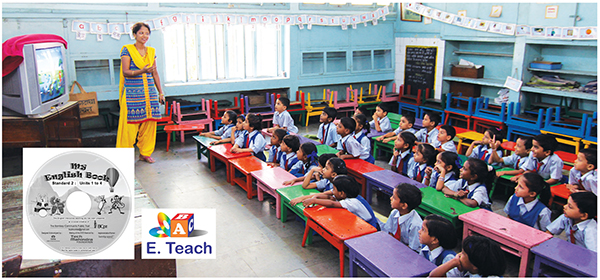
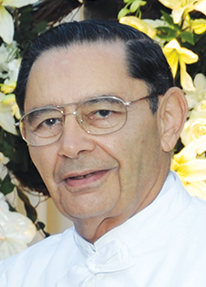
Clockwise from above: Astad Parakh; Class I English period in progress Photo: Jasmine D. Driver;
Project logo; Part 1 of English syllabus for Class II
Parakh contacted many organizations in the field of education and toyed with various models to help the local school system before the Project took shape in its current form. One such organization had its own learning material, and they sent two of their staff members out to teach at Awas. In the middle of one such session with primary schoolchildren, there was a power failure. When electricity was once again restored, Parakh was fascinated that during that session alone, the children in the Marathi medium school had learnt 70 new English words from the learning material. "That set me thinking,” he says, "about what we need to do to have a tool so that kids could enjoy the lessons.”
This former management consultant who started his career with the Tata Group had friends in high places. In 2005 he approached F. C. Kohli, the then chairperson of Tata Consultancy Services, who was a valuable sounding board. Kohli put Parakh in touch with Tata Interactive Systems, which had experience in developing learning tools for overseas markets. A sample tool was prepared pro bono. "It contained basic learning tips for students of Class I. "The content was restricted to ‘my world, my classes and the like,’” says Parakh. But it was a starting point. This was the beginning of what was to become the English E. Teach Project. It was time to ramp up and reach out to schools in a sustained and structured manner.
Since he "did not want to tackle the organizational issues involved,” or spend valuable money on administrative expenses, Parakh reached out to The Bombay Community Public Trust (BCPT), a ‘community chest’ which enables people to channel their resources to solving civic problems. It currently supports several organizations that work in the area of children’s education, women’s empowerment, health and community development among others.
With assistance for the learning content from Tata Interactive Systems and with some funding that was available, Parakh was ready to go citywide. He recalls the efforts involved in reaching out to various municipal schools in Bombay where the medium of instruction was either Marathi, Hindi or Urdu. "It was an uphill task,” smiles Parakh serenely, "as many schools were disinterested and those who supported me were not doing it wholeheartedly.”
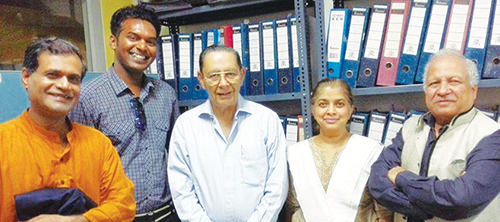
L to R: Nitin Orayan and Manish Dhiman of Learning Space Foundation, Parakh,
Dhanawanti Hardikar (member secretary) and Kumar Kelkar (chairman) of English Language
Committee of Maharashtra State Bureau of Textbook Production and Curriculum Research;
Bottom: On the Hillside, lesson for Class II
.jpg)
It was in 2010 that Parakh read of Nitin Orayan in an interview in The Times of India. Orayan was then doing pioneering work in child education in the small town of Ganeshpuri near Bombay. This founder of the NGO (nongovernmental organization) Learning Space Foundation, an education support trust for rural children and marginalized communities, Parakh decided, was a suitable partner with whom he could further his dream of making education fun for schoolchildren. He sent Orayan the then ready Class I DVD and within 10 days the latter had put it into practice at some of his classes and reported good progress. "The Project was ready now to be rolled out to rural Maharashtra,” says Parakh. Orayan describes their meeting as "a happy coming together” with both Parakh and he sharing the same vision.
The DVDs are custom-made to teach the prescribed curriculum of the Government of Maharashtra for vernacular medium schools, through their teachers, and in the class periods assigned for English. Schools are not required to pay to the Project for use of the DVDs. "The USP (unique selling proposition) of the Project is that it follows the syllabus exactly, page by page” beams Parakh. The DVDs use various graphics, animated characters, games and music to enliven the lesson, he demonstrates to us.
"The Project currently covers Classes I and II, and will be expanded to Class III in the academic year 2015-16 and into Classes IV and V thereafter,” informs Parakh. The mission statement on the website of the Project states that by the year 2020 it is proposed to spread this program across all schools in Maharashtra covering all districts and municipalities.
Showing us around at the Abhinav Prathamik School in Dadar, Bombay, Smita Nayakwadi, a facilitator with BCPT takes us to a classroom where Class II children are studying English. The faces of the tots brighten up as soon as the TV is switched on and, led by their teacher, they are happy to sing along with the lesson that explains common modes of transport with animation and music. The elephants are riding bicycles, the tigers are in a bus, they chant. We move on to Class I and the story is the same: happy faces, eager responses, delight at being taught English in an innovative way. The headmistress of the school, Megha Surve states proudly that "this was one of the first vernacular medium schools that implemented this interesting way to teach English to students four years ago.”
Orayan explains that in the academic year 2015-16, it is planned to work on new ways of delivering the lessons. The Project is toying with using newer methods, including flash drives (memory sticks for computers). On the cards is a portal where educators can view sample lessons to convince themselves of their suitability to their schools, and online support where educators’ queries can be handled. Parakh states that other district education officers from Raigadh and Beed have shown interest to roll out the Project in their respective districts.
"It is a mind-set battle,” says Parakh, when you ask him why more schools cannot be covered. "We have six resource persons in Bombay and about 10 in rural Maharashtra who wear dual hats — they convince more schools to participate and at the same time monitor the implementation of the Project by the schools. Both Parakh and Orayan acknowledge the informal help provided by the municipal corporations and the district education officers they work with. "It is easier to get assistance in the rural areas than in Bombay,” states Orayan.
Parakh acknowledges the handsome financial assistance provided by Tech Mahindra Limited over the years, donors and Parsi trusts from within his circle of friends. He narrates a humorous incident. In the first year of their association with the Project, one of the philanthropists donated a large sum, of which the Project was able to utilize only half. "We went back to return the balance to them, only to be told that no one had ever returned unspent money, and we could keep it for the next year,” smiles this conscientious Zoroastrian. "We still need more funds,” says Parakh, "to be able to sustain ourselves, to expand to more schools in Maharashtra and to increase coverage to Class V.”
Parakh affirms that he acquired his giving spirit from his mother Gool who ran a children’s nursery school in Wadia Baug, a Zoroastrian colony in Bombay. His father Nadir was a manager in a textile mill and later ran the family printing press in Mhow. His maternal grandfather Ardeshir Dadabhoy had endowed a public library in Mhow. "It was open to all castes and communities,” emphasizes Parakh who recalls coming to Bombay from Mhow, with no job, but was fortunate to be taken on as a management trainee in 1957 by Forbes Forbes and Campbell. He rose to be a director in the company. In 1980 Parakh left them to set up his own management consultancy that he ran for a few years, until he went into the business of modular furniture and export of wire products. The business is now run by his son Nader, an MBA, "leaving me time to run my Project,” laughs Parakh. Wife Dinoo is currently president of Indus International, an organization that endeavors to build a bridge of understanding between Indian and American women living in Bombay. Daughter Ayesha is married to Dr Darius Soonawala, an orthopedic surgeon.
"One need not be religious to do good work,” believes Parakh, stating that he has no strong views on any religion. "Just live with happiness and do your bit,” he recommends. "We are the enablers. In the process, some will walk with us, some will run and some will fall by the wayside. But we would have made some difference, hopefully.”
Donations (eligible for deduction under Section 80G of the Income Tax Act) may be sent by Account Payee cheques in favour of "The BPCT E. Teach Project” to The Bombay Community Public Trust, Ramon House, 3rd Floor, H. T. Parekh Marg, Churchgate, Bombay 400020.
◆ ◆ ◆
From the archive