
Seminar
The evolution of reincarnation
The first of the five Indo-Hellenic Cultural Transactions sessions debates the beginning of ethics and karma in two ancient philosophies
The hall buzzed with scholars, lay people and college students at the inaugural morning of the Indo-Hellenic Cultural Transactions at the K. R. Cama Oriental Institute (KRCOI) on January 19 and 20, 2013. The seminar featured speakers from India and abroad who "will take further the research done on coinage, Alexander’s conquest in north west India and the philosophical parallels between Plato and Kautilya,” observed Muncherji Cama, president of KRCOI, welcoming participants. "There has been renewed academic interest in the relationship between Greece and India,” he commented.
‘Philosophy and the care of the self’ started the first of five sessions whose speakers included Dr Vijay Tankha, Richard Seaford and Dr S. Paneerselvam. The second session on the first day was ‘Conflict and Co-existence: Alexander’s Legacy in the Indo-Iranian Borderlands.’ Dr Usha Thakkar delivered the inaugural address of the day.
‘Philosophy and the care of the self’ started the first of five sessions whose speakers included Dr Vijay Tankha, Richard Seaford and Dr S. Paneerselvam. The second session on the first day was ‘Conflict and Co-existence: Alexander’s Legacy in the Indo-Iranian Borderlands.’ Dr Usha Thakkar delivered the inaugural address of the day.
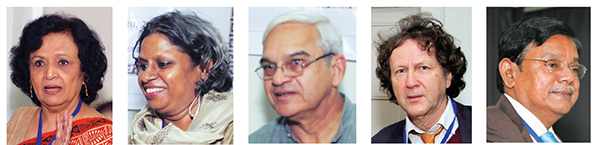
Dr Usha Thakkar, Dr Kanchan Mahadevan, Dr Vijay Tankha, Richard Seaford and Dr S. Paneerselvam
Honorary director of Mani Bhavan (M. K. Gandhi’s museum) and Asiatic Society of Bombay, Thakkar hoped that the seminar would infuse new insights from bygone days. She mentioned that there were several schools of thought before the statesman Kautilya but his Arthashastra was a wealth of science which lays down rules of foreign policy, inculcates righteous acts and discourages unrighteous acts. "He has what you expect from a good dissertation,” she said. Thakkar is head of the department of political science at the Shreemati Nathibai Damodar Thackersey Women’s University, her research areas of interest being Gandhian studies, ancient Indian political thought, women and Indian politics.
Kautilya talks of dharma (righteousness), kamma (action) which should not be in excess, leading only a few to moksha (liberation). She added that the author uses a critical comparative of these and that this was not the work of a single person but of a school which established the science of politics. This master of statecraft defines what good policy is and how the absence of policy causes chaos. Thakkar also dwelt on how Kautilya advocates secrecy, and how the book urges the king to be vigilant. She cautioned that the "book cannot be applied verbatim to modern days; however many principles can be useful for generations to come.”
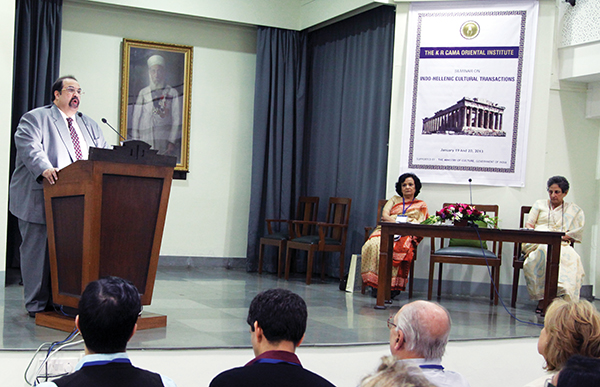
Muncherji Cama, Thakkar and Dr Nawaz Mody
The birth of an idea
Dr Vijay Tankha who is the head of department of philosophy at St Stephen’s College, Delhi and currently working on Plato’s Republic, indicated that "exercising the intellect is hardly the only thing philosophy should be doing… philosophy would actually concern itself with making the self better, morally.” He mentioned that the Greeks put much emphasis on knowledge and the intellect. In Phaedo Plato, a student of Socrates, tells us that "Philosophy is a preparation for death.” Plato supposes that all men are capable of reason but only a few, of "higher reason” and that too with much effort and training. Tankha then differentiated between good and evil "to judge which act is good and which act is evil, to embrace the one and avoid the other.” He also covered "notions of community and individuality, conceptions of the good life; and the doctrine of metempsychosis (Greek) and karma (Indian) philosophies and the practice of celibacy and asceticism.”
Dr Vijay Tankha who is the head of department of philosophy at St Stephen’s College, Delhi and currently working on Plato’s Republic, indicated that "exercising the intellect is hardly the only thing philosophy should be doing… philosophy would actually concern itself with making the self better, morally.” He mentioned that the Greeks put much emphasis on knowledge and the intellect. In Phaedo Plato, a student of Socrates, tells us that "Philosophy is a preparation for death.” Plato supposes that all men are capable of reason but only a few, of "higher reason” and that too with much effort and training. Tankha then differentiated between good and evil "to judge which act is good and which act is evil, to embrace the one and avoid the other.” He also covered "notions of community and individuality, conceptions of the good life; and the doctrine of metempsychosis (Greek) and karma (Indian) philosophies and the practice of celibacy and asceticism.”
Karma and Currency
Professor of Ancient Greek Literature at the University of Exeter, UK, Seaford, detailed that, whilst reincarnation was known to exist in some ancient societies, the Greeks and Indians had predominantly ‘ethicized reincarnation’ (determined by an individual’s behavior) and not ‘lineage reincarnation’ (where the dead person returns in the same kin group), "…where you inherit grandpa or grandma’s spirit, which is seen as positive in all old societies,” Seaford elucidated.
The professor propounded a third type — ‘ethicized indiscriminate reincarnation,’ where one’s actions will determine future status. One may well be born as an animal, plant or any other living creature as per the deeds of this life. This belief was held in north Indian and Greek cultures as the two civilizations influenced each other. Seaford, however, believes that till the sixth and fifth BCE, "these striking similarities result not from influence but from parallel autonomous development.”
The lecturer stated that "Plato was the first to claim that soul is immaterial and opposite of matter. This idea has a historical, intellectual and social process.” Plato claimed this revolutionary thought and stated that body and soul were not opposites. "The soul is not dependent on the body. For Plato, the soul is the directing force of the body.”
Indiscriminate reincarnation may have been influenced by the introduction of monetization and commerce which permitted "a cycle of unlimited and indiscriminate transactions,” hypothesized the professor. He traced coinage in Greece and India — 600 BCE in Greece and the fifth or sixth centuries in India as versus the older model of bartered goods and services. This enabled him to make a counter claim that "money was not only a cause of ethical indiscriminate reincarnation but also a ‘model’ for it. Money tends to isolate the individual, and provides a model for the individual consciousness.”
The academic propounds, "Money must be completely transferrable from one owner to another and so absolutely separable from any particular owner.
"Money can be inherited and bequeathed. Similarly karma is transmitted from one life to another.
"The conventional value of coinage (created by the stamp) was greater than its metallic value… Karma too is an invisible substance with universal power. The invisible power of money is really the power it bestows on its owner and depends on his intention. The same range of reference is found in karma.
"Money requires general agreement on the principles of exchangeability and value. That is a general principle of the ‘law’ of karma.”
The academic also expressed wonderment as to why the Greeks did not envisage karma. According to him Herakleitos (Heraclitus) the Greek philosopher, considered fire as the most fundamental element. Herakleitos believed fire gave rise to the other elements and thus to all things. He regarded the soul as fire. In turn fire changes or transforms to water and earth. Seaford finds "souls, which are in a sense composed of fire, are engaged in a cycle of transformation into other cosmic elements, which is also a process of death and rebirth. In this way the cyclical passage of the soul is influenced by the cyclical passage of money.”
Professor of Ancient Greek Literature at the University of Exeter, UK, Seaford, detailed that, whilst reincarnation was known to exist in some ancient societies, the Greeks and Indians had predominantly ‘ethicized reincarnation’ (determined by an individual’s behavior) and not ‘lineage reincarnation’ (where the dead person returns in the same kin group), "…where you inherit grandpa or grandma’s spirit, which is seen as positive in all old societies,” Seaford elucidated.
The professor propounded a third type — ‘ethicized indiscriminate reincarnation,’ where one’s actions will determine future status. One may well be born as an animal, plant or any other living creature as per the deeds of this life. This belief was held in north Indian and Greek cultures as the two civilizations influenced each other. Seaford, however, believes that till the sixth and fifth BCE, "these striking similarities result not from influence but from parallel autonomous development.”
The lecturer stated that "Plato was the first to claim that soul is immaterial and opposite of matter. This idea has a historical, intellectual and social process.” Plato claimed this revolutionary thought and stated that body and soul were not opposites. "The soul is not dependent on the body. For Plato, the soul is the directing force of the body.”
Indiscriminate reincarnation may have been influenced by the introduction of monetization and commerce which permitted "a cycle of unlimited and indiscriminate transactions,” hypothesized the professor. He traced coinage in Greece and India — 600 BCE in Greece and the fifth or sixth centuries in India as versus the older model of bartered goods and services. This enabled him to make a counter claim that "money was not only a cause of ethical indiscriminate reincarnation but also a ‘model’ for it. Money tends to isolate the individual, and provides a model for the individual consciousness.”
The academic propounds, "Money must be completely transferrable from one owner to another and so absolutely separable from any particular owner.
"Money can be inherited and bequeathed. Similarly karma is transmitted from one life to another.
"The conventional value of coinage (created by the stamp) was greater than its metallic value… Karma too is an invisible substance with universal power. The invisible power of money is really the power it bestows on its owner and depends on his intention. The same range of reference is found in karma.
"Money requires general agreement on the principles of exchangeability and value. That is a general principle of the ‘law’ of karma.”
The academic also expressed wonderment as to why the Greeks did not envisage karma. According to him Herakleitos (Heraclitus) the Greek philosopher, considered fire as the most fundamental element. Herakleitos believed fire gave rise to the other elements and thus to all things. He regarded the soul as fire. In turn fire changes or transforms to water and earth. Seaford finds "souls, which are in a sense composed of fire, are engaged in a cycle of transformation into other cosmic elements, which is also a process of death and rebirth. In this way the cyclical passage of the soul is influenced by the cyclical passage of money.”
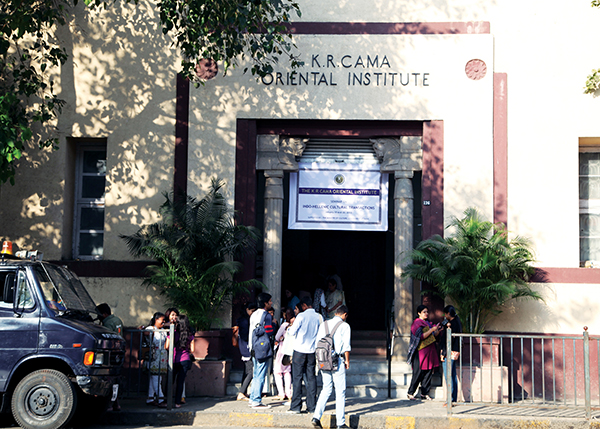
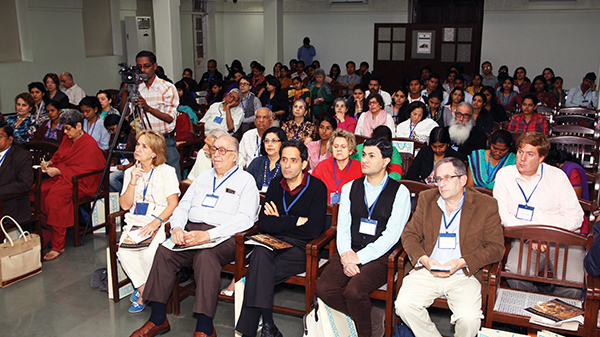
Above: the entrance; below: audience on first day
Plato and Sankara
Paneerselvam concluded the first session with his talk on ‘Greek and Indian thought with special reference to Plato and Sankara,’ (also known as Adi Shankara.) The head of the department of philosophy at the University of Madras specified the objective of his talk to "find out a suitable framework for a comparative study of two ancient philosophers.” Paneerselvam proceeded to define Hellenistic as the period "during which Greek culture became the common property of all Mediterranean countries.” Hellenistic differs from Hellenic in the fact that Hellenistic deals specifically with the language, literature and politics in Alexander’s time, while Hellenic deals with anything Greek.
Plato’s tripartite theory of the soul stipulates that the soul comprises the rational, spirited and appetitive (that which is responsible for the base desires of an individual). However, the three parts of the soul do not act independently of one another. Plato also states that every individual desires that which is good for him but does not know what constitutes this good. The Greek is concerned with the moral excellence appropriate to man. Both philosophers recommend the achievement of knowledge and concede to limitations to reach that knowledge. Sankara based his philosophy on the unity of atman (self) and brahman (whole) while making a distinction between appearance and the real world. Plato makes a distinction between body and soul, whilst Sankara distinguishes between ‘self’ and ‘non-self.’
Paneerselvam elucidated that Indian thought has a word for knowledge and for values but not for reason. In Greek thought reason or logos is central. The Hellenistic period witnessed philosophers who focused on reason rather than the quest for truth. He added that Indian thought questions how can consciousness know itself? He ended with the comment that in Greece reincarnation died out but in India it still exists. This may be linked to values and the absence of logos in Indian philosophy.
Dr Kanchan Mahadevan, associate professor with the department of philosophy at the University of Bombay chaired the session.
◆ ◆ ◆
From the archive