
Politics and Policy
Lend me your ears
The National Commission for Minorities Zoroastrian representative Dadi Mistry lobbies with the government against the advent of hawkers in the Mancherji Joshi Dadar Parsi Colony
The traffic was minimal so within seven minutes of leaving our office we reached the side gate of Mantralaya where the knowledgeable taxi driver dropped us. We wondered how we would pass the time till the meeting 23 minutes away. What we had not expected was having to secure passes to enter the Maharashtra state’s administrative complex. Our name, date of birth, mobile number and residential address had already been submitted thrice to the office of the Zoroastrian representative of the National Commission for Minorities (NCM) and we assumed we could now just walk in. No such luck. The constables stopped us. We explained we had an appointment with the labor minister but we still had to obtain a pass.
We phoned the local contact person in the labor ministry to enquire if a pass was required by us. He told us to await his representative at the "Garden gate” where we were standing. After a few minutes a pleasant, smiling person came up to us with a note in hand bearing our names as part of the delegation to meet Prakash Mehta, minister for housing, labor and mines. He then asked for our identification cards so he could obtain a pass on our behalf. One Parsiana representative had identification. The other could not locate a suitable photo identity document and had to reluctantly depart.
Once the pass was obtained (there was a sizable queue), we walked through the metal detector and were told to put the camera through the x-ray machine. A seated lady constable said in Hindi, "No cameras allowed.” We explained permission had been asked for and obtained (we really had), the lady confabulated with another constable and let the camera through. Accompanied by the assistant one entered the complex. Like most of Bombay, the ingress and egress road was being repaired/concretized so one walked cautiously permitting the cars right of way.
We phoned the local contact person in the labor ministry to enquire if a pass was required by us. He told us to await his representative at the "Garden gate” where we were standing. After a few minutes a pleasant, smiling person came up to us with a note in hand bearing our names as part of the delegation to meet Prakash Mehta, minister for housing, labor and mines. He then asked for our identification cards so he could obtain a pass on our behalf. One Parsiana representative had identification. The other could not locate a suitable photo identity document and had to reluctantly depart.
Once the pass was obtained (there was a sizable queue), we walked through the metal detector and were told to put the camera through the x-ray machine. A seated lady constable said in Hindi, "No cameras allowed.” We explained permission had been asked for and obtained (we really had), the lady confabulated with another constable and let the camera through. Accompanied by the assistant one entered the complex. Like most of Bombay, the ingress and egress road was being repaired/concretized so one walked cautiously permitting the cars right of way.
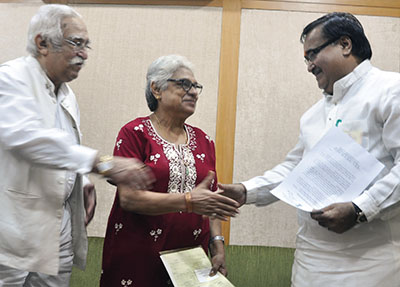
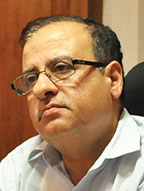
(L-R): Dadi Mistry, Katy Bhacca and labor minister Prakash Mehta; Municipal Commissioner Ajoy Mehta
The clock was ticking closer to the appointed time of 3.30 p.m. On the sixth floor we were directed to the minister’s closed door with a constable enquiring the purpose of the visit. The meeting with the minister, was the reply. The Parsiana representative was then directed to an adjacent, large, air conditioned conference room which was almost full with people sitting around a large table laden with several files, and others seated on chairs along the wall, none of whom looked like Parsis. In less than a minute realization dawned that this was not the meeting one was supposed to be attending.
On making fresh enquiries we were on the point of being shooed away when the word "Parsis” resonated with the constable and a personal assistant, and Parsiana was directed into a small room lined with three sofas on which were seated the Zoroastrian representative on the NCM, Dadi Mistry and his sister Katy Bhacca. There was no sign of the other invitees. Mistry had fixed meetings throughout May 12 and 13 with various government functionaries to voice the community’s concern about hawker zones being demarcated in the residential confines of the Mancherji Joshi Parsi Colony in Dadar (see "To protest and protect,” Parsiana, May 7, 2015).
Dressed in a spotless white kurta pyjama with some papers in his hand, the jovial minister warmly greeted the trio and asked for the purpose of the visit. Mistry explained about the impending hawker menace and Mehta said he knew nothing of it and would never allow it. "There is no question of any feriwalas (vendors) coming to the Parsi Colony.” Mistry said the subject had been written about in the newspapers. "Newspapers are all wrong. The papers say something. Can the sarkar (government) run” on that basis? He inquired which papers had written on the subject and instructed one of his several assistants standing in the cramped room to obtain the copies. He added that "I live in Ghatkopar and pass the Colony every day.” He recalled the late corporator Rustom Tirandaz and how the Bharatiya Janata Party had worked together under his leadership (Tirandaz was leader of the opposition in the Bombay Municipal Corporation for some time). "Yours is a most helpful community. It must remain as such,” added Mehta.
Mistry handed him some papers and inquired, "When can I meet you again?” The hard pressed for time minister replied, "No need to come. I will let you know.”
As the delegation stepped out of the seven-minute meeting, they espied World Zoroastrian Organisation Trust Funds managing trustee Dinshaw Tamboly, builder and chartered accountant Zarir Bhathena, Mancherji Edalji Joshi Memorial Trust chairman Dinyar Panthaki who had assumed that the meeting was yet to start. When Mistry told them the minister promised he would look into the matter they felt the meeting had served its purpose. They all good naturedly walked down the long corridor lined with rooms, filing cabinets and assorted furniture on either side, descended in the elevator and departed. Mistry kindly offered to drop the Parsiana representative at his office but first we had to locate the car in the maze of vehicles parked haphazardly all over the complex.
That evening at 5.45 p.m. Mistry was to meet the new Municipal Commissioner Ajoy Mehta who had occupied the office end April, and asked Parsiana to join him. Once again we emailed all the particulars in advance and accepted Mistry’s offer for a ride, knowing that entering the Municipal headquarters and locating the Commissioner would otherwise be an ordeal. A beacon on a car works wonders. So this time there was no problem. We entered from the main, front gate and were escorted to the correct floor and office.
We had to wait in an adjoining room where Bhathena also joined us. We entered the Commissioner’s spacious, high vaulted room and sat on some sofas for a few minutes before we were summoned to sit opposite him across a large wooden writing table. He turned down Mistry’s offering of sweets and suggested he offer them to the staff instead. Mistry informed him about the proposed hawking zones in the Dadar Parsi Colony and Mehta inquired, "How best can we support you?” He further said the hawking zones "had not been finalized. Let the experts” study the proposals. Then the public would be called to state their point of view. Every citizen "should have the right to a peaceful life,” the commissioner stated. Noting the citizens’ concerns will be "kept in mind,” he added, "We do not intend to create any inconvenience.”
In a few minutes the meeting was over and developer Boman Irani of Rustomjee builders was next in line to meet Mehta. We spied Silloo Billimoria in the corridor waiting for a meeting with the Commissioner. Though retired from the Bombay Municipal Corporation (BMC)’s legal department several years ago, her services have proved indispensable to the BMC’s top bureaucrats and she works a full day returning home at 7, 8 or 9 p.m. most days. Ever smiling and dressed in a sari, she chatted amiably with the visitors, noting that day "Sir had a lot of visitors” hence her meeting with him along with other BMC colleagues was delayed.
She, corporator Noshir Mehta and the statue of Sir Pherozeshah Mehta standing outside the Gothic building overlooking Dadabhai Naoroji Road are probably the last remnants of the Parsi presence in the once glorious BMC. But the corridors of power still continue to lend a sympathetic ear to this almost decimated community.
◆ ◆ ◆
From the archive