
Seminar
Trade and textiles
A seminar on Indian textiles at the K. R. Cama Oriental Institute weaves various threads together
Lectures on comparison of Roman and Indian drapery, different types and traditions of Indian weaves, textile holdings in Indian museums, and how trade was built or identified with textile presence were all knit together in K. R. Cama Oriental Institute’s (KRCOI) annual seminar on "Textiles, Collections, Communities, Culture and Trade.” Sir Jivanji Modi Hall of the 100-year Institute was well filled on January 9 and 10, 2016.
Drapery, textiles and weaves from around the globe
The first session of the first day, "Textiles, Clothing and Drapery” was split into drawing a parallel internationally and then tracing trends nationally. The paper on "Ikat and resist-dyed textiles found in Israel and originated in India,” dwelt on the discovery of these textiles in Nahal Omer (NO), Israel. The warp-like ikat technique, which was sighted at NO caves, had patterns of Indian origin, similar to those depicted in Ajanta cave paintings. All the retrieved samples from the caves exhibited the ikat technique of dyeing threads before weaving the pattern using blue, red and green colors. Dr Orit Shamir, currently curator of Organic Materials at the Israel Antiquities Authority in tandem with Alisa Baginski from the Bezalel Academy of Art, Jerusalem presented this joint paper. Shamir established that all textiles in the seventh century site of NO were found in one room, in a waste dump. She added, "It seems that ikats were status symbols because of the skill and time their production required.”
Romans considered luxury a vice, eulogizing Roman frugality of their ancestors. Silks were considered "barbaric, effeminate and luxurious,” especially if they came from the East and only "bad emperors” like Caligula and Nero (around 15-68 CE) ignored these Roman rules! Despite this disclosure, there is documented evidence of bejeweled Roman emperors, garments interspersed with gold and sapphires, emeralds, Red Sea pearls, amethysts and even green jasper. These privileged folk yearned for these luxuries to distinguish themselves from their peers as also to show wealth and their far-reaching connections. Dr Berit Hildebrandt from the University of Hanover, Germany placed evidence of India’s influence in the luxury market. She examined India’s contribution as a source of luxury goods — silk and stones — and questioned the belief that China was the sole provider of silk which was much in demand in the third century BCE.
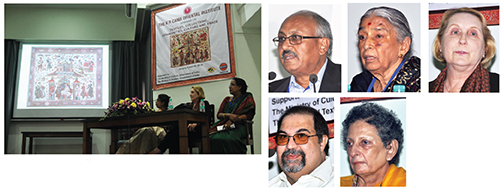
Clockwise from top left: the panel on "Collections;" Ishrat Alam; Dr Lotika Vardarajan;
Jenny Spancake; Dr Nawaz Mody; Muncherji Cama
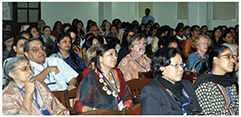
Part of the audience
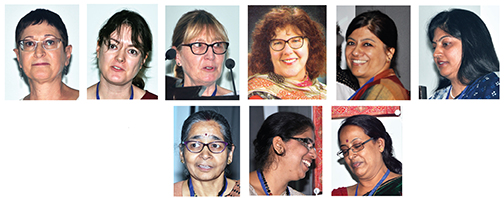
Clockwise from top left: Dr Orit Shamir; Dr Berit Hilderbrandt;
Dr Mary Harlow; Dr Sandra Lee Eveuson; Dr Sharmila Dua;
Toolika Gupta; Dr Nita Sen Gupta; Manisha Nene and Dr Anamika Pathak
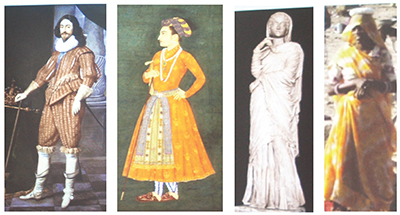
From the topic of silks, Dr Mary Harlow of the University of Leicester, UK, spun off on ‘Thinking Indian, Looking Roman.’ Seeing herself "as a Roman historian looking at dress,” and being closely associated as a member of the "European Dress ID” project, Harlow threaded commonalities between Roman clothing and Indian dress — both are woven on the loom, draped, wrapped around the body rather than tailored and both have centuries of history and adaptability. The scholar talked of the sari as "a garment with over 1,000 years of history, encompassing variables in pattern and weaves structure to enhance drape…” She disabused the audience of the myth about women who wear a sari being constricted in movement, citing heavy domestic chores accomplished while garbed in this attire. These perceptions, according to her are due to history being recorded by élite men, who have either depicted women as whores or idolized them.
"In the United States, Indian madras (IM) (cloth) was most closely associated with the ‘preppy’ look of wealthy, preparatory school-educated Americans and those aspiring to the ‘old money look,’” said Fulbright scholar Prof Sandra Lee Evenson of the University of Idaho, Moscow, USA. She revealed that IM was used as clothing and currency to trade on the coast of West Africa, being traded for gold as well as for slaves. African slaves were transported to the USA wearing IM as it was inexpensive cotton. Its availability was in checks or plaid, with borders in red, indigo, yellow, violet and green. The Kalabari tribe of southern Nigeria used IM as it became central to their ethnic identity as the primary Goddess of the Kalabari barred Africans from using fruits and flowers patterns.
Coming closer home, Dr Sharmila Dua spoke on the humble Ajrakh (Persian word for blue) block-printed textile from the Kutch, which has come into its own with the setting up of village Ajrakhpur after the devastating 2001 earthquake. The professor of the National Institute of Fashion Technology, Bombay, wove these facts together. To reclaim livelihood, the Indian government established a town to celebrate Ajrakh. However, artisans have been forced to adapt to customers’ taste leading to a loss of motif vocabulary of traditional patterns unique to each tribe. No more can an onlooker identify the marital status or community of the wearer, depriving Ajrakh of its original technique or ornamentation-block printing has given way to screen printing in favor of volume. Original Ajrakh displayed patterns on both sides of the cloth printed identically to make turbans, lungis, shoulder cloths, chadors and shawls. The material came to life with 16-17 processes. As the wearer grabbed the shawl on waking up, it always remained right side out as both sides had an identical print.
Toolika Gupta’s paper explored how the British frock coat influenced the sherwani. The independent researcher and consultant who is completing her PhD at the University of Glasgow specializes on the "Influence of British Rule on Elite Indian Menswear: The Birth of the Sherwani.” Gupta believes the high-neck, stand-up collar of British India army uniforms is the precursor to the sherwani. She attributes "Most of these changes are limited to the inclusion of buttons and pockets and the adoption of coats by the Bengalis and the Parsis.” She credits the sixth Nizam of Hyderabad with popularizing the sherwani at his investiture, emphatically denying that the sherwani is a descendant of Mughal wear. According to Gupta, the word comes from the city of Sherwan in Iran, from where the first designer probably hailed. She pointed out that another change of those times was wearing shoes and sitting on chairs!
Moderator and speaker Dr Lotika Vardarajan, beckoned B. B. Paul on stage as "having firsthand knowledge of all aspects of weaving in India and is trying to revive some beautiful fabrics.” Paul heads the Weavers’ Services Centre in Delhi and has vast experiential knowledge as he belongs to a weaving community in Bengal. "Despite India having 4.4 million artisans hardly anyone wants to pursue this profession anymore,” bemoaned Paul. He mentioned how the craft of double ikat, Pochampalli in Andhra and Jamdani from Benares are losing weavers as future generations do not opt for the traditional profession. The expert also narrated the plight of Mysore weavers who want to continue their craft but are ignorant about marketing. He revealed how women have battled to keep tradition alive but society has opted for cheaper mill cloth with dyes which pollute and are actually banned in some countries. Paul recommended that schools, colleges should introduce arts and craft as a subject as should Indian Management and Technology Institutes (IIMs and IITs) as threads have to be counted; patterns calculated; dyes regulated — which can be complex formulae.
The inaugural address was delivered by Prof Ishrat Alam of the Department of History, Aligarh Muslim University, who spoke of the textile trade in Gujarat and the Coromandel Coast. Cotton textiles from both boomed in the 1650s, due to a change in fashion and Europe’s increased purchasing power. Textile exports doubled in the years from 1681 to 1695. Holland used to import manufactured cloth from India which was then printed and dyed in Holland, ultimately leading to Holland having its own 4,000 looms.
Textiles that are defined as woven fabric or a type of cloth are "the most fragile heritage. A collection is a way of preserving the past for the future. Not easy to store, not easy to display,” said Jenny Spancake, who chaired the session on "Collections”, artifacts assembled from Indian museums from three metro cities — Bombay, Calcutta and Delhi.
Three spokeswomen of museums — Dr Anamika Pathak from the National Museum of New Delhi, Manisha Nene of the Prince of Wales Museum (POWM), Bombay and Dr Nita Sen Gupta from the Indian Museum, Calcutta concentrated on textile exhibits from their museums in the last session of the first day.’
The Jain Cloth Painting is the earliest textile in the National Museum, Delhi, though not on par with their other prized possessions such as the Dancing Girl from Harappa, the Sarnath Buddha Head and the Babarnama manuscript, Pathak informed us. The Delhi curator specified the learnings about communities, their culture and commerce from textile collections, saying, "Museums are known by their collections.” The Delhi museum has painted, woven and embroidered textiles of tribal and folk origin, Coptic and Central Asian textiles, etc, over and above collections that are block printed, yarn and dyed fabric, multi religious cloth samples, tents, cotton fabric, besides papyrus, parchment or papers, etc.
"Our lifestyle in the cities no longer accommodates textiles,” Nene stated. She then reeled off the possessions at the POWM initially established by the collection of art publisher Seth Purshottamdas Mavji. These artifacts were subsequently augmented by Sir Ratan Tata and then his brother Sir Dorab. Nene described the Tata gallery’s collection of costumes, drapes, carpets and bedspreads from India, Pakistan and Afghanistan as well as Kashmiri shawls. The POW also acquired printed textiles, odhanis (stoles), phulkari of Punjab (a style of embroidery) and carpets from the Sir J. J. School of Art.
POWM has a sizable collection of Parsi textiles — navjote coat, jhablas, Tanchoi saris and shoe pieces, garas, embroidered sari borders, sudrehs and phetas. The Museum is in possession of J. N. Tata’s (the founder of the Tata Empire) jhabla and topi of his naming ceremony on the sixth day after birth. POWM possesses poet Ardeshir Khabardar’s family’s garas and embroidered saris. Shirin Sabavala (wife of the late painter Jehangir), recently gifted a fine example of the Oriya ikat from Sambalpur with a rich pallu. Similarly, Nene mentioned a 10-yard sari "imaginatively combining the technique of ikat and jamdani weaving.”
Sen Gupta talked of the popularity of Indian textiles, especially in Europe. The art curator specified that muslin, chintz, calico, palampore and calmendar are all of Indian origin. Most of the Calcutta museum’s 5,500 textile collection comes from weavers directly or bought at international fairs and exhibitions. The museum is proud owner of varied sari weaves — jamdanis, brocades, Benarasis, armus, himrus, patolas, Balucharis from Murshidabad and kanthas of Bengal.
With the traditional, older participants were attired in Indian weaves — handloom saris, dupattas and salwar-kameez, a riot of colors and styles — a difficult task for youth to match in their ubiquitous jeans and tops.
Muncherji Cama, KRCOI president noted in his message in the brochure, "We are very grateful to Dr Varadarajan for her painstaking efforts and in preparing the theme paper and helping us locate the appropriate resource persons to present papers at the Seminar.” She is currently working on cataloging, the textile collection of the National Museum, New Delhi. In his welcome address Cama urged all, "to make better use of the library which has a treasure house of ancient books in Avestan, Pahlavi and Persian with books on oriental studies, comprising about 26,000 books, 2,000 manuscripts on a variety of subjects.” He lamented that more foreign scholars utilize the facilities than Indian ones.
The second day’s proceedings shall appear in a forthcoming issue of Parsiana.
◆ ◆ ◆
From the archive