
Seminar
From antiquity to anarchy: the growth of Bombay – V
Bombay’s current slide into chaos is documented in the valedictory speech of urban planner Shirish Patel
This is the fifth part of the story of the building of Bombay that emerged from the papers presented at the K. R. Cama Oriental Institute (KRCOI) seminar reflecting the ideas of town planning, the available techniques as well as the circumstances that necessitated construction activity. The report has been serialized by Parsiana in five parts. The first dealt with the legacy of the Portuguese and the needs of the early British colonists that led to the building of the Bombay Fort (September 21, 2010). The second installment dealt with the growth of the cotton mills on which the prosperity of the city was founded (October 21, 2010). The third installment discussed the laying out of the government buildings of South Bombay after the Fort walls were demolished and the role played by the major bureaucrats and architects in the definitive style of development (November 7, 2010). The fourth part described the advent of the Indo-Saracenic style as British scholars imbibed and disseminated Indian art and architecture and later, with changing technologies, the Art Deco buildings such as those that face the Gothic structures across the Oval Maidan (December 7, 2010).
The seminar had examined the growth of Bombay in five sessions. "Ancient to Urban — from islands and backwaters to a port city (until 1660)” had Dr Rashmi Poddar, associate editor of Marg Publications in the chair. Prof Anita Rane-Kothare, head of the department of Ancient Indian Culture at Bombay’s St Xavier’s College, set the ball rolling by her paper on Magathane caves whose location near the Western Express Highway in Borivali East (in current terms) made them centers of economic and religious activities on an important pilgrim cum trade route in the medieval period. Dr Vaishali Welankar, curator of the Bhau Daji Lad Museum, focused on the nature and spread of Shaivism in Bombay, referring to the centers of Shiva worship like Elephanta, Walkeshwar, Babulnath, etc while Agnes de Sa described the Portuguese Legacy.
"Company Bombay — Its Ports and Walls (1660-1860)” had four speakers chaired by Dr M. D. David. Prof Aban Sethna’s topic was the Bombay Fort and Esplanade — a socio-political profile, followed by Dr Rekha Ranade on the Making of Modern Bombay — a dream accomplished, while Dr Mariam Dossal focused on Henry Conybeare.
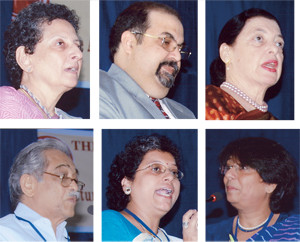
L to R (clockwise): Dr Nawaz Mody, Muncherji Cama, Homai Modi, Dr Rashmi Poddar, Anita Rane-Kothare and Shirish Patel
"Bombay After The Walls Come Down — The Public Buildings (1860-1920)” had the president of the Asiatic Society of Bombay Dr Aroon Tikekar in the chair while Dr Christopher London spoke about Bombay Gothic: The Growth of Bombay City in the 19th century; Tasneem Mehta on the Politics of Aesthetics and the Development of 19th Century Art Institutions; Vikas Dilawari on Indo Saracenic in Bombay — the revival of a style or the creation of a new one; and Shehernaz Nalwalla, lecturer in philosophy at the Wilson College, on the Growth of Educational Institutes in 19th Century Bombay.
Dr R. N. Sharma, professor at the Center for Development Studies of the Tata Institute of Social Sciences, chaired the session titled "An Emerging Modernity: the People’s City (1920-1947)” which had author and doctoral student Kaiwan Mehta’s paper on Clusters and Communities — The Architectural Patterns in Colonial Bombay’s ‘Native Town’ presented by Prateek Bannerjee; teacher Neera Adarkar’s presentation on Chawls, Chimneys and Chalwals: Making of the Social and Political Fabric of Girangaon; and Prof Mustansir Dalvi’s This New Architecture: Contemporary Voices in Bombay’s Architectural Development in the 1930s.
"Contemporary Mumbai: Bombay and its many absences (1947 and beyond)” with speakers Rajiv Mishra, architect and urban planner and principal in-charge of the Sir J. J. College of Architecture addressing Planning and Policies Post Independence — the Making of Mumbai; and a combined presentation, Diversity of Built Forms and User-Generated Habitats in Contemporary Mumbai from teacher and writer Rahul Srivastava and urban planning researcher Matias Sendoa Echanove, an expatriate from Switzerland. The session was chaired by environmental journalist Darryl D’Monte.
KRCOI president Muncherji Cama had a special word of thanks for joint honorary secretary Dr Nawaz Mody and Mishra who as member of the governing body of the Institute had conceived and executed the project.
The valedictory address of urban planner Shirish Patel, whose civil engineering firm Shirish Patel and Associates is one of the leaders in the field, brought the two-day seminar to a close. Speaking on how Bombay’s architecture will reflect the changing society and its changing values, Patel began by referring to the change of name to Mumbai: "A tell-tale sign of the creeping parochialism that wants to change the cosmopolitan character of the city.”
Explaining the enormous pressure on maximizing the use of land in Bombay, Patel noted, "When the economic reforms of the early 1990s made smuggling no longer viable, the mafia turned its attention among other things to real estate… This land mafia is well aware that there is far more money to be made, and much more easily made, out of scarcities and upward spiraling prices than can be made from normal developers’ profits. So, in deference to the wishes of this land mafia we have what I believe is a deliberate policy on the part of our political leaders to keep land in Bombay in short supply.”
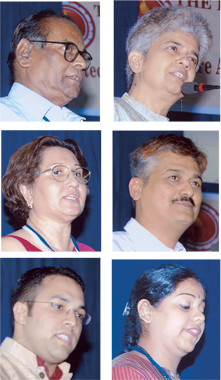
Clockwise from top left: Dr Aroon Tikekar, Neera Adarkar, Rajiv Mishra, Shishti Iyer, Prateek Bannerjee and Shehernaz Nalwalla
To shore up his argument Patel cited the continued existence of the salt pans ("Is Bombay, with its land shortages, the place to make salt, of all things?”), the suspended animation of the Sewri-Nhava Sheva Sea Link which promised to open large areas of the mainland for the city’s growth ("Are we seriously to believe the government when it tells us it could find no bidders for this Rs 6,000 crore project?... Or could it be that the terms of the tender are set in such a way that no one dares take the risk of tendering?”), and the previous chief minister’s (CM) decision to reserve large tracts of land for mangroves ("I find it hard to believe that the previous CM was really interested in mangroves as such. Much more likely, to my mind, is that he seized on this as yet another way of keeping land in the city in short supply, with the added bonus of having made a grand environmental gesture.”)
The result of this land shortage, Patel argued, is that no matter how grand a building is added to the city in future, there will be no urban vista from which to view it. Also, there will be no more public buildings like the Rajabai Tower, public library or museum in the foreseeable future: "Philanthropy on a grand scale is not part of our current cultural makeup.”
Speaking of the way building regulations affect the appearance of a city, Patel referred to medieval Paris transformed by Baron George Eugene Haussmann. There buildings are required to be constructed from one side boundary of one’s property to another, joining up with the neighboring buildings. There can be no side windows. If a neighbor chooses not to build, there will be a large blank wall on that side. Also the floors have to be precisely aligned with that of the neighbors, all being built to the specified levels. "This is what gives the streetscape its ordered urban quality,” noted Patel. Similarly, New York’s streetscape is characterized by the steel fire escape stairs which are a part of its building regulations.
Two Bombay areas Patel cited with approval were Marine Drive and Ballard Estate. In the former all buildings were required to conform to a uniform height and be more or less of the same size with the facades of the buildings aligning and an identical gap between them. In the latter, the buildings were required to be built to a specified front line opening directly on the footpath with no front compound or open spaces. "This gives a certain élan, a pleasing disciplinarity to the district which is missing when you have individual compounds with front and side open spaces filled with parked cars… We could have had such building regulations in our newer areas if we so wanted. The Bandra-Kurla Complex is a glaring example of a lost opportunity in this regard,” noted Patel ruing that there are no urban designers among the bureaucrats who make such rules, nor is there any interest in architectural outcomes. "Our central problem is that the leadership of the city is in the hands of politicians who have no long-term interest in it.”
Patel did not spare the architect fraternity either, noting that "design is always the result of a series of compromises between conflicting demands. The more elegantly these conflicts are resolved the better the design,” he added. "Unfortunately today’s architects seem to have lost this understanding, and their value system now prizes not a well-functioning building that serves the client’s needs in an excellent way, but primarily weirdness and the pursuit of random notions of aesthetics… If… sticking out like a sore thumb is the norm, then a collection of sore thumbs will produce a disfigured and distorted cityscape.”
The urban designer also pointed out that India’s cities were much older than America’s, closer in their layout to European cities. "We cannot accommodate motor cars in the way Los Angeles can.” We need to follow the European towns with their emphasis on public transport and pederstrianization rather than the limitless addition of motor cars, he noted. "Better still, evolve an Asian model of a city that is centered on pedestrians first, with the focus on the pedestrian’s perspective of the city.”
Hoping that all is not lost and that some building control rules may be evolved to "impose a minimal order on the developing streetscape,” Patel concluded by wishing for an "urban leadership with vision and long-term commitment… I leave it to you to think through how such a change can be brought about.”
Concluded
◆ ◆ ◆
From the archive