
Environment
Vulture culture
There is good news on conservation of vulture populations in Maharashtra and Madhya Pradesh
After years of reports of dwindling populations of vultures in India, "the number of ... (certain species of vultures has gone) up over the last three years,” state forest officials at a conservation center at Srivardhan, a picturesque coastal town 200 km from Bombay. A report in The Times of India, April 27, 2015 goes on to state that "about 110 of the birds fly in and out of nearly 30 nests perched atop palm trees.” The report quotes Deepak Sawant, assistant conservator of forests at Roha Range stating "a few NGOs (nongovernmental organizations) and bird experts are helping in this drive to increase vulture numbers.” There has been a drastic drop in vulture numbers all over India for almost 20 years largely due to the pain reliever diclofenac administered to cattle. When the vultures eat the carcasses of such animals diclofenac enters the blood stream causing deaths due to renal failure. The drug has been banned for veterinary use by the government of India but is still used surreptitiously. This trend is reversing, at least at two locations in India.
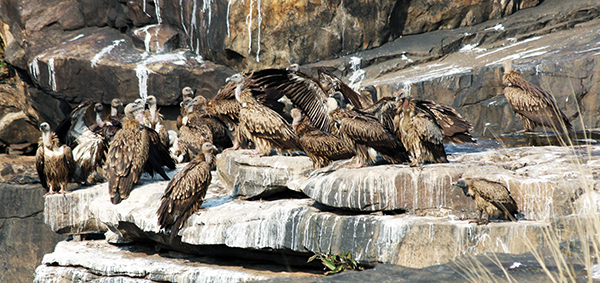
A committee of vultures at Panna
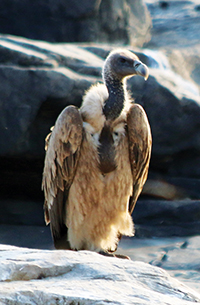
Long billed vulture
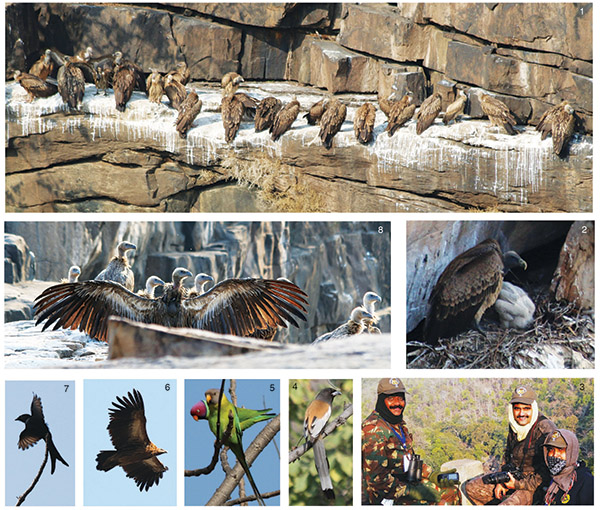
1) A committee of vultures on a mountain ledge at Panna; 2) a lonesome bird;
3) Nand Kishore Rajput (center) and co-volunteers at Panna;
4, 5 & 7) other bird species at Panna; 6 & 8) griffons
Nand Kishore Rajput, a media marketing professional from Bombay who completed a Bombay Natural History Society (BNHS) course in ornithology and leadership in bio-diversity conservation, was recently involved in a unique exercise in estimating vulture population. "My story begins on the day I got an invitation from the forest authorities of the Panna Tiger Reserve (PTR) in Madhya Pradesh, India to participate in the vulture estimation program for 2015,” he says. This yearly program of vulture estimation started in 2010 as a crude exercise, but since 2011 the authorities have invited volunteers for the exercise from all over the country. "The vulture population estimation is now done on a true public-private participation model,” mentions this professional with 20 years of experience in handling marketing and sales of advertising space in various newspapers, television channels and radio.
Of the nine vulture species found in the country — Oriental White-backed, Long billed, Egyptian, Griffon (Himalayan and Eurasian species), Cinereous, Slender billed, Red headed (also called Asian King or Indian Black) and Bearded Vulture or Lammergeier, the first six have been noticed in PTR in previous years, reveals this enthusiast.
The survey was conducted between February 5 and 8 this year. Narrating his experiences, Rajput states that the first day was spent in a briefing and the 80 selected participants from 13 states were divided into teams of three each. Each team was accompanied by a local guide or shramik and was given a select area within the park for the census. "After the briefing at Camp Hinota, the teams dispersed to their allocated sites inside the reserve. We were pleasantly surprised and excited when my team reached Dhundhwa site inside the jungle late in the evening. Our accommodation was inside the watch tower at the site. The chilly climate made us shiver,” he reminisces. With no electricity and mobile signals, they were cut off from the world, except that the guides were connected via wireless to the base camp of Hinota.
The Dhundhwa Ghat site is a large U shaped cliff, states Rajput avidly, who was on his second trip to PTR. "When we reached the site our first view was of scores of vultures between the rocks and cuts of the cliff.” After marking the site with a Global Positioning System (GPS), the team counted the vultures and identified the species. He had the opportunity of seeing "many of our vulture friends basking in the sun atop the cliff at a distance of just 50 m,” he mentions. "We took care to not to frighten them and walked around them to other points of observation. Then suddenly we saw our predator, the Peregrine falcon, which is a known threat to the vultures, as they feed on their eggs and chicks. He was photographed and noted in our observation sheet,” he states.
As the exercise came to an end, Rajput’s team concluded the count at Dhundhwa Ghat to be around 125 vultures, a mix of Long billed, Eurasian and Himalayan Griffons with a couple of Egyptians and one King vulture.
Finally, all the teams congregated at Camp Hinota and after pooling all data and its analysis, concluded that there were a total of 1,676 vultures at PTR of which 1,268 were ‘residential,’ 284 ‘migratory’ and 124 ‘unidentified,’ along with 17 Peregrine falcons. The current number of 1,676 marks an increase over the 893 counted in 2014 and 1,347 counted in 2013. The drop in number in 2014 he ascribes to climatic changes. Rajput explains, "Eurasian Griffon, Himalayan Griffon and Cinerous are migratory species who come to India from places north at the start of the winter months and stay till the end of March or the first week of April.”
Rajput says, "The analysis showed there is good increase in the population of the vultures at Panna, especially the Long billed variety; the worrying factor was the diminished count of White-backed vultures. As the White-backs make their nest after February, another study during summer would be required.”
He is happy at the less frequent use of diclofenac by locals in and around Panna, despite being part of the backward Bundelkhand region. He cautions, however, that awareness programs must continuously be carried out for veterinary centers, pharmacists and locals.
He concludes that the PTR is one of the best places to have a secured habitat for highly endangered vultures. "The park may be the most important nesting site for the thriving endangered vultures of India.”
◆ ◆ ◆
One reader wrote
Very interesting. Wish something could be done to increase the number of vultures in Mumbai.
From the archive