
Environment
Vulture venture to take flight? – II
The proposed aviary at Doongerwadi is a project fraught with pitfalls of which the community should be made aware
There are many inherent dangers in the Doongerwadi Vulture Recovery Project which the Bombay Parsi Punchayet (BPP) has not placed before the community. Since the Project would cost the community Rs 25 crores (US $ 4,545,454) over 15 years I thought it my duty to make public important shortfalls of this Project.
Two authorities on vulture conservation, Prof Rhys Green of the University of Cambridge, UK and Dr Richard Cuthbert, principal conservation scientist, Royal Society for Protection of Birds, UK, were present at the symposium on vulture conservation at New Delhi on May 3 and 4, 2012, and many of my observations are from their research papers.
Green and others have stated that an insignificant amount of diclofenac, just 0.004-0.16 ug g in a cadaver, is enough to kill vultures. Besides, there being 1,051 combinations of diclofenac, other drugs also cause vulture mortality. In addition to the drugs there are several other fatal infections the vultures are susceptible to such as infectious bronchitis, avian renal disease, West Nile virus, liver cirrhosis, chronic granulomas, amyloidosis, muscular digeneration and avian influenza.
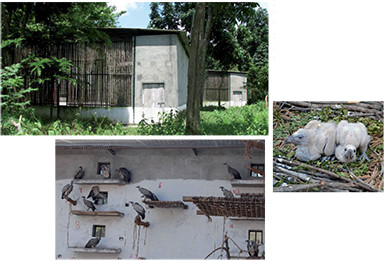
(Top) A BNHS vulture breeding center; (bottom left) enclosure; (above) Vulture chicks
The BPP would sign a memorandum of understanding for this Project, in which the government, the Bombay Natural History Society (BNHS), the Central Zoo Authority, the Maharashtra Forest Department and the International Union for Conservation of Nature (IUCN) would be stakeholders. The BNHS would be responsible for the overall implementation of the Project, provide the necessary expertise for project management and coordinate with the Government of Maharashtra and the BPP.
The Project proposal states that "as with any scientific experiment, there can never be any absolute guarantee of success, but provided the use of diclofenac by Parsis consigned to the Towers of Silence is eliminated completely, there is a good chance that the Project will succeed.” This is tantamount to admitting that there is absolutely no guarantee that the Project would succeed.
Aban Kabraji, regional director of Asia, representing the International Union for Conservation of Nature, in her letter to BPP chairman Dinshaw Mehta dated July 29, 2012 states, "Does this project come with risks? Of course — as does any experiment, particularly one that invloves wildlife...”
This will be the first time an experiment to breed vultures consuming human flesh in an aviary will be conducted at Doongerwadi. What is the guarantee that other partners including the government, would not demand the premises being used for other types of experiments in the future?
The first dakhma to be built at Doongerwadi in 1672 was the Hirji-Vatcha Modi dakhma. For the first time in 340 years other agencies, including the government, would obtain a foothold on our sacred property. By entering into a ‘partnership’ with other agencies, we are certainly endangering this valuable property handed down to us by our ancestors. The present BPP trustees who may take this precarious step would not be there after 15 years. Who will take on the responsibility, facing insurmountable problems, to save our property then?
The Project proposal states that "BNHS is also very interested in preserving Bombay’s fast vanishing forest (and) cover and the biodiversity present at Doongerwadi which is a very old forest (and) is certainly worth protecting.” Hence, it will not only be personnel attending to the vulture Program but also other specialists/botanists interested in the forest and biodiversity at Doongerwadi who will have access to our property. There would also be a Technical Advisory Committee (TAC) composed of eight agencies responsible for technical oversight and monitoring of this Project.
With the functioning of these multiple agencies, the sanctity of this ‘sacred grove’ preserved for centuries will certainly be violated. For many in the community, Doongerwadi has a very special significance as it has been the resting place of their near and dear ones. Do the BPP trustees have the right to disregard and trample on their sentiments?
Seven High Priests of India have made a public statement opposing the move to provide meat of any kind either inside or outside the dakhmas, the Project proposal provides for chopped up goat meat to be fed, if required, to the birds. Does our religion permit the slaughter of innocent animals to feed vultures?
Moreover, our High Priests have always maintained that dakhmas should never be covered from the top. Despite this, for the first time there will be a ‘netlon’ netting over the dakhma, thus restricting sunlight.
Parsis would be required to carry a list of 1,051 combinations of diclofenac and other drugs known to kill vultures. Relatives of the deceased would be required to make a declaration that three days prior to death, diclofenac was not given to the patient. The corpse would be tested at Doongerwadi to see whether it contains deposits of the drug. Who can predetermine when a patient will die? What happens in case of sudden death or accident? Does the BPP intend to inform all Parsi and non-Parsi doctors in all hospitals in Bombay as to what drugs should be administered to Parsi patients? Would relatives of the deceased permit tests on their loved ones?
The BPP should convince the community on how it proposes to overcome the various inherent dangers of this project. Providing a rosy projection to the community without revealing the serious problems would be improper. An open debate on this Rs 25 crore enterprise would be in order. In my opinion, this is a precarious venture fraught with danger. Taking into consideration the above factors, the chances of the project succeeding are extremely slim.
Founder president of the World Zarathushti Cultural Foundation and a scholar of Zoroastrianism, Dr Homi Dhalla has represented the community at various international conferences and interfaith meets. Among the community projects he is involved in are the conservation of Bahrot caves, the Sanjan excavation, documentation of Parsi history and the introduction of solar concentrators at Bombay’s Doongerwadi.
◆ ◆ ◆
From the archive