
Comment
Vital to the vultures
If the total ban on diclofenac is implemented, there is a possibility of their numbers recovering
The appearance of the Eurasian griffon vultures in large numbers in Rajasthan in February 2006 was good news for the vulture culture enthusiasts among the Parsis. Unfortunately, this is not the case says Prof Rhys E. Green of the Department of Zoology at the University of Cambridge, UK. The Eurasian griffon vultures that were observed in Rajasthan were mostly immature birds on a migratory path from Central Asia, Mongolia, and Tibet. In Tibet the smaller griffon vulture comes to the aid of those Buddhists who choose the ‘sky burial’ for their departed, i.e. exposure of the body on a flat rock on top of a hill. The body is hacked to pieces to accommodate the smaller birds who perform their scavenging function rapidly and efficiently, so that at the end of the day the task is finished. I have witnessed first-hand, from afar, such a disposal of the dead in Lhasa, Tibet, in 1993.
The Eurasian griffon vultures are merely visitors to the lower altitudes since they always return to Central Asia to breed and lay their eggs. They are no doubt attracted to the lower altitudes by the abundance of carcasses of livestock that are left uneaten since the almost total demise of the three resident species of vultures in South Asia.
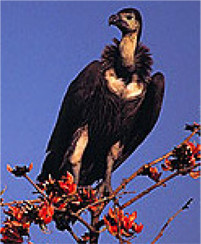
In India, we had three species of vultures which were endemic to South Asia, viz the oriental white-backed vulture, the long-billed vulture and the slender-billed vulture. Their numbers have declined to less than three percent of what they were only about a decade ago! And the decline continues. In fact, there is now substantial scientific evidence that the cause of the decline of vultures in South Asia is the widespread use of the veterinary drug diclofenac that is also widely used in human medicine. The vultures ingest this drug when they feed on human corpses, carcasses of cows or water buffalos that have been treated with the drug.
The Eurasian griffon vulture is as susceptible to diclofenac as its three South Asian cousins and hence before long even they will be affected. The drug causes kidney failure in the vultures, making them sick and droopy, till they die within weeks after ingestion. However, till now their decline has not been observed since it is very difficult to monitor the flocks of these birds, and those that die in India are replaced by new flocks arriving from Central Asia. Ultimately, the numbers in Central Asia are expected to fall.
In March 2005 the Prime Minister of India, Dr Manmohan Singh, announced a total ban on the veterinary use of the drug diclofenac. Recently, there have been published findings on the safe use of the alternative drug meloxicam that can possibly save the griffon as well as the three South Asian species of vultures. The studies are in their initial stages as the vultures used in the experiments were captive but not captive bred. Seventy-two birds were involved in the experiment out of which 66 were given meloxicam directly whereas six birds were allowed to feast on cattle carcasses that had been administered the alternate drug. The results are promising as the birds have not yet shown any symptoms of kidney failure. Nevertheless, how long will it take for the vulture populations to rebound to the levels a decade or more ago remains anybody’s guess.
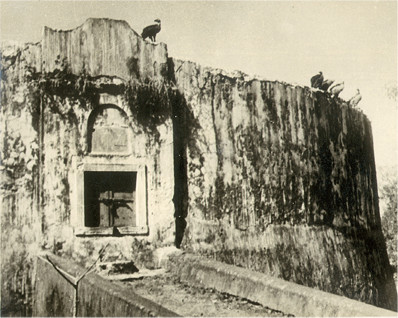
Top: The Indian vulture Above: Vultures atop a dakhma wall
Knowing that this question is of the utmost importance in the minds of orthodox Parsis, I asked Prof Green if the vulture populations will rebound in South Asia in the near future. He replied: "If diclofenac is banned as effectively as the Government of India can practically achieve, it will still be quite some time before the environment is sufficiently free of it to allow any remaining viable vulture populations to increase and begin to recolonize lost ground. The drug is also widely used in human medicine and I suspect that some of this will be diverted for use on livestock for a while. Because vulture populations are declining by 20 to 50 percent per year, I think we can expect lower populations than now and local extinctions, even with a ban, in the medium term (say within five-10 years).
"If there are still substantial populations (say more than 30 breeding pairs) left in five to ten years in some regions when (if) the ban is fully implemented then I think that vulture numbers can recover. Recovery programs for other Gyps vultures and for species with similar life history, such as eagles and condors, indicate that the rate of increase, and hence recolonization, will be slow — maybe five percent growth per year is the maximum you would expect.
"There are large tracts of India and Pakistan where there are no breeding vultures left at all. Reintroduction from captive stocks may help there. There will probably be less food around for them in future than in the 1990s because some people are disposing of animal carcasses by burying them now. This is to remove the nuisance of uneaten flesh that vultures used to eat and the dogs that this food supply attracts. However, surveys show that there is still a substantial amount of carrion potentially available. For these reasons, I do not think that there will be tens of millions of vultures in India and Pakistan again within the next 50 years, or maybe ever. However, if conservation efforts go well there might be hundreds of thousands of vultures and the former breeding range might be more or less fully occupied. But first we need diclofenac to be totally removed from use in humans and livestock.”

Associate research geneticist at the University of California, Dr Ardeshir B. Damania’s area of interest includes biodiversity conservation issues, early agriculture, crop domestication and plants of economic and medicinal values. His early career was with the Food and Agriculture Organization of the United Nations and he subsequently worked with the International Center for Agricultural Research in the Dry Areas.
◆ ◆ ◆
From the archive