
Tradition
Taking wings
The aviary project for breeding vultures is once again on the anvil
Does the aviary come first or do the vultures? Do the government permissions come first or the funds? Do the vultures come first or the keepers? Even as these queries remain unanswered, concerted efforts are being made by Bombay Parsi Punchayet (BPP) trustee Maneck Engineer, executive committee member of the Bombay Natural History Society (BNHS) and member of the Doongerwadi Advisory Committee Rishad Naoroji and Zoroastrian Studies (ZS) founder Khojeste Mistree to strengthen the traditional dakhmenashini method of disposing the dead.
Following the absence of vultures at Bombay’s Doongerwadi and the consequent putrefaction of corpses and pugnacious stench for those residing in the vicinity, the BPP installed solar concentrators which initially had teething problems. The proposed aviary where vultures will be bred in captivity could reestablish dakhmenashini as the most environment-friendly, economical and hygienic way of disposing the dead only if...
Their first priority is to find Parsi trainers and caretakers, says Engineer. They must be people with "a vision and love for birds of prey,” adds Mistree. These keepers will be trained at Jemima Parry-Jones’ Birds of Prey Sanctuary in Gloucestershire where they will have to undergo a six-month training program.
"The captive vultures would need to have some veterinary monitoring to ensure their health. Because of the severe drop in vulture numbers and because adult birds are difficult to train and habituate to captivity and management regimes, young birds are preferable for this project. They would also give the Parsis more time to understand the maintenance and welfare of the vultures before having to learn about captive breeding techniques,” Parry-Jones together with Todd Katzner had reported at the fourth Eurasian Congress on Raptors, Sevilla, Span in September 2001.
Recently elected trustee Engineer’s role is to coordinate and design an aviary for the up-and-coming Vulture Project at the Doongerwadi complex. "The aviary netting around the dakhma will be approximately 120 m (394 ft) length, 80 m (262 ft) width and 25 m (82 ft) height from the center (i.e. approximately the height of a six-storied building), covering the crown of the existing trees in the area of about 2.5 acres,” says Engineer. "The area is huge enough for the vultures to be able to fly comfortably and live a natural life. According to some experts, a pair of vultures when brought up in an aviary can easily stay in an area of 100 cubic meters.”
It is important to use a strong wire mesh for aviaries: 50 mm (2 inch) diameter mesh with 2.3 mm (1 inch) wire thickness lasts a long time, say experts. The mesh, if embedded into concrete, rusts within a few years. Instead one can attach the bottom parts of the mesh to angle iron cross beams that can be connected to the uprights. Again, strong steel channels for the uprights (10 mm x 50 mm x 5 mm) and strong channel for the overhead beams (75 mm x 38 mm x 4 mm) need to be used. Perches within 1.5 m of the mesh need to be avoided as vultures’ faeces can destroy the mesh in a short period of time. Also, a shade cloth (50 percent green) can be draped over the roof of the aviary at three-meter intervals to provide shade.
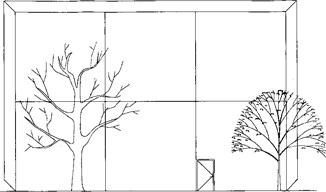
Sketch of proposed aviary
Some are of the opinion that vultures would not be leading a completely natural life if they do not soar long distances. Also, some other infection may affect these scavengers whose natural urge to fly would be curtailed. With his expertise in birds of prey, Naoroji puts these apprehensions to rest: "Vultures travel large distances, but only for food. Not otherwise. They can go up to 250 km for foraging. That has no bearing on captivity because they will be getting food in the aviary. They can fly horizontally and hop around from one tree to another tree. They will expend more energy by flapping and hopping than soaring and gliding as they do in the wild. They will get their exercise this way in shorter time. Besides, vultures, just like other animals, have been kept in captivity in other parts of the world as well (Europe, USA, South Africa), and nothing has affected them. Although it may seem unnatural, they do have the capacity to adjust in large enclosures.”
Although the original idea was to have 90 to 100 vultures, Engineer opines: "I feel that we should have a small aviary, of approximately 30 m in length, 30 m in breadth and 20 m in height, with only 10 or 15 pairs of juvenile vultures and get acquainted with the day-to-day maintenance.” Vultures can be trained like pets. They can be released by the keepers to fly into the dakhma, have their fill and then fly back outside the dakhma, to their aviary, which is planned to be built near the Bisney dakhma. "After at least a year or so, once we are sure that we are doing things the right way, we should take up the entire project.” Mistree is said to be resigned to Engineer’s idea though he thinks that this experimental route will take another three years or so.
Earlier, the Central Government "gave permission to the BPP to use foreign expertise in the breeding of vultures with the clause that the trustees of the BPP had to revert to the Centre after the aviary was built in order to seek permission to get vultures thereafter,” noted Mistree. Some of the trustees of the BPP were not favorably disposed and so wanted guarantees that the vultures will be available once the aviary was built. Permission was granted to take 20 pairs of vultures from the wild.
Thereafter timely decisions were not taken and considerable amount of time lapsed. But this time Naoroji says, "We shall first build an aviary. Then we shall procure permissions and look for vultures. We would prefer the White-backed vulture, but this vulture has been affected the most in drastic numbers. The Indian Long-billed has also decreased sharply, but not as drastically as the White-backed. So we may take a few White-backed supplemented by a few Indian Long-billed depending on the vultures’ status. I shall invite the top brass of the Maharashtra Forest Department and the Zoo Authority of India to come and have a look at the cages so that they are satisfied with the cages and the quality of the work done before I apply for permission. The Zoo Authority of India and the Environment Ministry in Delhi have been very helpful in the past and I am sure they will be again.”
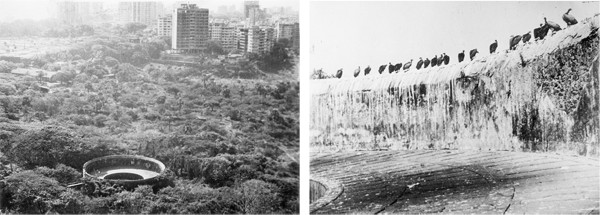
Dakhma with Bombay city skyline in the background (circa 1973) Vultures on mofussil dakhma (circa 1960s)
Human bodies are pumped with antibiotics and are full of chemicals. Will the vultures touch the dead bodies? Will they like to eat what they are dished out? In Bombay pollution levels (carbon monoxide) are so high! Pollution affects our skin, our faculties, our lungs, our brain. How practical is this project going to be when vultures throughout south east Asia are known to be suffering from the Drooping Neck Syndrome believed to be caused by a virus which results in their early death? Besides, what will prevent the virus from attacking the vultures again? If scientists have not yet determined a cure for the virus, then how feasible is this project going to be? These are just a few questions that come to mind. Answers Naoroji: "Generally, there have been no observations where large scale deaths of vultures have occurred after feeding on carcasses. The mortality has been sporadic and widespread. Vultures are tough birds. They have the capacity to digest food pumped with antibiotics without any problems. They are quite capable of clearing up carcasses that are even in advanced stages of putrefaction. In fact vultures prevent proliferation of various harmful germs and flies that cause serious diseases and epidemics directly or indirectly. Any way, we have decided to quarantine the birds, for which there will be separate cages, and then release them in the aviary thereby ensuring that we release healthy birds. Even when we initially come up with a pilot project, a relatively small aviary, we will still have separate cages to quarantine the birds and monitor their health before releasing them. Indeed nobody knows much about the virus as yet. Therefore this project will be useful from the conservation point of view, as it will also contribute to scientific research. Keeping the vultures at Doongerwadi will be similar to keeping them in any holding capacity and observing them. Of course, I would definitely like to invite some foreign vets and experts to continue studies on our vultures also. Thus we will keep abreast with all latest developments.”
The initial investment, according to Engineer, would be "at least Rs 1.5 crores. The annual expenditure then may be approximately Rs 35 lakhs.” Donations will have to come from within the Parsi community although Naoroji is confident about procuring financial aid for this project from various foreign agencies, especially foreign non-governmental organizations, for breeding these birds of prey from a conservation angle.
The argument of spending money for the living rather than the dead, according to Mistree, is a misnomer. "The Zoroastrian religion cannot be bargained with. We have to safeguard what is precious to us. The idea behind the vulture project also is to safeguard and strengthen the age-old mode of disposal of the dead, and not throw out the baby along with the bath water. The vulture project is not just any ordinary project. It is God’s work. We have to be agents of Ahura Mazda and help make this project a success.”
As Parry-Jones concluded in the report at the Eurasian Congress on Raptors, "The theological and religious needs of the Parsis often make approaching this project difficult. Nevertheless I have always ensured that they understand that our main interest is in the conservation of the vultures first and foremost. We believe that this project could play an important role in assisting the Royal Society for the Protection of Birds, the Institute of Zoology, the BNHS and the National Birds of Prey Centre in their conservation efforts. In particular, we hope to allow monitoring and studies of the Parsi captive vulture population and the captive breeding program for research into the management of large captive vulture populations. This program will be most successful if all parties involved are able to work together, providing support and sharing information towards the greater goal of conserving vultures in India for the future.”
◆ ◆ ◆
From the archive