
Politics and Policy
Vulture venture to take flight?
An ambitious program to return the vultures to Doongerwadi is being keenly debated
Will the vultures once again soar above Bombay’s Doongerwadi in the near future? Not likely. They may sooner flutter in an aviary or two built around the Towers of Silence. In an audacious attempt to entice the winged scavengers to devour Parsi corpses, the Bombay Parsi Punchayet (BPP) is contemplating initiating the Doongerwadi Vulture Recovery Project (DVRP) in conjunction with the Bombay Natural History Society (BNHS) and with technical assistance from the Wildlife Institute of India (WII), the Central Zoo Authority and the International Union for Conservation of Nature (IUCN).
"In principle the BPP trustees have given their approval,” said BPP chairman Dinshaw Mehta at a Press briefing to a section of the Parsi media on the afternoon of July 19, 2012, at the BNHS offices. Others addressing the Press were BNHS president Homi Khusrokhan, IUCN Asia regional director Aban Kabraji and WII director P. R. Sinha. The Press meet followed discussions held that morning between the various agencies, the trustees of the BPP and the Doongerwadi Advisory Committee (DAC) members. Mehta admitted there were "certain glitches,” in the program and that the BPP "didn’t want the government to (intrude) onto Doongerwadi land.”
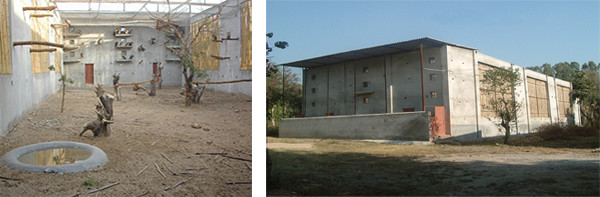
Aviary colony and vultures nesting (above): Safety of vultures will be foremost
Photos courtesy: Bombay Natural History Society (BNHS)
The matter would also have to be discussed by the DAC at their next meeting before a green light could be given, said Mehta. And a samast anjuman meeting is also on the cards to acquaint the community with the plans. But BPP trustee Muncherji Cama asserts, "The aviary project has never been on the agenda for a board meeting discussion. It has never been discussed. It has never been minuted… How can we go into a partnership?… The holy, sacred Doongerwadi land is for exposure of the dead and the religious rites and ceremonies of the Parsis. It is not meant for an ornithological experiment.”
"Till we are sure of a test to accurately determine whether the anti-inflammatory drug diclofenac is present in the Parsi cadaver, the vultures would not be put at risk,” said Khusrokhan. The pain killer is banned by the Government of India and other countries for veterinary use but is present in over 1,000 medical formulations for humans. Some species of vultures die from renal failure if they ingest the drug from any carcass administered the medication 72 hours before death. "We don’t want a single vulture to die,” reiterated Khusrokhan.
Only if a non-invasive test to determine the presence of diclofenac is perfected, "will we bring back the vultures to Bombay’s Doongerwadi,” he added. Currently the method for determining the presence of the drug is performed by inserting a needle into the liver and drawing out a minuscule part of the organ for a biopsy. A test by taking a swab of the cadavar’s saliva or blood can be developed in a year or two if there is a need for it, explains Kabraji.
Dr Vibhu Prakash, BNHS principal scientist and director of the Society’s Vulture Conservation Breeding Programme, noted though diclofenac is banned for veterinary use and meloxicam is recommended as a substitute, "human diclofenac formulations are now being used by veterinary practitioners.” Thus the need to breed the vultures in captivity until such time as vulture safe zones can be created by ensuring diclofenac is eradicated from use. The ultimate objective is to release the birds in the wild, in 15 to 20 years.
To begin with the Himalayan griffon, a non-endangered species would be brought to Doongerwadi, informed Sinha. The birds would be housed in concrete rectangular enclosures with netting on top. The DVRP has been "largely designed by Prakash,” noted a press release issued by the IUCN and BNHS. Prakash had made an audiovisual presentation that morning to the gathering to which the Press was not invited.
The suggested dimensions of the Doongerwadi aviaries are 100 feet in length, 50 feet in breadth and 30 feet in height. The netting would continue 10 feet above the dakhma height. BPP trustee Jimmy Mistry also unveiled an elaborate aviary design to the morning gathering but the cost of his model would presumably be high.
Himalayan griffons would be kept for one year and if no fatalities occur, they would gradually be replaced by the White-backed and Long-billed species, explained Prakash. Vultures start breeding at the age of five to six years and 25 pairs of vultures will procreate into 100 in 15 years’ time. There are eight vulture breeding centers in India but none in Maharashtra. The government along with the BNHS and the IUCN intends to set up a breeding center at the Borivali National Park; Doongerwadi would be a satellite center managed by the BNHS.
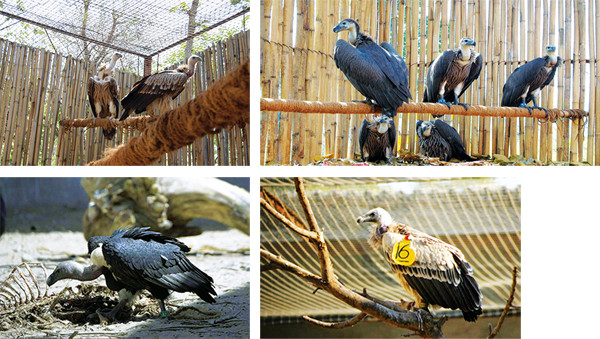
Clockwise from top left: Himalayan Griffons, nursery aviary, Long-billed vultures and a White-backed vulture: Eight vulture breeding centers are set up in India
Photos courtesy: BNHS
A vulture consumes three to four kgs of flesh in a week, roughly five percent of their body weight. With three deaths a day on an average (there were 763 bodies consigned to the dakhmas in 2011, an average of two a day — editors), 300 vultures would be required to consume the corpses, observed Prakash. Thirty-eight pairs of vultures would be assigned to each dakhma. Of course at first a limited number of bodies would be fed to the birds. Only diclofenac-free corpses could be placed in the aviary dakhmas, the others being consigned to the Towers of Silence which utilize solar concentrators to dehydrate the body, a method which is largely ineffective during the monsoons. "The onus is on the Parsi community to ensure total compliance” that the corpses are diclofenac free, stated Prakash.
Sinha cited the example of the USA where DDT (Dichloro Diphenyl Trichloroethane) was successfully banned because the poisonous pesticide was threatening the survival of several species.
When asked as to the cost to the BPP of the DVRP, Mehta replied, "a few crores.” Asked if the cost could be in the region of five to 10 crores, both he and Khusrokhan said the figure would be "not more than three crores,” (US $ 5,45,454) with annual running expenses of around Rs 50,00,000 rupees ($ 90,909). Around five qualified personnel would need to be employed. Does the BPP have the monies? Yes, replied Mehta confidently, "the BPP has enough funds.” He noted that the BPP’s trust deed specified the safeguarding and maintenance of dakhmenashini and nothing else. Housing, doles, scholarships, etc were add-ons. (Aside from a present annual deficit at Doongerwadi of around one-and-a-half to two crore rupees, the BPP is also faced with negotiating a new wage settlement with its unionized employees, including Doongerwadi personnel — editors.)
Mehta will also have to contend with a sizable and influential section of the community opposing the DVRP. Aside from Cama, former BPP trustee and head of the Centre for Advancement of Philanthropy, Noshir Dadrawala, in an e-mail titled, "Aviary at Doongerwadi,” stated the DVRP "may be a journey worth taking (but that) some Parsis are inclined to believe the remedy is worse than the malady… The system of dakhmenashini is presently weakened but has not failed completely. However there is a very real concern that the aviary project may lead to total system failure.”
As regards the cost, Dadrawala noted, "One should also keep in mind the fact that this sum of money is just about the value of one mid-size flat at Cusrow Baug. Besides, what are a few crores for the BPP when it comes to ‘saving the religion?’ We are told the BPP spent almost a crore just to ban two priests from performing ceremonies at Doongerwadi.” He ended his missive asking the trustees to consider, "If this experiment was on my personal estate, at my personal expense, using my own private wealth, would I take this risk?”
Dr Homi Dhalla who introduced the solar concentrators at Bombay’s Doongerwadi which also are being used elsewhere by several anjumans, believes the possibility of educating Parsis to shun the use of diclofenac is impractical. In a note prepared for Parsiana, Dhalla noted "In various research papers written by Prof Green, Dr Cuthbert, Dr J. Lindsay Oaks and Dr Martin Gilbert, it is reported that besides diclofenac a host of other NSAIDs (Nonsteroidal anti-inflammatory drug) such as indomethacin, flunixin, meglumide, keto-profen, metamizole, naproxen phenylbutazone, analgin, nimesulide, paracetamol, carprofen and ibuprofen would cause mortality in vultures. It is imperative to note that there are 1,051 combinations of diclofenac itself…
"Several other causes of death are infection with avian influenza, infectious bronchitis, West Nile virus, liver cirrhosis, chronic granulomas, amyloidosis and muscular degeneration. In certain cases, experts state that they are unable to determine the cause of death.
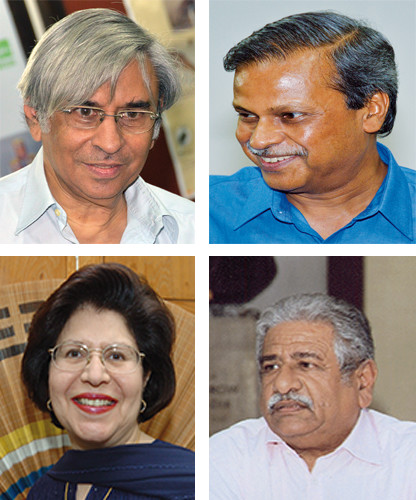
Clockwise from top left: Homi Khusrokhan, P. R. Sinha, Dinshaw Mehta and Aban Kabraji: "We don't want a single vulture to die"
"Taking into consideration the large number of drugs that would kill the vultures and the various diseases they are prone to, the chances of this project succeeding are very slim...
"The first dakhma at Doongerwadi, the Hirji-Vatcha Modi was built in 1672. Thus for the first time in 340 years, other agencies including the government would obtain a foothold on our sacred property. Needless to say, this would be a very dangerous trend endangering our valuable property permanently.
"At this meeting, it was made amply clear that scientists and other specialists would have access to our property. It means that the peace and tranquility of this ‘sacred grove’ shall certainly be affected by persons from various agencies entering our premises…
"The only certainty about this project is its uncertainty.”
The proponents of the scheme counter by stating that Parsis afflicted by the G6PD enzyme deficiency carry cards alerting doctors not to administer them certain drugs. The medical fraternity has also been made aware of the infirmity. Why could not the same awareness program be done for diclofenac? Kabraji, Khusrokhan and Sinha believe this would help to build up public opinion against the use of this drug and an eventual ban; diclofenac is a pain killer, not a life saving medication, they note.
"It’s not often that a conservation project also fulfills a pressing social need. This is what makes the project so attractive,” states Khusrokhan in the press release.
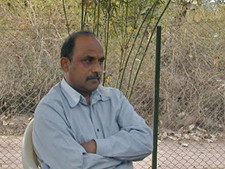
Dr Vibhu Prakash: Onus on Parsis to see corpses are diclofenac free
Photos courtesy: BNHS
Terming the program "a unique partnership,” Sinha noted, in the press write-up, "The Parsi community is providing a model of leadership and conservation action which we hope other communities in different parts of India will follow.”
For those concerned about government obtaining a foothold on community property, Kabraji pointed out that the BNHS will be managing the project along with the BPP. The government only comes in if funds are required but in this case the funding is by the community. She also stated that the additional people employed would as far as possible be Parsis.
Khusrokhan mentioned after the press briefing that thanks to the efforts of Kabraji, the BNHS was able to solicit the cooperation of the government. He believed this was a unique opportunity for the community to not only strengthen dakhmenashini but also make a substantial contribution to conservation of a dying species. As one of the participants at the morning discussion veterinarian Dr Percy Avari reportedly stated, for over 300 years these birds have served our community. Shouldn’t we now give something back to them?
◆ ◆ ◆
From the archive