
Felicitations
A high five for his honor
The fifth member of the bar to be directly appointed a judge of the Supreme Court, Rohinton Nariman is also the fifth Parsi to join the bench of the apex court
That he enjoyed the distinction of being only the fifth counsel from the bar to be elevated directly to the bench of the Supreme Court (SC) of India was a fact repeated by many speakers at the felicitation for Rohinton Fali Nariman organized by the Bombay Parsi Punchayet (BPP) on January 31, 2015. Also the fifth Parsi to be appointed a judge of the SC, his first appearance in SC being before a panel of five judges, the first judgment he delivered in SC being from a five-member bench, the fifth Parsi priest turned lawyer, Nariman sought to impress on the audience gathered at Sir Ness Wadia Pavilion in Cusrow Baug the significance of number five in his legal career.

Armaity Tirandaz, Rohinton Nariman, Arnavaz Mistry, Muncherji Cama, Dinshaw Mehta

Ronnie Screwvala, Janak Dwarkadas, Darius Khambata, Nariman, Mehta,
Dr Farokh Udwadia, Fredun DeVitre, Godrej Dotivala
Considering himself fortunate to continue in "the great tradition” of his four priestly forebears who were also legal legends, he named Sir Dinshaw Mulla known for his "expert treatise on every facet of law;” Sir Jamshedji Kanga who had gained fame for "everybody who is anybody has emanated from his chambers;” Hormusji Seervai who was "an exemplar of everything great – brains, courage, ability” and who although was never a judge, "he judged judges;” Justice Dinshaw Madon "who stood up when the chips were down” and had the courage to state during the infamous Emergency that "the censorship order was wrong.”
On a lighter note he stated that although he would have preferred this felicitation function be scheduled for January 30, BPP chairman Dinshaw Mehta requested him to avoid the anniversary of Mahatma Gandhi’s assassination. Since January 30 also coincided with the date of beheading of Charles I in 1649, the birth of Franklin Roosevelt in 1882, Hitler’s coming to power in 1933, Nariman jested that Mehta wanted to avoid "a fifth great disaster” by asking him to speak! A glimpse of the jurist’s love for history and his photographic memory were discernible during his brief address.
For SC judges, Mondays and Fridays are reserved for barrels of paper when they have to decide whether a matter needs to be dismissed or heard. Tuesdays are set aside for ‘after notice matters,’ each of which can be dealt in less than an hour. That leaves Wednesdays and Thursdays to hear the backlog of cases, do additional homework and be ready with their judgments. According to him, it is not that the SC is final because it is infallible; "we are infallible only because we are final.” Describing the SC as having "vast jurisdiction and great power,” Nariman stressed, "With power comes the need for circumspection and introspection.”
Umpteen references to Nariman’s religious scholarship, as attested by the six speakers before him, made the motivated mobed explain how during the reign of King Shapur II (309-379 AD) of the Sasanian dynasty the "Great Aderbad Marespand fashioned the kusti prayers” that are a blend of three languages. Kem-na-Mazda starts with "two difficult/obscure verses picked out of the second Gatha” after which there is a passage from the Younger Avesta and finally the lines that advocate humility Nemascha ya Armaitish izacha from the third Gatha. The next prayer Hormazd Khodae is in Pahlavi, the spoken language of the day, and refers to "the evils to be abjured, including not tolerating tyrants or being wilfully blind.” Jasa me avenghe Mazda prayer is the proclamation of faith.

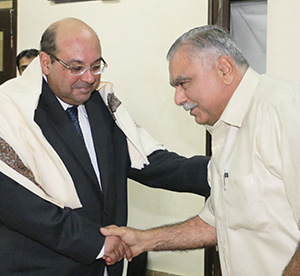
Nariman being felicitated by Dastur Khurshed Dastoor; and Khodadad Irani (Photo: Nauzad Daroga)
The jurist believed there is no point in having good thoughts and words unless they translate into good deeds; in having wisdom unless it is accompanied by courage; in having intelligence without vision; and in being wealthy unless it results in generosity. "Trying very hard to live by… these precepts,” among Nariman’s last thoughts were the lines from Rudyard Kipling’s poem If: "If you can fill the unforgiving minute/ With 60 seconds’ worth of distance run,/ Yours is the Earth and everything that’s in it.”
Acclaim and admiration
Commending his "impeccable sagacity” and describing him as "Truly a gem of our tiny community,” Mehta referred to Nariman’s thirst for religious knowledge from a young age that made him understand and memorize the 72 Has when he was ordained as a navar. In life, he has been able to balance "secular tradition on the one hand with the Zarathushti faith on the other.” Rohinton’s father Fali being a legal legend in India, Mehta stated, "It is uncommon for a son to outshine a famous father.” He gave the new judge credit for earning accolades this decade, first as a solicitor general of India, a post from which the principled jurist resigned after 18 months in office due to differences with the law minister, and his recent elevation to the SC.
"Ask him anything, and the kind of exposition you get is truly phenomenal and remarkable,” attested his former colleague at the bar Fredun DeVitre who viewed Nariman as "a colossus striding the corridors of the SC… an authority on comparative religions…(and) western classical music with a dream to become a conductor of a world famous orchestra.” A lover of history, Nariman can recount in chronological order, with dates, the tenure of heads of different nations and on a trip to London was even able to point out an error on a plaque at the Westminster Abbey which was subsequently rectified by them!
Having accompanied him on his holidays to different hill stations, DeVitre attested, "He is a mountain and hill person, not a beach person.” Among the immutables in his life are a daily walk; his "chhatopani, disciplined intake of alcohol” although his friends do not take kindly to his mixing scotch with cola or wine with tons of ice; his collection of coins; and newly acquired interest in golf. "A great mimic of people’s voices and mannerisms,” DeVitre recalled how he had once played a prank on their lawyer friend Navroz Seervai who believed it was his father Hormusji talking to him! "Extremely simple in his habits, needs and wants… he is a true blue bawaji of the old school.”
Commending his "impeccable sagacity” and describing him as "Truly a gem of our tiny community,” Mehta referred to Nariman’s thirst for religious knowledge from a young age that made him understand and memorize the 72 Has when he was ordained as a navar. In life, he has been able to balance "secular tradition on the one hand with the Zarathushti faith on the other.” Rohinton’s father Fali being a legal legend in India, Mehta stated, "It is uncommon for a son to outshine a famous father.” He gave the new judge credit for earning accolades this decade, first as a solicitor general of India, a post from which the principled jurist resigned after 18 months in office due to differences with the law minister, and his recent elevation to the SC.
"Ask him anything, and the kind of exposition you get is truly phenomenal and remarkable,” attested his former colleague at the bar Fredun DeVitre who viewed Nariman as "a colossus striding the corridors of the SC… an authority on comparative religions…(and) western classical music with a dream to become a conductor of a world famous orchestra.” A lover of history, Nariman can recount in chronological order, with dates, the tenure of heads of different nations and on a trip to London was even able to point out an error on a plaque at the Westminster Abbey which was subsequently rectified by them!
Having accompanied him on his holidays to different hill stations, DeVitre attested, "He is a mountain and hill person, not a beach person.” Among the immutables in his life are a daily walk; his "chhatopani, disciplined intake of alcohol” although his friends do not take kindly to his mixing scotch with cola or wine with tons of ice; his collection of coins; and newly acquired interest in golf. "A great mimic of people’s voices and mannerisms,” DeVitre recalled how he had once played a prank on their lawyer friend Navroz Seervai who believed it was his father Hormusji talking to him! "Extremely simple in his habits, needs and wants… he is a true blue bawaji of the old school.”

A section of the audience
Wondering whether to give him the title of "Rohinton the wise” for his ability to give solutions which are long lasting; "Rohinton the just” for he likes to be fair, "does not suffer fools gladly nor knaves at all;” or "Rohinton the humane” who always remembers his old teachers from Cathedral and John Connon School, extends charity to the impoverished in Abu, has set up a fund for young SC advocates, will ask his buddies to alight from a car on a cold, wet night to give a lift to total strangers who have been lost on the highway, DeVitre felt his friend’s humaneness would override all.
"I have had two sleepless nights over him,” mentioned eminent physician Dr Farokh Udwadia who recalled Rohinton being brought to him many months ago with a bad form of malaria. "That time he was very mild. He would turn around… sit up… cough when you asked him to although I am told he is liable to be angry quite easily. Perhaps it was the malaria at work,” quipped Udwadia who has long been a friend of Rohinton’s parents Fali and Bapsi and felt they too deserved to be congratulated on Rohinton’s progression to the bench.
Delighted that "Rohinton is steeped in the humanities,” Udwadia was sanguine that his knowledge of literature, poetry, history, philosophy "will widen his horizons and perspectives and give an extra sharp strength to his judgments.” Since Rohinton, like Udwadia, is a "great admirer of Napoleon” who epitomized "courage, fire in his belly and determination,” those traits along with a life spent in the "true spirit of Zoroastrianism” should bring "together an extremely powerful amalgam,” declared the doctor.
With Rohinton’s inclusion on the SC "we can expect a veritable feast of law and justice in the years to come… The stage is set (with this) game changer,” declared erstwhile additional solicitor general and advocate general of Maharashtra Darius Khambata. Commending Rohinton’s "devotion to truth and directness of approach,” Khambata also saw in him the qualities that eminent jurist Nani Palkhivala commended in Kanga — "desire to do justice... intellect... philosophy... vision... resistance to temptation.” Quoting from Hamlet, he advised his friend, "Give every man thy ear but few thy voice. Take each man’s censure but reserve thy judgment.”
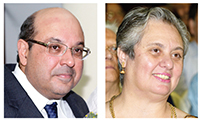
Rohinton and Sanaya Nariman
Khambata appreciated that "being the son of a famous father” it was difficult for Rohinton to shake off the Nariman mantle and pave his independent way. "Behind him are four women — wife Sanaya, his alter ego and thermostat, daughters Nina and Khursheed, and mother Bapsi Aunty,” added Khambata who recalled their younger days when he was "always different and incredibly ahead” of the rest, "a ringleader of sorts… always a torrent on arts and history, (gave remarkable) exposition on military history… If he had been Hitler’s field marshal, the outcome of World War II would have been different!”
Besides his depth of knowledge of western classical music — "he knew score after score backward and had a humongous collection — his eclectic tastes ranged from the philosophical to the mechanical,” stated Khambata remembering well how a recently acquired railway set which could set the train in motion and switch tracks made Rohinton’s eyes light up. Having already decided that after retirement "he would devote himself to all things non-legal,” Khambata hoped that with his "scholarship of the Zoroastrian religion” Rohinton would pursue this line for "he has so much light to shed.”
Yet another childhood friend, Ronnie Screwvala, founder of UTV, lauded Rohinton’s "laser sharp focus and laser sharp passion” from his younger days. Besides displaying his oratory skills from his school days, Screwvala remembered well "his element of giving.” When Screwvala lay in a hospital bed for three months, it was his classmate Rohinton who meticulously prepared notes for him. Whilst Rohinton enjoyed teasing Screwvala by giving him nicknames like "Screwballs and Screwy” he also knew that he could not always have his day. Having changed his name from Rohinton to Ronnie, Screwvala regretted they could no longer share a first name! He was certain that with Rohinton around "This country is going to be richly blessed.”
"Neither the name Nariman nor the honor of graduating from Harvard University (where he was nicknamed ‘IBM’ for his exceptional memory)... successfully appearing in 500 cases in the SC, being made a senior counsel (at the young age of 37) when the minimum age bar (set at 45 years) was lifted to accommodate him, the luxury of owning five or six beautiful homes in most exotic locations have seen the slightest change... in Roh, as we affectionately call him,” declared advocate Janak Dwarkadas. He considered Rohinton "a child of a special god... who made him quadri brained with one each for law, religion, history and western classical music... so that he excels in all four.” Admiring Rohinton’s ability to cite para, page and volume of any SC judgment thanks to the "copy/paste function in his brain” having developed before the arrival of computers, Dwarkadas recalled how the young lawyer would tenaciously study Law Reporters of the SC during his early years in Bombay. Despite his busy legal practice Rohinton continues to expand his knowledge bank "closeting himself with books for days at end on his holidays like a hermit on hills.”
Barely had Rohinton resumed his seat after his address when he was asked to rise again to receive the plaque at the hands of five BPP trustees in attendance (another ‘five’ for his pentagon collection!) — Mehta, Arnavaz Mistry, Khojeste Mistree, Armaity Tirandaz and Muncherji Cama. Prompt came a one-liner from Rohinton: "Another thing Aderbad said is ‘Don’t sit where you are liable to be unseated!” For the next 10 minutes a steady stream of representatives of more than 30 Parsi organizations in and beyond Bombay conferred floral tributes/shawls/mementoes on Rohinton. At the start of the function, master of ceremonies Godrej Dotivala, public relations officer of the BPP read out a message from senior advocate Jimmy Pochkhanawala who considered Rohinton’s move to the bench as "an inevitable progression and foregone conclusion...(having) chosen to join the bench by way of service to the country.”
Three years earlier the Punchayet had felicitated Rohinton on his appointment as solicitor general of India. To see him rise as the chief justice of India was a wish frequently expressed that evening.
◆ ◆ ◆
From the archive