
Cover Story
The Law – sacred and secular
Friends and the legal fraternity have high praise for India’s current solicitor general Rohinton Nariman
"The evil that men do, lives after them. The good…Oh boy, my ears are burning!” exclaimed India’s solicitor general Rohinton Nariman as he rose to respond to the accolades heaped on his multifaceted personality at a function hosted by the Bombay Parsi Punchayet (BPP) on November 4 at Cusrow Baug on his being appointed the solicitor general of India this July. As gynecologist and obstetrician and old friend Dr Avan Dadina had interjected in the course of her happy recollections, "It’s truly unfair, the amount of expertise gifted to a single individual!”
The priority of the man who seems to be working at the interface of religion and law — and music — was evident: "The most important thing when I was a young boy was my priesthood…It turned out to be a delightful experience.” Reminiscing of the time when he, as a lad of 11, spent the long holiday preparing for his navar initiation in Bombay, he noted, " The stint in the Tata Agiary was fabulous. I was a child among grandfathers… Ervad Manekshaw Bharda would come and coax me into learning huge words that meant nothing to me then, induced me to learn 50 of the 72 chapters (of the yasna). In the Ushahen gah (the period between midnight and dawn) one of them would gently pat me awake saying "Baba ooth, bhanwanu chhè (Wake up, child, its time for prayers). They gave me love, discipline, a sense of purpose…Unfortunately, I was not taught the Gathas…Only Dastur Firoze Kotwal, who was the panthaky, would call me sometimes and give me glimpses (of them).”
Nor was life at the agiary a dull and endless recitation of prayers. The priests were given to good-natured ribbing and included him in some of their pranks, as when "Khushroo Kaka was forcibly fed snuff, the idea being that his wife would smell the stuff and bell him.”
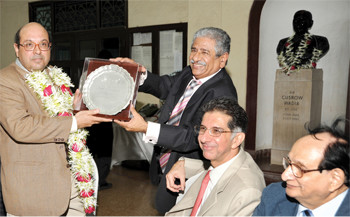
Rohinton Nariman receiving the BPP’s silver salver from Dinshaw Mehta. Also seen Navroz Seervai and Dadi Engineer Photo: Nazneen K. Vajifdar, Spectravison Labs
On the given day he "had to belt out the 50 has for two-and-a- half hours” in front of an audience which included friend and fellow prankster Navroz Seervai (now a senior counsel in the Bombay High Court) and his revered father Hormusji, a constitutional expert who had undergone the ceremony at the age of eight. "At the end of the ordeal, I was made to stand on a chair and speak about my experience. I was so winded, I couldn’t breathe!”
But worse still, at the end of the vacation, Dr Kuruvilla who taught the boys religion at the Cathedral and John Connon, learning that Rohinton had become a priest, called him to the front of the class to speak about his religion. "I felt a fool because I didn’t know anything. (As a result) my ego forced me to study the religion along with everything else,” he traced his advent into religious scholarship. It is amazing that "the Prophet spoke thousands of years ago, in verse which could be recited, which we could (eventually) understand and that it’s still relevant! To live by what he said is extremely fulfilling though so difficult.”
Seven speakers on the dais had had things to say that were not only flattering to the subject but spiced with humor. Speaking of Nariman’s A+ career, Bombay Parsi Punchayet chairman noted, "He was not only a chip of the old block (jurist and member of the Rajya Sabha Fali Nariman) but one step ahead of his father who was assistant solicitor general” in former Prime Minister Indira Gandhi’s time, but had resigned when she declared the Emergency and curtailed civil rights.
Retired Supreme Court (SC) judge Sam Variava recalled the times when they were all colleagues in Jamshedji Kanga’s chamber or Chamber I as the lawyers know it. Variava was one month a junior with Nani Palkhivala who was working on the Minerva Mills case when Nariman returned from Harvard after his master’s and decided to work independently (of his father) in Bombay. Nariman joined Bomy Zaiwala as a junior in the same chamber in 1982.
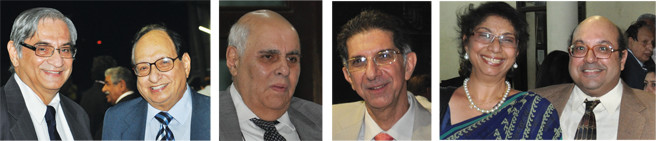
L to R: Sam Variava, Dadi Engineer, Khushroo Suntook, Navroz Seervai and Avan Dadina with Rohinton Nariman
"There was a happy mix of work and play, friendly verbal jousting, no discrimination between senior and junior, everyone was considered equal,” Variava recalled the prevailing atmosphere. Nonetheless, those who were urgently required to work were left un-disturbed. "Rohinton has a great sense of humor and participated in the good-natured banter in the chamber.” In 1986 Variava was appointed to the Bombay High Court and was grieved to learn he wouldn’t be able to continue his association with his colleagues. He was reassured when "Rohinton said he would not appear before me in court but continue our friendship.”
Speaking of Rohinton’s "phenomenal knowledge of the law, voracious reading, vast and varied interests,” Variava noted, "He is very thorough in his work, always completely and thoroughly prepared. He works extremely hard but spends time with the family with walks, music and the mandatory chhato-paani (evening aperitif) in limited measure.” He described Rohinton as a man of simple and sparse habits who spent most lavishly on books and musical equipment. "He switches it off if he feels his visitor ("tone-deaf like me”) is not taking the music seriously.” And his evening walks are an institution. "Walk? It’s closer to a jog. I have stopped joining him because I can’t keep up with him!” notes a sparsely built Variava of his more rotund friend.
Later, as a judge of the SC Variava had found that "government matters were not properly represented. The difficulty is that the lawyers don’t get assistance or proper briefing.” Variava said he asked Rohinton’s wife Sanaya how Rohinton was managing and she said, "He does not wait for instructions, He readies all the papers himself.”
Noting that "the private litigants’ loss was the government’s gain,” Variava congratulated the government on its good sense to appoint Rohinton and told the audience, "You may be felicitating not just the solicitor general but the future chief justice of India (CJI).”
Noted solicitor and former BPP trustee Dadi Engineer was his usual expansive self, complimenting BPP public relations officer Godrej Dotivala who functioned as the evening’s compere, as "the best events manager in the community,” while Dotivala maintained that the function could be held thanks to Engineer’s intercession with the solicitor general who hardly had time to breathe!
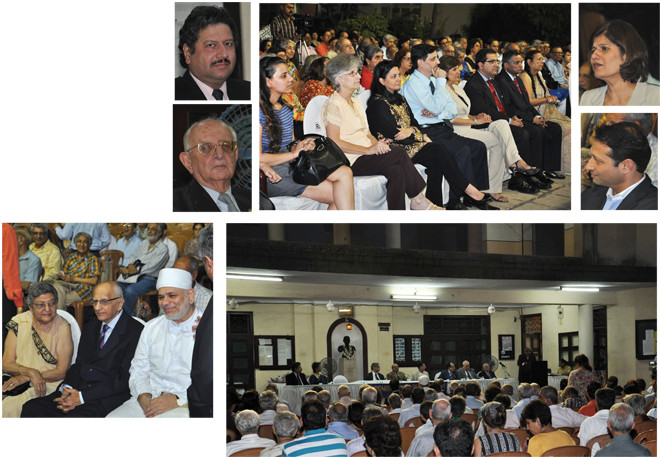
Alongside (clockwise from top left): Mehli Colah; BPP trustes Armaity Tirandaz, and Yazdi Desai (2nd and 4th from left) with Anahita Desai between them; BPP trustees Arnavaz Mistry and Jimmy Mistry; a view of the dais; (L to R) Ratu Dastoor, Minoo Shroff and Dastur Khurshed Dastoor and Godrej Dotivala
(Initially Dotivala had sounded out BHC Justice Dhananjaya Chandrachud to preside over the function. When the trustees come to hear about this, they made Dotivala withdraw the invitation. This flip flop caused much heartburn amongst members of the legal fraternity. BPP trustee Khojeste Mistree also wrote a letter opposing Variava’s presence at the function but Mehta overruled the objections as Nariman had specifically asked that Variava and Seervai be present and speak — Editors)
Engineer harkened back nearly 50 years to family holidays in Mussoorie when he had asked Rohinton, then a little boy, what he’d do when he grew up. Too young to speak of advocacy, the boy had said "he’d speak like his father.” "He did speak, perhaps better,” noted Engineer, averring that Rohinton had no recollection of that holiday. [Later, in his response, Rohinton had a riposte to offer: With a laugh that brought guffaws from the audience, he noted, "I remember everything about the trip. Hoshang Nanavutty (partner of Mulla and Mulla who was in the audience) will bear me out. You were cavorting with the crooner!”]
Engineer spoke of Rohinton’s "meteoric rise” in the SC where a long standing rule precluding a man from becoming senior counsel before the age of 45 was amended by CJI Justice Venkatachalaiah to permit 37-year-old Rohinton to don the mantle. "It has been rumored in the SC that he would be a direct recruit from the bar to the SC bench. Would it be too stifling for his talents?” he wondered and suggested Dotivala remain in readiness to arrange another felicitation — with snacks — when Rohinton takes the next step to become the attorney general of India. Referring to Rohinton’s well-known interest in and knowledge of western classical music, Engineer noted, "Had he been born in a music city like Salzburg or Vienna, we would have had two maestros in the community,” the reference being to internationally acknowledged conductor Zubin Mehta.
Engineer spoke of Rohinton’s celebrated ability to recall citations of case law from the All India Reporter (AIR)’s annual publication of High Court and Supreme Court cases including the page number, comparing him to Sir Jamshedji Kanga who had been blessed with a similar ability late into his life, even being able to recall whether the apposite paragraph lay on the right or left of the page.
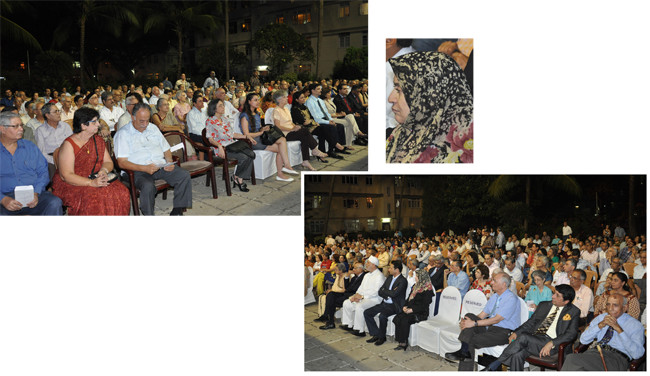
Alongside: Pervin Daneshvar, first consul of Iran; views of the audience at the Cusrow Baug gathering
Khushroo Suntook, chairman and trustee-in-charge of the National Centre for the Performing Arts (NCPA), believed Rohinton’s "penetrating legal mind would probably find errors in the Ten Commandments!” He suggested that the BPP use his religious knowledge and easy delivery to speak to the Parsi youth on the subject. Suntook was particularly appreciative of Rohinton’s knowledge of music, his "incredible observations and study of the conditions under which artists and composers have functioned.”
There had been comments on Rohinton’s portly build, as also Engineer’s and some of the old lawyers they spoke about. Suntook’s contribution dealt with the rotund Pilloo Mody, a founder member of the Swatantra Party and member of Parliament. When he wanted to enter politics, he asked his father Sir Homi Mody, a lean man, to give him a letter of introduction to Prime Minister Jawaharlal Nehru. Nehru was in a peevish mood until he read the letter but thereafter could not stop laughing. Mody had written, "I’d like to introduce Pilloo to you. He may not be a chip of the old block, but is certainly a block of the old chip!”
"How do you felicitate some one who you’ve known for 48 years, whom you’ve squirted with coke and been squirted right back, whose shoulder you pulverized with a tennis racket and was hammered right back?” started noted counsel Navroz Seervai. "Please forgive me if I don’t sound reverential…” Seervai maintained Rohinton was seven when he was six and though they studied at different schools, they "played every game and played the fool” on the Princess Victoria Mary (PVM) Gymkhana grounds.
"What struck me was his incredible focus and sense of purpose. He had charted out his life before the rest of us had even thought about it…He tried playing the piano and gave it up. I played the violin badly for 15 years.” Seervai wondered at his friend’s thirst for acquiring knowledge of music and everything connected, his abiding faith in his religion and that of others, his voracious reading and endless list of subjects, his moral sense of purpose, absolute integrity and unshakeable resolve not to swerve from the path of truth, to oppose what he believes to be wrong…
"He brought his manifest talents and gifts, extremely high standards of ethics and morality, intellect of the highest (to his work). Despite the complexities of facts and of law, the secret of Roh’s success is that he loves the Law. To him it is not a money making occupation. To him it is and remains a noble profession, its mysteries to be unravelleld, knowledge to be gained, that distinguishes great lawyers. There are those who say ‘Law is a jealous mistress.’ Far from it. Roh belongs to the rare and small band who ask, ‘What does he know of the law who only knows the law?’” Seervai paraphrased Kipling.
Referring to the lawyer’s attachment to his family, to his "obscenity” of mixing scotch and coke, to his relishing the friendships of childhood, Seervai celebrated their relationship in the words of Voltaire ("Friendship is the marriage of the soul”) and Byron ("Friendship is love, without its wings”).
"To us close friends, his knowledge mattered not as much as his hearty laugh, his hearty appetite for life,” noted Dadina. Recalling their annual holidays in Mahableshwar, she described Roh dressed "at the crack of dawn in T-shirt and white shorts. He took us on l-o-n-g walks or to clean and scrub a horse’s grave. Between Roh and Firdaus Taleyarkhan we came back looking like unwashed rags,” adding, "He doesn’t accept fools gladly...
"Nobody could hold a candle to Roh when it came to argument,” Dadina continued. He knew it all, even medicine, she declared, recalling long dissertations "peppered with good humor and modesty.” When he lost his temper, "his face resembled a beetroot and it required all our ingenuity to mollify him. But the phase was short-lived… Behind Roh is Sanaya, a pillar of strength” noted Dadina and considered herself "blessed to have him as a friend.”
Maharashtra additional solicitor general Darius Khambatta was out of town but sent his congratulatory message read out by Mehta. Calling Nariman "William Pitt the Younger (who became an effective Prime Minister of Britain at the age of 25) of the legal profession and a legal Toscanini,” Khambatta spoke of Nariman’s understanding of history, of his impish sense of humor, his simplicity and directness of approach, his conception of religion as ultimate truth, and noted "One day he will use his knowledge to dispel misconceptions.”
Nariman spoke of the Parsi priests who went on to become memorable lawyers: Sir Dinshaw Mulla who founded the law firm Mulla & Mulla was an advocate and judge of the Bombay High Court who "landed up in the Privy Council and wrote on every facet of law.” When the day’s legal work was done, he would "squat with books around him and call for whisky…He wrote on every facet of law.” According to Nariman, one of the Indian princely states adopted Mulla’s version of the law. "So if he disagreed with any aspect in a footnote, the footnote became a part of the state’s law!”
Taken to see Kanga as a little boy shortly after his navar initiation, he remembered the old man, almost on his deathbed, his mind rambling. "Until father told him, ‘Dikro navar thayoch (My son has become a priest).’ He called me to him and asked ‘Ketla ha (how many chapters did you memorize)?’ I told him and he said I had learned 13 more than him and therefore I should be 13 times better!”
Hormusji Seervai, that titan of the Bombay Bar who presided over it as advocate general for 17 years, was the "greatest constitutional authority in the world. He knew the constitutions of Australia, the United Kingdom, the United States. You could question him about any case and he could tell you,” Nariman paid tribute. But it was a special memory of a night in Delhi when he was all alone in the huge house shortly after his 11th standard exam and the only person he knew in Delhi was Hormusji — then engaged in fighting one of the most iconic cases of Indian constitutional life, the Keshavananda Bharati case — which Nariman fondly related. "I phoned him and asked him if he would have dinner with me. There was a long pause. Then he asked who else would be there. I told him I’m all alone. There was another long pause before he set the time. I picked him up, we sat down and chatted, had dinner….He died on January 26, 1996; he died with the constitution in his heart, after having completed the fabulous fourth edition of the three-volume Constitutional Law of India in which he has stated that everything he had argued in the Keshavananda Bharati Case was wrong. ( Seervai had argued for the government against Nani Palkhivala’s stand that the basic tenets of the constitution could not be changed by Parliament. Thereafter, when Indira Gandhi brought in amendments that affected civil liberties, he realized his mistake, Nariman later explained to Parsiana.)
"He didn’t bother about anybody else’s reaction and squarely blamed Gandhi and Nehru for the Partition of India. On his 89th birthday he had looked like a minor prophet from the Old Testament. He took me aside and said, ‘Make sure nobody touches my book.’ He was right. Nobody can touch it.”
The last of the celebrated priest-lawyers Nariman spoke of was Justice Dinshah Madon, "an unsung hero who did not propagate himself.” While Justice Khanna was bypassed for the post of CJI because he voted against the government in the Keshavananda Bharati case defining human rights under the Emergency, "Madon actually struck down a censor’s order and said ‘free speech and free trade in ideas did not stop even during an Emergency.’ He knew his whole future was finished but suddenly there was an election and the Janata government that came in made him chief justice of the Bombay High Court.
"By the time a chastened Indira Gandhi returned to power, he was almost blind, and there were those who told her that he had struck down her censor’s order. But she said ‘We need such judges’ and appointed him to the Supreme Court.”
According to Nariman, misused English made Madon unhappy. On one occasion Madon was horrified with a lawyer’s use of the language until he said the words ‘faux pas.’ " ‘You pronounced it correctly,’ noted the judge, surprised. The lawyer drew himself up and said ‘Milord, I was taught French in school.’ Madon shot back: ‘Pity they didn’t teach you English!’” (According to another version, the lawyer pronounced the words as "fox pas” causing Madon to inquire what he had said. When the lawyer proudly announced it was French and he had studied it at school, Madon retorted it was a pity he had not studied English.)
A vote of thanks by BPP chief executive Mehli Colah was followed by the presentation of a silver salver by Mehta to Nariman on behalf of the BPP and a long queue of various anjumans and community organizations, representing a proud community, plied him with shawls and flowers. Unlike other felicitations organized by the Punchayet in the past, they reflected the warmth of a smaller audience, one more intimately connected with the dignitary they honored.
◆ ◆ ◆
From the archive