
Felicitations
Officer of the Law
Though solicitor general of India, Rohinton Nariman has more than the Law on his mind
It was with some trepidation that we had phoned Rohinton Nariman to seek an interview during his trip to Bombay. The Government of India is involved in a lot of litigation apart from other critics and snipers at its heel and the solicitor general may hardly be inclined to speak to the Press. On the first couple of calls we were told the gentleman is out for a walk (!) and though our call was returned, the conversation, short and brusque, heightened our unease. That is until we witnessed the joviality of his greetings to the many who met him at Cusrow Baug. Though he tried to grant our request for a personal chat, there were just too many who wanted a hand shake and a hug from the boy, now all of 55, who had grown up as their friend. We had to settle for his e-mail response to our queries — which came earlier than promised.
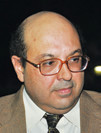
Not all of our questions found an answer. He steered clear not only of those that could have a political or legal bearing vis-à-vis the government but all those that pose a challenge to our minuscule community like the religious status of Parsi women married to men of other communities, of their children, of the status of priests who perform the funerary prayers of those who opt for cremation, of the controversies bedeviling the community, etc. The proverbial "no comment” could be interpreted in different ways; but there is no ambivalence in his personal commitment to the traditional way of life: "Of course I do (wear the sudreh kusti)” and though he says he is "not a regular agiary goer, (he) would opt for dakhmenashini” if he has the choice.
Though Nariman’s own "interest in religion developed after (he) became a priest,” he believes that "religions can be harnessed to the task of social harmony by teaching children between the age of five and 10 that all religions have the same ethical principles and therefore need to be respected even though their metaphysics may widely differ.”
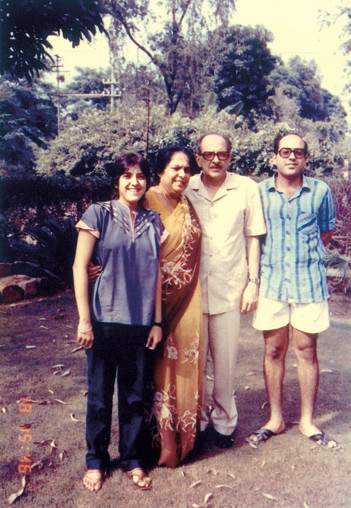
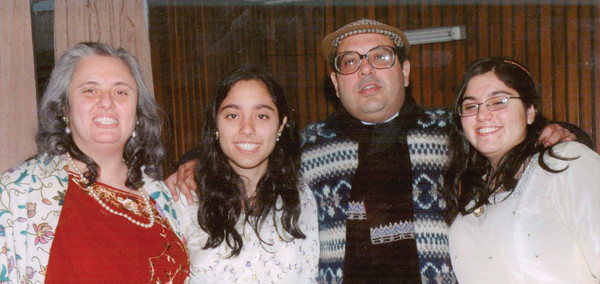
Rohinton Nariman: enjoying over the years, life’s many facets, above and with (L to R) wife Sanaya, daughters Khursheed and Nina, sister Anaheeta, parents Bapsy and Fali
Nariman endorsed the opinion of his friends and admirers who said he had decided on his career early in life. Without specifying his age at the time, he admitted in the Parsiana interview that the decision was made "when I was young” and that "it was tough” to carve out his own niche away from the shadow of his father: "That’s why I never worked with my father. My father was not an ordinary father, he was extraordinary because he was at the top of the profession, so the shadow became longer.”
According to Nariman, the legal profession today is "less of a profession, more of a business…. In the Supreme Court everything comes up, therefore you practice every subject under the sun, whereas in the High Court you do very limited subjects,” he explains.
We ask for his take on the corruption issue. Aren’t we all — givers and taker of bribes — a part of the economic landscape? "The giver of the bribe is often helpless. The law should come down much more heavily on the taker of the bribe,” he avers. And "yes,” it is possible to control graft. " The less government has to do with business, and the more it has to do with governing, the less graft there will be.” As for public interest litigation (PIL) and judicial activism, he says "Judicial activism is a good thing when there is either lack of governance or mal-governance. It takes a thief to catch a thief — so even if a thief brings a PIL, it should not matter if another thief is getting caught.”
How do the jobs of the attorney general and solicitor general differ? we wondered. "The attorney general is a constitutional post — he is the advisor to government and has a right of audience in parliament. The solicitor general also advises government and appears for it in court, but the post is not constitutional and he has no right of audience in parliament,” Nariman distinguished between them.
We had heard of his admiration for Napoleon Bonaparte, the French emperor who changed the face of Europe, deputing many of his siblings as sovereigns of the countries he conquered. But Nariman had a different approach: "Yes I admire Napoleon, just as I admire many, many other great leaders in world history. He is different only in that he himself drafted the Code Napoleon, which is a whole system of law which continues to be followed in six nations today.” Touché!
The son of Fali and Bapsy (née Contractor) Nariman ranked second at Delhi University when he completed his LLB after graduating from Delhi’s Shri Ram College of Commerce, then going on to the Harvard Law School where his thesis on ‘Affirmative action: a comparison between Indian and US constitutional law’ won him his LLM degree. For a year he practiced Maritime Law in the New York law firm Haight, Gardener, Poor and Havens. In an effort to be independent of his father’s shadow, Rohinton Nariman spent three years in Bombay as his friends and colleagues depicted at the felicitation. In 1986 he shifted professional base to Delhi. An expert in Comparative Constitutional Law and Civil Law, Rohinton Nariman’s tally of Supreme Court judgments in his favor number a stunning 500 as per his bio data. He sits on the Governing Board of the Gujarat Law School in Ahmedabad and on the Mediation Committee of the Supreme Court of India.
Committed daily walker, passionate music lover, avid reader of history, philosophy, religion, literature and science, Nariman has lectured on subjects related to his interests in Bombay, Delhi, Ahmedabad, Philadelphia and New York, notes his bio data.
Nariman is married to the gracious Sanaya (née Contractor), a PhD in education who has recently authored an Encyclopedia Britannica series titled Science Spark – A Course in Science for classes one to eight. Their elder daughter Nina has recently done her LLM from Harvard Law School, and the younger one, Khursheed, is studying political science at Lady Shri Ram College in Delhi.
With so much positive achievement around him, Rohinton Nariman does not agree that the community’s youth tends to be complacent. "Several in the professions are still doing very well,” he says, adding, "We need to encourage more to do well.”
◆ ◆ ◆
From the archive