
Felicitations
Leader of the Bar
Speakers extol Maharashtra’s new advocate general, Darius Khambata’s legal acumen, his honesty and humaneness, at a community function to felicitate him
The community is legitimately proud of its legal luminaries from Sir Jamshedji Kanga — then known as the Lion of the Bombay Bar — to Darius Khambata. It’s been a rich journey,” noted Bombay Parsi Punchayet (BPP) chairman Dinshaw Mehta, flagging off the felicitation event organized by the Punchayet and supported by other associations and anjumans, at Bombay’s Cusrow Baug Pavilion on April 27, 2012.
Kanga was the first Indian advocate general of Bombay, appointed in 1922. Khambata was appointed advocate general of Maharashtra on March 27, 2012. According to former Supreme Court Judge Sam Variava — who led the galaxy of speakers which included medical doyen Dr Farokh Udwadia, noted solicitor Zia Mody and chartered accountant and B. E. Billimoria and Company’s managing director Kaiyoze Billimoria — the advocate general is the highest law officer in the state and is considered to be the leader of the Bar. Former Chief Justice of India Sam Bharucha had been billed as a speaker but did not attend.
All the speakers, starting with Mehta, touched on Khambata’s humaneness and lack of ego. Variava and Khambata share a common background in that both are products of Kanga’s chamber, albeit in different generations. Khambata joined the chamber as senior counsel Iqbal Chagla’s junior after completing his LLM from Harvard Law School in 1995. So too was Khambata’s father Jangoo who, according to Variava, left the Bar to join the corporate world, rising to become Glaxo’s first Indian managing director and chairman. The judge and the doctor referred to Khambata’s mother Eva as a "great debater” in her college years, as they traced the genesis of Khambata’s achievements at a relatively young age.
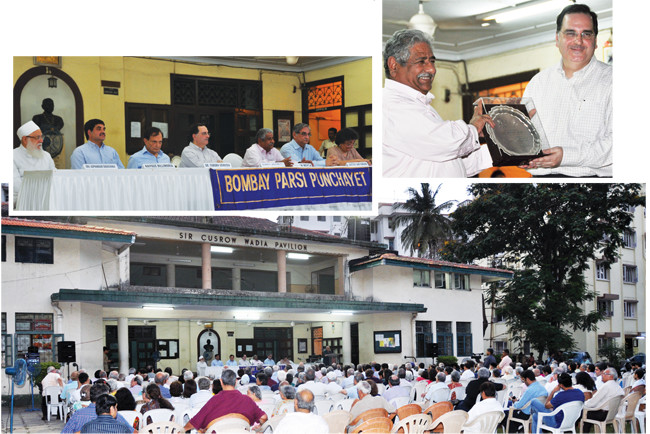
Top right:: Dinshaw Mehta presenting a memento to Darius Khambata Below: Speakers and gathering at the Cusrow Baug pavilion
Khambata responded by evoking the two attributes which the community had imbibed from the Zoroastrian faith and which had been extolled since the time of Herodotus: speaking the truth and being tolerant, as amplified in the life and work of two of the most eminent advocates general of India — Kanga and Hormusji Seervai.
Variava recalled that towards the end of 1986 the High Court requested all advocates having their chambers in the High Court building — notably Kanga’s chambers — to vacate the space which was required for its own functioning. "Everybody vacated, though it was not easy finding office space (in the vicinity). Chagla shifted to Prospect Chambers and Darius went with him…There could have been no one better than Chagla to speak today…I have observed Darius for many years as his practice grew,” noted Variava recalling a case in the court over which he was presiding when Khambata, then still a junior, was part of a team comprising two senior lawyers who were arguing the case. The arguments remained incomplete at the end of the day but the next morning neither of the two seniors could make it to court and Khambata "was told to (argue the case) only on reaching the court. He argued persuasively and won the case before me. There are also reports from other judges that he is always well prepared on facts and law. He has also appeared in national and international arbitration.”
Khambata, who is a member of the Hormusji Seervai Memorial Trust as noted Variava, had his office in Mulla House but has now "shifted to the High Court Annexe building, very close to our earlier office where he began his career,” said Variava, adding, "He is very popular. Many juniors want to join him and he has eight juniors, one of whom is my daughter. Despite his heavy schedule, he finds the time to guide them.”
Commenting on Khambata’s "great honesty, fearlessness,” Udwadia noted, "a good bit of Darius’ attributes are because of his parents. His dad has shown the way with his love of integrity, righteousness. Eva has passed on her love of good food (which) he must keep restrained! He has great sterling qualities but what joins him and me in a special bond is our interest in history and literature. We often speak about battles won and lost. Jangoo (with whom Udwadia shared his undergraduate years at Wilson College) is a paragon of western classical music. Darius comes second…It puts him a cut above other legal individuals. But he is also a jolly good fellow.”
In an aside, Udwadia recalled how he had gone to Wilson College "on sufferance” because he had wanted to go to St Xavier’s but his "mother frowned, saying, ‘Juarak bi nahi! Chhokrio ni vachhé chhokro bagri né dhur thai jasé (No way! The lad will get totally spoilt amongst all those girls)!’” He recalled debating with and losing to Eva: "She won and I lost. She was a good debater.”
Udwadia drew parallels between the medical and legal professions. "Both presuppose competence but also humaneness — which Darius has — as well as honesty and integrity. He is an extraordinarily honest individual. He doesn’t hesitate to speak his mind,” the doctor complimented the young advocate general. "Charity is very important for doctors but also for lawyers — Darius fights deserving cases free of cost. (And both need) humility in ample measure for in its wake comes wisdom and wisdom brings more humility. Finally, there’s judgment. It is a characteristic you are either born with or not. There are some individuals, not very clever, who are very good at judgment. The study of literature, religion, history makes you an all-rounded personality. Your judgment improves…
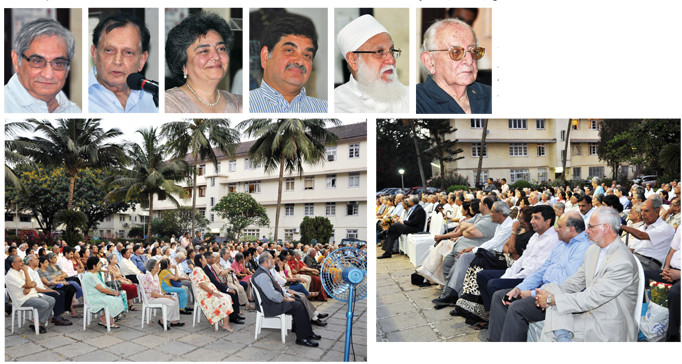
(From top left) Justice Sam Variava, Dr Farokh Udwadia, Zia Mody, Kaiyoze Billimoria, Ervad Asphandiar Dadachanji and Godrej Dotivala; (below) sections of the audience
"We are all men of the world. Everyone desires success. But first I wish you (Darius) good health because without it you cannot enjoy success. Also happiness, which is a state of mind. Also contentment and equanimity — equanimity to bear with courage the slings and arrows of life. My friend had once sent me this prayer: ‘Oh Lord, I wish He grants you purity, strength from righteousness and success that comes from good thoughts.’”
Mody represented the younger generation of speakers that evening. Though she arrived after the proceedings had begun, she made up for it with her effervescence and close family relationship. "Darius grew up with my family. My first impression of him is as the younger brother of my friend Meher.” The daughter of former attorney general of India Soli Sorabjee recalled their annual trips to Mahableshwar, the long, contemplative walks and pranks of mastikhor (mischievous) Darius. "It was a time to unwind and banter with friends.” Later they worked on several briefs together and she commented on his "intensity of research, that he never wanted to be shortchanged. His juniors are confident that he brings his whole attention (to the case at hand).”
Mody claimed she was "most upset” when Khambata accepted the job of additional solicitor general of India in 2009. She "scolded him,” she said because she felt deprived of a colleague she could rely on in the rough and tumble of work. "But he really grew in this position. He found his own space and responsibility… the post gave him a real sense of objectivity. Now (as advocate general) he can accept our briefs,” she noted happily. The London Court of International Arbitration asked her to suggest someone worthy of their appointment. She said she named Khambata and within 10 minutes the party called back in confirmation of his suitability.
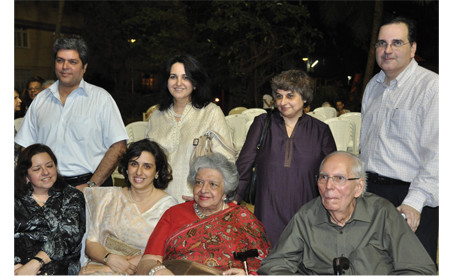
From left (standing): Percy Balsara, Navaz Dastur, Dina Wadia, Darius Khambata; (sitting) Meher Balsara, Kerman, Eva and Jangoo Khambata
She read out legal luminary Janak Dwarkadas’ SMS comment: "Darius is quiet, loyal, humble to a fault, not spoilt by appointments of office and continues to fulfil the Parsi promise to India in that he continues to add sugar to our lives.”
Speaking as Khambata’s friend and client, Billimoria underlined the graciousness with which the lawyer "gives generously of his time to all who approach him…without drawing attention. Even in school it was obvious he would go far.” Though their youth had been fun-filled, Darius continued to excel at studies. "There are few who can pull off a practical joke with a straight face like him. But his jokes are never personal or rude to anyone.” Variava had also cautioned, "One has to be careful, he is not pulling one’s leg!”
Referring to Khambata’s "huge collection” of western classical music, Billimoria was grateful that he "helps those of us who don’t understand the nuances; he has the patience to get into discussions with my children.” Well traveled, with the joie de vivre to take part in all activities Khambata is "immensely caring, takes matters so seriously, he begins to take the cause more seriously than the litigant,” noted Billimoria, going on to call his friend an "exasperatingly thorough person…My father had immense faith in Darius. He never let us down.”
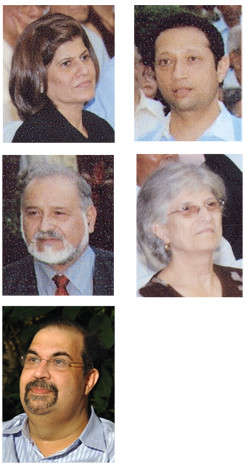
Clockwise from top left: BPP trustees Arnavaz Mistry, Jimmy Mistry, Armaity Tirandaz, Muncherjee Cama and Khojeste Mistree
"Deeply humbled by the generosity of my friends,” Khambata responded, "I am twice honored today, not only by the Punchayet but also by the presence of all of you” and advised the audience to take all that was said with a pinch of salt...
"I think Kanga and Seervai would have spoken today of the specter that is haunting every section of society in India including our community and that is the specter of intolerance...
"When I was growing up in the 1970s Parsis were known for two things — their honesty and Parsi nataks. Strangely the two are not as divorced from each other as might seem. Several honest truths get uttered during a jolly evening at a Parsi natak.
"Today, sadly, there are no more great Parsi nataks to be had and much less tolerance within our community for things said and done. Division and exclusion rather than acceptance and tolerance are the order of the day. I look to the Punchayet to encourage rather than discourage contending points of view and to act as an impartial arbiter rather than as a protagonist.”
Khambata was presented with a shawl and a memento by Mehta on behalf of his Bombay co-religionists. As always, representatives of anjumans and association queued up to present flowers and shawls, with Khambata obligingly posing for photographs with all who desired them.
The BPP’s public relations officer Godrej Dotivala has organized so many such events in the recent past, he could vie with any professional events manager! It was barely six months ago that the venue reverberated to the accolades heaped on Rohinton Nariman on being appointed India’s solicitor general. On each occasion every speaker was introduced by Dotivala in remarkable detail and at the end of the proceedings the community got what it likes best — boxes of food!
Excerpts from Khambata’s speech will accompany the interview with the advocate general of Maharashtra that will be carried in a forthcoming issue of Parsiana.
◆ ◆ ◆
From the archive