
Business
Say ch-e-e-e-e-se…!
Shernaz Sethna makes and retails cheeses, jams, jellies and mustard from her home in Coonoor
While Indians are traditionally keen consumers of dairy products like milk, dahi and paneer, cheese was considered a western concept indulged in by only a few professionals returning from western countries and tea planters, influenced by the British. Not any more. Today a growing number of Indians are not only consuming cheese but experimenting with and succeeding in making a variety of cheeses in limited quantities.
One such delightful discovery was cheese manufactured by Shernaz Sethna in Coonoor under the Gray’s Hill logo.
"This enterprise has been born out of my passion,” says Sethna, an MSc and MPhil in Food and Nutrition from Nagpur University. "I feel so happy and fulfilled that my education is being put to profitable use. For many women, the years spent in study end up as a time-pass,” she observes.
One such delightful discovery was cheese manufactured by Shernaz Sethna in Coonoor under the Gray’s Hill logo.
"This enterprise has been born out of my passion,” says Sethna, an MSc and MPhil in Food and Nutrition from Nagpur University. "I feel so happy and fulfilled that my education is being put to profitable use. For many women, the years spent in study end up as a time-pass,” she observes.
.jpg)
Shernaz had no work experience when she left Nagpur to get married to Homi Sethna and settle in Coonoor. The Sethna family has lived amid the mist and magic of the Nilgiris for the past three generations. Homi’s father Noshir headed the Bombay-Burma Tea Corporation, part of the Nusli Wadia group of companies.
Shernaz’s first job was as a tea taster with a tea export company. She received on-the-job training during which her study of food and nutrition helped. "Being a tea taster is very much like being a wine taster,” she explains. "You have to understand the finer nuances of taste, texture and aroma.” She worked for five years with Container Tea and Commodities which blends and exports container loads of tea to the UK and USA. Though she enjoyed it, she felt the stirrings of wanting to try her hand at something more challenging.
During a visit to Kodaikanal, Homi’s cousin took them to meet his friend Balakrishna who runs Cinnabar Farms where, among other things, they saw cheese being made. When told that the cool climate of the Nilgiris was very well suited for cheese making, Shernaz decided: "This is what I should try!”
"I read up on the net, from where I got a lot of useful information,” she said. "Actually, making cheese is the easy part. The real challenge is in aging it. It can take anything from four to eight months of turning, airing, cleaning and allowing a rind to form, before a cheese is ready to be packed for the market,” she explained.
After months of experimentation, of alternating failure and success, of giving friends and family free samples of cheese to get their feedback on taste and texture, Shernaz gained confidence. One day her husband announced: "Enough of experiments. Any more, and I will go broke!” Shernaz decided it was time to go professional. With the help of a friend in advertising, she designed the Gray’s Hill logo set against the background of a charming black and white sketch of West Croft, their colonial style home. It is as hospitable as it is comfortable. Interesting books, old artefacts and fresh flowers jostle for admiration. The large garden has a well tended mix of exotic flower beds, fruits and vegetables.
.jpg)
Pasteurizing milk in a double boiler
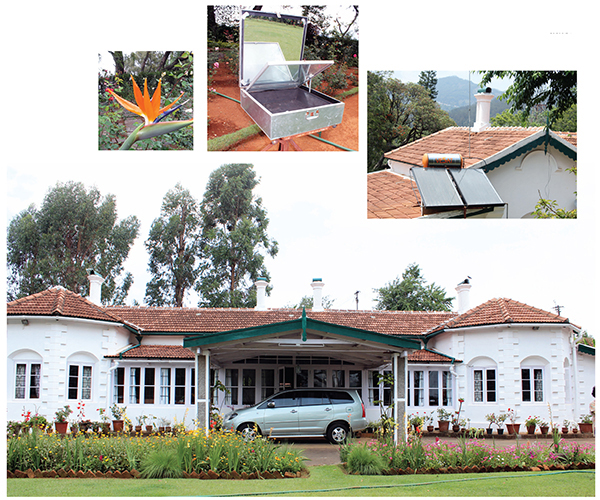
(Clockwise from top): a Bird of Paradise stem; solar cooker,
solar geyser and the colonial West Croft Photos of the house: Jasmine D. Driver
Shernaz explained the cheese-making process: "Cow’s milk is first pasteurized in a stainless steel double boiler. I started with a five liter utensil. Today I pasteurize in 30 liter lots. Cleanliness is of utmost importance in cheese-making, otherwise the bad bacteria would overpower the good bacteria. After pasteurization, the additives are added. These come in the form of ‘cultures’ and provide the distinctive taste to different cheeses, and the rennet which acts as a coagulant to bind the milk.” Shernaz makes Gouda, Colby, Romano, parmesan (most popular) and cheddar. All these can be used as table cheeses as well as for cooking. "There is a big difference in the taste and texture of a commercially made cheese and a homemade cheese,” Shernaz notes. "Again, like wine, cheeses mature with age. The longer you age them, the darker the color and more flavorful the end result.”
Once the cheeses were well established and enthusiastically received by customers, Shernaz turned to making jams, jellies and preserves, starting with orange marmalade. Nagpur is known as the Orange City and every girl who has grown up there has seen her mother make marmalade, the recipe for which becomes part of her dowry! Guava jelly, strawberry jam, ginger ’n lime, rhubarb jam and rhu-berry (a combination of rhubarb and strawberries) followed. The latest product from Gray’s Hill is delicious, nose-tingling mustard. She markets her wares from Bakers Junction in Coonoor and Modern Stores in Ooty as well as from her home where friends and acquaintances come to buy.
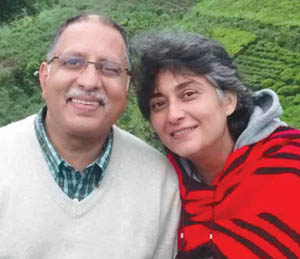
Homi and Shernaz Sethna
"The highlight of my career,” states the gracious and capable lady was "exposure on NDTV 24/7 in the program ‘Will Travel for Food.’”
Shernaz’s advice to young Parsi entrepreneurs is: "A very important element is confidence in one’s abilities. Do not begin by thinking of the obstacles and the competition. Be positive. On the other hand, do not build castles in the air. Start small, test the market and have some backup capital. It is much nicer to grow from small to big than to start big and crash.” Family support is important. Mother-in-law Freny was very appreciative of Shernaz’s culinary skills. Her sons Sarosh and Jehan are both critics and admirers. "And without my husband Homi’s support, I would not have made it,” Shernaz acknowledges. A team of well trained domestic staff and their four dogs are their constant companions.
Homi is managing trustee of the Nilgiri Anjuman comprising Nilgiri District, Kodaikanal and Coimbatore. The president of the Anjuman is Homi Dhunjeebhoy. "The total strength is 27 resident Parsis, most of whom are over 60 years of age. Many other members of the Anjuman are spread all over the world,” Homi stated. "This Anjuman serves the peninsula, south of Bangalore.” The community meets for the annual general body meeting, for Jamshedi Navroz, Parsi New Year and for a couple of jashans during the year.
The very well maintained prayer hall in Ooty is where all community functions take place. Adjoining this is the aramgah, located on a hillside. The last dignitary to be buried there was Field Marshal Sam Manekshaw who was laid to rest in 2008, next to the grave of his wife Silloo. The land for the aramgah was given to the Parsi community of the Nilgiris by Pestonji Nusserwanji Battliwalla in 1840. John Stedman, an Englishman married to the late Ketayun Cowasji of Mhow, and the Sunawalas have taken great pains in compiling and documenting the lives of the Parsis who lived and died there, along with photographs wherever possible. John himself now divides his time between England and India.
By and large all pockets of Parsis espouse the same fine qualities of their forebears. There are some wise leaders, people in high positions with a sense of social responsibility, the cultured and the enterprising, a few crackpots and a bedrock of solid citizens.
.jpg)
Exotic flora
.jpg)
Brass artifacts
.jpg)
Fireplace in the living room
◆ ◆ ◆
From the archive