
Cover Story
“Light the inner fire”
Releasing Justice Rohinton Nariman’s book the Chief Justice of India T. S. Thakur lauded the author’s efforts to promote religious unity
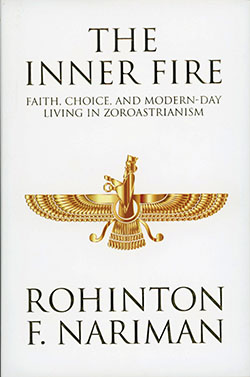
"Over seven years in the Supreme Court, I have released any number of books…related to law, jurisprudence… This release of a religious work is something I have never done before,” stated the Chief Justice of India T. S. Thakur who had sacrificed a function in Bombay to attend the launch of the inspirational book The Inner Fire: Faith, Choice, and Modern-Day Living in Zoroastrianism authored by his colleague at the Supreme Court, Justice Rohinton Nariman. Convinced that "Parsis in this country have sweetened our lives” with their contributions in the fields of industry, commerce, science, law, he expected that Nariman’s book "will add sweetness to our spiritual lives. I strongly recommend everyone to read and benefit from it.”
The Multipurpose Hall at the India International Centre in New Delhi was packed to capacity on the morning of November 20, with "judges — past, present and future,” political personages like finance minister Arun Jaitley, Nariman’s peers and community members from different parts of India who had taken varied routes and diversions necessitated by the Delhi Marathon to reach the venue on time.
The Multipurpose Hall at the India International Centre in New Delhi was packed to capacity on the morning of November 20, with "judges — past, present and future,” political personages like finance minister Arun Jaitley, Nariman’s peers and community members from different parts of India who had taken varied routes and diversions necessitated by the Delhi Marathon to reach the venue on time.
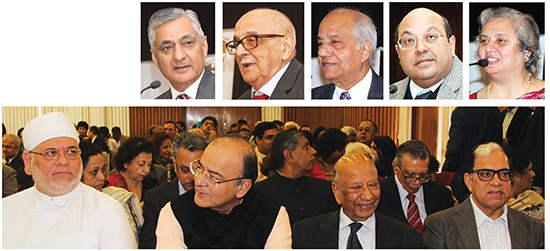
Top, from left: Chief Justice of India T. S. Thakur, Fali Nariman, Justice (Retd) B. N. Srikrishna,
Justice Rohinton and Dr Sanaya Nariman; Above, from left: Dastur Khurshed Dastoor, Arun Jaitley,
Avinash Rana, Justice A. K. Sikri and a section of the audience
The author "has done a great service” by expounding the message of "oneness of God… which is beautiful. (Further) he has simplified it” for an easy understanding, commended Thakur. "In this world where more lives have been lost in religious war than political ideology…only tolerance, brotherhood and acceptance that all paths lead to one God will bring peace,” observed Thakur. Viewing religion as one of the paths "to connect yourself to the Almighty,” he declared, "Religion is something very personal. How do I connect with my God? What relationship do I have with God... is no one’s concern, only mine.”
In the pursuit of absolute truth, half truths can be condoned, believed Thakur, in three circumstances: when the husband or wife says it to make the other partner happy, to bring about reconciliation between different groups, and in times of war.
"This book will really awaken the fire in the younger generation of Zoroastrians. We have a lot of translations (of the Gathas) but all difficult to understand by the layman. This book will really help the reader to connect with the teachings of Zarathushtra as also connect to all the religions of the world,” said Dastur Khurshed Dastoor of Udvada. To reiterate the message of "brotherhood, humanity and peace” that the Prophet has conveyed in the Gathas, Dastoor recited Avestan passages from the sacred verses accompanied by their English translations as rendered by Nariman.
According to Dastoor, the most relevant part of the book for those "engrossed in the materialistic world” is found in the translation of the last verse: "Whosoever proves himself to be better than good, thus fulfilling life’s purpose, will be helped by God’s power. But it shall be worse than bad for him who does not do so at the final end of life.” Reiterated the High Priest, "ultimately good deeds” done in one’s lifetime matter more than prayers and rituals performed by others after one’s death. He congratulated "Fali and Bapsi for having a beautiful son like Rohinton” and prayed for "a heroic, active mind, joyous life and blessings of the Iranshah for the Nariman family.”
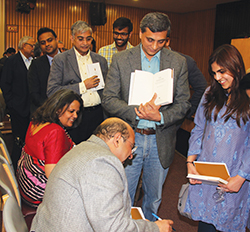
Rohinton Nariman autographing the books
Giving a brief introduction to the Parsi community and the Zoroastrian adherents, Rohinton’s wife Dr Sanaya Nariman informed the gathering that there are "750 of us in Delhi, 22 in Jaipur and 12 in Agra,” the northern triangle. With the maximum concentration in Bombay, and none in Kashmir, they continue to be dotted all over the country. She further described them as "hardworking, individualistic, eccentric, educated, high achieving, outrageously open (as evinced in the case of the Ratan Tata-Cyrus Mistry spat).” To explain "how the community has come to be like this,” she alluded to the "culture, beliefs and faith” of the community, convinced that "the kernel comes from the Gathas” with its core message: "truth is central to living and charity is central to leading a good life.”
 Justice (Retd) B. N. Srikrishna drew parallels between the Rigvedic mantras and the Avestan prayers, and the importance of agni or sacred fire, "symbol of truth,” being the only constant among all the five elements "for it burns with equal ferocity the sinner and the saint.” Referring to the Ashem Vohu prayer he explained how the connotations of certain words are similar like vahishtem in Avestan and vashisthem in Sanskrit that qualify "superlative” good; or ahmai in Avestan and asmai in Sanskrit refers to him who has practiced right conduct. He likewise did an analogy of the Yatha Ahu Vairyo prayer. Satya or truth and dharma or duty is at the core of every religion, he stated, adding, "In every religion… at the summit is one truth, one God, one principle (that seeks) the good of all mankind. Unfortunately we emphasize the differences.” Inscribed on the backrest of the chair occupied by the Chief Justice of India are the words: "Yato Dharma Tato Jaya” meaning, where there is dharma, there is victory. When the Chief Justice occupies the chair, no judge, nor lawyer, nor litigant can see this dictum which should be displayed prominently, he urged for "These are the values we must implement so that the whole world becomes a better place to live in.”
Amusing anecdotes from the life of the author and insights into the book were shared by senior counsel Fali Nariman who revealed in his candid speech, "Parents learn only in retrospect what they should have known about the characteristics of their children from the start.” The father appreciated that their son was "precocious, truthful and compassionate” from the time he was in school. As he further revealed in his speech laced with humor, "To members of his family, he is not only our spiritual head, he is also our family memorialist.” Blessed with the "proverbial memory of an elephant,” he can invariably recall names of friends or relations. "And worse, when after he tells us we forget again, then he reminds us once more. Even the kindest of elephants don’t do this!”
In the prevailing scenario where there is a lot of ambivalence about the existence of God, where "many say ‘No’ and some say ‘God only knows,’” Fali gave proof of Rohinton’s "unshakable belief in God.” In the book marked to his parents, Rohinton had written: "238 obscure hymns have been sought to be explained by me. And the book has also turned out to be of 238 pages — a divine intervention!” Continued Fali, "All those unbelievers who do pick up this book…and read it through, may not become believers when they put it down. But I assure you that they will certainly have less doubts about the existence of a Supreme Being…
 "In this world of believing and doubting, and then doubting and not believing, what sticks out like a sore thumb is that human beings, in spite of being wounded by ‘the slings and arrows of outrageous fortune’ have a profound belief in the rightness of things or right-mindedness (which is the other word for wisdom). I suggest that right-mindedness should drive you to read this book. Hopefully you will enjoy it – particularly Zoroastrians, but non-Zoroastrians as well…”
 "Thank you for giving up your Sunday morning for something as prosaic as this,” stated Rohinton before informing the audience that in his family the maximum number of books had been authored by his mother Bapsi who deserved "the first prize... for having brought me up.” "This was not the first book I planned to write,” he mentioned. He wanted to write a book for middle school children carrying gems of precepts from different religious faiths to dispel the prevailing ignorance. Through Sanaya, an educationist, the suggestion was put forth to the National Council for Educational Research and Training who turned down the offer saying they did not want to touch the subject of religion as "we live in a secular country!” Continued Rohinton: "I thought that fraternity as enshrined in the original constitution…would be conducive to unity!” His first idea being "sabotaged,” he pursued his second project which proved to be "a painstaking, difficult task,” to ensure he had arrived at the accurate meaning of each word.
As conveyed in the "Author’s Note” in the book, Rohinton told the audience of the "three miracles” connected with the poetic Gathas: They had come down almost intact by oral tradition for thousands of years before they were written. Although they are in a "dead language” they can be better understood because of their similarity to Rigvedic Sanskrit. Thirdly the "eternal truths” they contain are as relevant today as in years past.
"The purpose of creation is to move back to the great creator. Fire is the symbol of truth, symbol of moral choice. The animal creation is different from us because it cannot light a fire and shies away from it,” pointed out Rohinton before urging the readers to "light the inner fire, kindle it and become better individuals. If it is extinguished, you are no better than an animal.”
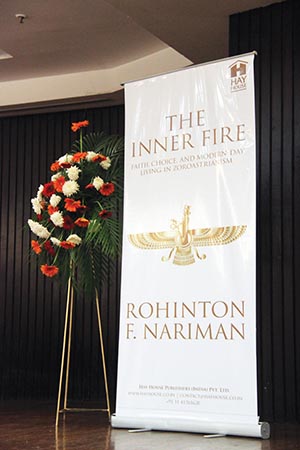
Outside The Multipurpose Hall, the publishers Hay House India had organized a counter that was briskly selling Nariman’s 240-page book offered at a discounted price of Rs 250. Long after the speeches ended, the dignitaries patiently stood in a queue to get their copies signed by the author.
◆ ◆ ◆
From the archive