
Legacy as a lodestar
Let not responsibility be sacrificed at the altar of liberality, opined stalwarts at two Congress sessions
The responsibility for the current mediocre tendencies in the youth lies with the parents and families, declared World Zoroastrian Organisation Trust Fund chairman Dinshaw Tamboly who regretted that there is a change in psyche "from being entrepreneurs to white-collared employees… To study, work and reside in Bombay has become an obsession… We have become complacent rather than competitive… We expect support from community institutions as a matter of right. Giving anything on a platter is the kindest way of destroying the spirit of enterprise. If the Zoroastrian community is to flourish, we need to revitalize ourselves and redefine our priorities. The task is daunting but exciting… The youth have the spark in them which can be ignited through motivation.”
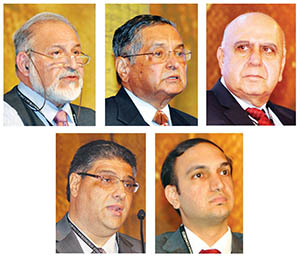
Parsis of India were "the earliest to trade to distant lands. Taking advantage of the economic vacuum they settled all over India. They have become non-adventurous and soft now; completely risk averse. The best minds veer towards the safe haven of professions because you can’t go very wrong,” observed Mehernosh Humranwala who has his legal firm Humranwala and Company. "It may be okay to fail, but it is not okay not to try at all,” he believed. During the British rule the community rose because it was able to "adapt to new realities… But there has been a gradual loss in our adaptability… We failed to anticipate the change with democracy… From a community known as ‘charity givers’ we have become ‘charity demanders’” with members feeling they "not only have a right to free housing but housing in south Bombay.” With the world changing and "becoming flatter than it ever used to be,” a level playing field requires us "to reinvent ourselves and find a new USP (unique selling proposition) to bring to the table.”
"The legacy — of goodwill, respect — that we have come to inherit is not just a privilege, it is a responsibility,” mentioned Zerick Dastur, partner in the legal firm of J. Sagar Associates. The fact that the sacred fires have been burning in Yazd for the last 1,000 years "is a living manifestation of our Zoroastrian spirit… a reaffirmation of our survival without compromising on our racial or ethnic identity…despite innumerable persecutions.” To those in the community who show indifference or are content to remain passive, he urged, "Be instruments of positive change… play a pivotal role in the future of our community…Every segment has a role to play. Every individual is as illustrious as anyone else...Let us stand together as a cohesive force and learn from the mistakes of our ancestors.” To the youth who "are the torchbearers for the future” he had a special message: "Do not be afraid to dream, to give wings to your passion.”
When Nairyosang Dhaval came to India, "there was a religious fire burning in our hearts… Now instead of visiting fire temples we are going to churches, dargahs, Sai Baba mandirs…” regretted Antia who is disappointed that Zoroastrians are talking of accepting converts. "It is a negation of the purpose of our coming to India. We had promised to live as brothers of Indians. Instead of that we are trying to become brothers-in-law.” He recalled the words of Thomas Jefferson who advocated "In matters of style, swim with the current; in matters of principle, stand like a rock.” Antia further impressed on the audience the words of King Vishtaspa who when lured by the wicked Durasan declared that he was ready to give up his life but he would not forsake his Zoroastrian faith.
Thinning of identity
"Zoroastrianism is the religious cradle of truth, justice, good governance and tolerance,” asserted BPP trustee Khojeste Mistree in his talk on "A Zoroastrian Legacy through the Ages,” also on the second afternoon of the Congress. Being "inheritors of this religious legacy” members of the community should be "willing to be recipients” as also to hand over this 3,000-year-old "legacy intact to the next generation,” he stated.
"Our greatest legacy is the framework of a conscious and ethical life that was unique to the ancient world… The Zoroastrian theology is different to the other faiths; in fact there are more differences than similarities when studied at the academic level,” he noted. Viewing Zarathushtra as a "religious genius of the highest order…archetypal prophet-philosopher, most celebrated prophet of the east,” Mistree referred to his influence as discerned in Raphael’s "School of Athens” painting and Nietzsche’s Thus Spake Zarathustra.
The ability to ride a horse, to shoot an arrow and speak the truth were the three hallmarks of a Persian, reminded Mistree.
Refuting the statement made by the advocate general of Maharashtra Darius Khambata in the morning session regarding the first wave of migrants from Persia, Mistree claimed, that we came in three boatloads, men, women and children. The apocryphal narrative Qisse-I Sanjan has "a subliminal message… Nine out of 10 times even from the rear, a Parsi walking down Flora Fountain could be recognized as a bawaji. There is now a thinning of this Parsi religious identity.”
Until 80 years ago, Parsi/Irani/Zoroastrian meant one and the same thing. He cited a letter in the archives of the Zoroastrian Trust Funds of Europe where Iranian philanthropist Shahrokh Shahrokh writes, "I am proud to be a Parsi.” Zoroastrianism has survived because of interlinking of ethnicity and religion. In India, the legacy of the religion has sustained the brand image of industry and hard work. If we change that, it will be the deathknell of our community. The Government of India has given Rs 10 crores for the Parsi fertility program, not given it to promote Zoroastrianism. Our religious legacy has given us the wherewithal to excel in whatever we do. Being a Parsi/Irani Zoroastrian carries the implication of "high ethical values. Non-Zoroastrians respect us. They say, ‘We trust and like your community.’ If we disconnect with our ethnic identity we will turn into a faceless, moorless community…
"Do we want to run our religion on what a European judge has to say? Religion has to be run by those who have studied our faith, those who have done enough research. It cannot be left to legal luminaries. Change, yes, but do we want to throw out the baby with the bathwater?” questioned Mistree.
It is modern and fashionable to be liberal. "Religion does not work on flavors but on legacy.” To those who want to open the doors of their faith to other communities he counselled, build your own temples "but don’t expect the majority of the Parsis/Zoroastrians to fund it. Our forefathers built our fire temples for us, not the whole world. Let them not break down our customs…
"The choices we make will determine our destiny.” He cautioned against taking the "choice route and losing the raison d’être of our existence. The choice is to do that which is right and not that which is wrong. If we salvage our historical identity we can create our pathway. That will be our gift for generations to come. That is the true gift of the Magi.”
When Mistree agreed to "get into the lion’s den” and respond to questions, one member of the audience enquired whether it was correct to describe Cyrus the Great as peace loving if he had made so many conquests. As explained by Mistree, Cyrus conquered for territory, not to convert. "Being a non-proselytizing faith we do not have blood on our hands. He recognized the ethical core of live and let live. Zoroastrian money went to build Jewish temples.”
To answer the query regarding the increase in community numbers in India if we had only come by three dhows, Mistree stated that there were many migrations from Iran to India. The first settlers did not bring the sacred fire because they came over water. To build the cathedral grade fire some priests went back to Iran and brought with them over land the sacred alat (tools) with great difficulty, crossing the River Indus by walking over the water bed at the source of the river. Subsequently more migrants started to come. "It is not that we fooled around and increased our numbers.”