
10WZC
Making positive moves
How the Zoroastrian community can work to look forward to a brighter future
I have been a pessimist bemoaning the future of our great community for too long. Seeing the community’s socioeconomic and demographic decline, I felt that the odds were definitely stacked against our long term survival. But I find myself becoming more optimistic as I see signs of the community waking up from its lethargy and making positive moves in many directions.
When the United Nations Educational, Scientific and Cultural Organization (UNESCO) selected the Parsi Zoroastrians as the first subject of their program called "The Memories of the World” it appeared to be global acceptance of our decline. The program recognized that several communities, e.g. the Incas of South America, who had made a singular contribution to civilization had disappeared with only archeological ruins to testify to their existence. History had failed to record their presence or their achievements. This, UNESCO felt, should not happen with other groups and chose the Parsis as their first subject. So the Parzor Foundation was created to record every aspect of Parsi community history, its culture, socioeconomic condition, language, achievements, record of its outstanding leaders, its craft heritage, etc... and it has done this with singular devotion and dedication under the determined leadership of Dr Shernaz Cama and her father, the late Lt Gen Adi Sethna. What was heartening was that rather than accepting this assignment as a swan song for the Parsis, all the activities of Parzor, besides recording Parsi history, were directed towards rejuvenating the Parsi community.
When the United Nations Educational, Scientific and Cultural Organization (UNESCO) selected the Parsi Zoroastrians as the first subject of their program called "The Memories of the World” it appeared to be global acceptance of our decline. The program recognized that several communities, e.g. the Incas of South America, who had made a singular contribution to civilization had disappeared with only archeological ruins to testify to their existence. History had failed to record their presence or their achievements. This, UNESCO felt, should not happen with other groups and chose the Parsis as their first subject. So the Parzor Foundation was created to record every aspect of Parsi community history, its culture, socioeconomic condition, language, achievements, record of its outstanding leaders, its craft heritage, etc... and it has done this with singular devotion and dedication under the determined leadership of Dr Shernaz Cama and her father, the late Lt Gen Adi Sethna. What was heartening was that rather than accepting this assignment as a swan song for the Parsis, all the activities of Parzor, besides recording Parsi history, were directed towards rejuvenating the Parsi community.
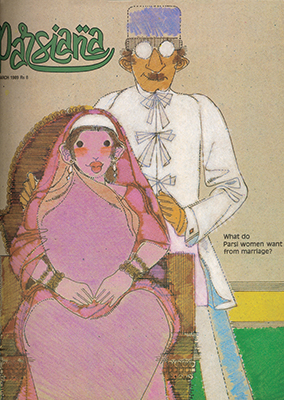
Illustration by Mickey Patel
January 2013 started with a unique conference in Navsari organized by the Meherjirana Library and Parzor. For three or four days, in an atmosphere of cordiality and respect, 18 foreign scholars of Zoroastrianism, most of them from prestigious foreign universities, and four Zoroastrian priests along with Parsi scholars spoke on different aspects of the faith in a truly Parsi ambience — chalk, toran, authentic Parsi cuisine, exposure to Parsi culture and drama with the enthusiastic participation of young and old residents of this old-style Parsi town, concluding with a tour of Parsi vads (localities) and visits to Parsi homes in Navsari. It was heartening that four young priests took leave from Surat to attend the gathering and learn more about their calling.
In October Parzor, along with the Bombay Parsi Punchayet (BPP), was able to persuade the Ministry of Minority Affairs, Government Of India, to support the program "Jiyo Parsi: The Central Sector Scheme for Containing Population Decline of Parsis in India.” The Rs 10 crore program will help Parsi couples facing fertility problems to avail of medical assistance to reverse the declining trend of the Parsi population. Around 200 couples would be covered.
Following a similar initiative undertaken by the Jewish community whereby young Jews are sponsored to visit and stay in Israel and bond with the Jews of the homeland, The Return To Roots program has been started for the diaspora Parsis, and the first batch will be coming to India during the 10th World Zoroastrian Congress (10WZC) in December. The effort to keep the global Parsi youth in touch with their homeland and bond with youth in India is another effort to keep the Zoroastrian flame burning.
That Zoroastrianism has been engendering interest in many countries is also evident. On December 21, 2013, when the Delhi Parsi Anjuman celebrates the anniversary of its dar-e-meher, there is a talk by Dr Khusro Khazai Pardis, director of the European Centre for Zoroastrian Studies in Belgium, who is himself a Zoroastrian and has written extensively on Zoroastrianism. That the pristine principles of the faith have drawn many followers in different lands with the whole hearted devotion of the new initiates puts to shame the indifference of the average Parsi towards the religion. Scholar Shahin Bekhradnia spoke about the rejuvenation of Zoroastrianism in Iran, with educated young Iranian men and women, familiar with English and holding university degrees, undergoing rigorous religious training and joining the priesthood as qualified mobedyars. In October of this year the School of Oriental and African Studies in London, in collaboration with several other sponsors, held the first ever international exhibition and conference on Zoroastrianism, bringing this ancient faith to the international community. The setting up of an eight-foot-wide steel Asho Farohar on Zoroastrian Faith Hill in London as part of seven man made hills dedicated to different religious faiths, the launching of the Zoroastrian All Party Parliamentary Group (ZAPPG) in England all testify to this growing interest. There was also the Singapore Conference held earlier, to celebrate the 3,000th anniversary of Zoroastrian culture. All these are healthy signs of a community stirring from its lethargy and endeavoring to take its place among world religions.
The 10WZC in Bombay was much awaited. It was therefore a sad spectacle to find the trustees of the apex body, the BPP, airing in public their internal agenda of squabbling, and in the mayhem that followed putting the very holding of the Congress in jeopardy at this late stage. But saner and wiser minds from India and across the globe came together with one voice to stop this madness and under the calm stewardship of Dr Cyrus Poonawalla and Nadir Godrej, the two main sponsors of the Congress, the program was put on track again. This uniting of the world community to ensure that the Congress goes on in spite of the four trustees of the BPP who voted to postpone it is itself a sign of our growing and determined togetherness.
So then what ails the community in India? While elsewhere, Zoroastrian communities are going the extra mile to keep Zoroastrianism thriving and readily joining interfaith groups and making the voice of Zoroaster heard and recognized worldwide, why are we in India burying our heads like ostriches in the sand and refusing to face up to the realities before us? If our long-term survival is the main threat should we not accept the causes of this pragmatically, take remedial action where possible as in the Jiyo Parsi scheme and where not possible accept the inevitable and turn it around as far as possible to the community’s advantage? This sadly is missing where it matters most — among the leadership of the largest group of Parsis based in Bombay.
I recall the president of the Federation of Zoroastrian Youth Associations of India summarizing a protracted discussion on marriages outside the community: "Tamé loko kaibi bolo pun jéné bahar punwu hosé té tau punséchuj (You may give any advice, but that will not deter a person planning to marry outside the faith)!” And one must understand that in a situation where it is difficult for youth to find suitable partners within the Parsi community, the alternative is non-marriage — a personal sacrifice they are not ready to make. More than late marriages and few births it is the looming percentage of spinsters and bachelors that is bringing down the population figures. When a male or female remains single, a whole line of prospective descendants is lost. Communities in the West and anjumans like Delhi strive to keep even the families of those married outside within the Parsi fold, ensure that the children meet and interact in the hope that it may lead to marriage. We have a harmonious community in Delhi because of our inclusive policies.
Coming back to the Congress, a wide variety of subjects are covered, all of interest and concern to the Parsi Zoroastrians. But pragmatism suggests that the Congress make headway in the following:
Bringing youth from across the diaspora closer together, with the twin advantage of creating awareness and pride in community membership and hopefully leading to marriages among them. In this, special efforts require to be made to include young Iranian Zoroastrians. Inability to communicate in English was an impediment that kept the two groups apart, but the scenario has changed and the growing tilt towards learning about the religion and taking to the priesthood and mobedyari among them may rub off among Parsi youth through contact.
Rather than the older generation clinging on to leadership positions and not involving youth in crucial decision making, the youth in all anjumans, and more so in the diaspora, should be given position and responsibility. The more the involvement, the more the likelihood of attachment to the community. Youth participants at the Congress must demand this and the Congress must carry the proposal forward.
Some mechanism must be worked out for the care of our elderly on the model adopted by the Calcutta Anjuman. This would be a seminal/worthy contribution of this Congress if we can make the last years of every needy Parsi free of pain, suffering and poverty.
Finally, we urgently need responsible and mature leadership in the tradition of the past when stalwarts led the community with their own examples of integrity, honesty, humility and putting the interest of the community always first and foremost. Will the recent pre-Congress fiasco spur our eminent Parsis — and we have so many all over the globe — to take greater and direct interest in steering the community along the right path?
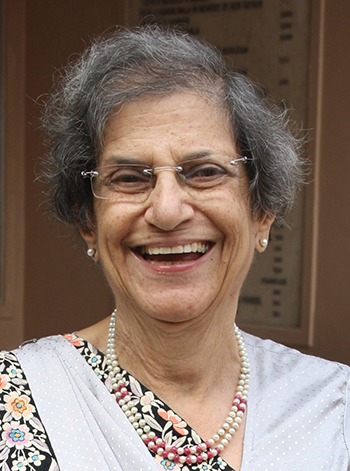
Ava Khullar has been involved in research on the Parsi community, especially concentrating on its demography and socioeconomic situation. She is an active member of the Parzor Foundation and is currently associated with its Craft Module which is reviving Parsi embroidery. She is vice president of the Delhi Parsi Anjuman.
◆ ◆ ◆
From the archive