
10WZC
Relevance of roots
The first batch of 16 overseas youngsters visited India to familiarize themselves with their Zoroastrian origins
Sitting prominently in the first row at the post-lunch session on the third day of the 10th World Zoroastrian Congress, December 29, 2013, were 16 Zoroastrian youth sporting white and green T-shirts with "RTR (Return to Roots) Fellow” emblazoned on them. The select youngsters from the diaspora were in Bombay to attend the Congress and to familiarize themselves with the community and its landmark institutions in the metropolis. Besides Bombay, the 14-day religious, social and cultural odyssey also took them to Sanjan, Udvada, Navsari and Surat to experience the journey that their forefathers had undertaken.
"Our youngsters are very capable. We must trust our youth,” commented Dr Shernaz Cama, co-chair of the RTR program that is functioning under the auspices of the Parzor Foundation where she serves as honorary director. Following her opening remarks, co-chair Aban Marker Kabraji introduced the four-member core team representing different regions: Dinsha Mistree (US and Canada), Rosheen Kabraji (UK, Europe, Pakistan and Iran), Shireen Havewala (India, UAE and Singapore) and Kaiyan Mistree (Australia, New Zealand and Hong Kong).
"Our youngsters are very capable. We must trust our youth,” commented Dr Shernaz Cama, co-chair of the RTR program that is functioning under the auspices of the Parzor Foundation where she serves as honorary director. Following her opening remarks, co-chair Aban Marker Kabraji introduced the four-member core team representing different regions: Dinsha Mistree (US and Canada), Rosheen Kabraji (UK, Europe, Pakistan and Iran), Shireen Havewala (India, UAE and Singapore) and Kaiyan Mistree (Australia, New Zealand and Hong Kong).
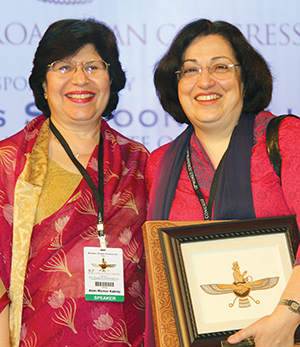
Aban Marker Kabraji (left) and Dr Shernaz Cama
Seeing his American friends from other faiths have opportunities to better acquaint themselves with their traditional roots by visiting the country where the religion had taken birth or had its principal followers, Dinsha Mistree, a PhD student at Princeton University, strongly felt the need to address this lacuna in the Zoroastrian community. "Now that Zoroastrians have this program, we want the youngsters to reconnect with their roots,” stated Dinsha. Whilst ideally they would like the program to encompass Iran, due to political reasons they are presently restricting themselves to India.
After the idea was initially mooted in May 2012, it took one-and-a-half years to organize the first RTR trip, stated Rosheen Kabraji, Asia program manager at Chatham House, a foreign policy think tank, in London. The RTR program will not only give youngsters an avenue to "Return to their roots,” but also to "Reconnect to their identity and revive the community,” she noted. They have plans "to institutionalize this youth led inclusive program that celebrates diversity” and urged the audience to "take this opportunity to meet” the RTR members.
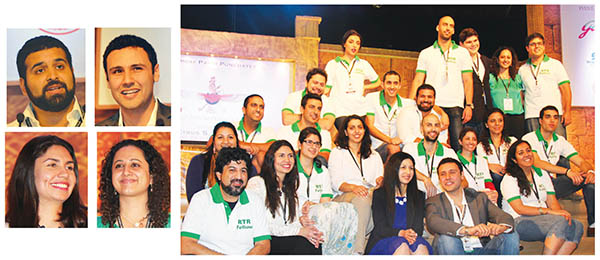
Core team (clockwise from top left) Kaiyan Mistree, Dinshaw Mistree, Shireen Havewala
and Rosheen Kabraji with Return to Roots participants
The pilot RTR trip in 2013-14 involving visits to consecrated agiaries and atash behrams, it was open only to those individuals who met the criteria of entry into these religious sites. Giving an overview of their itinerary in India, Kaiyan Mistree, an architect working for Hafeez Contractor mentioned that the RTR journey to Gujarat was planned from Varoli River, traversed Nargol and Sanjan where archeologist Rukshana Nanji familiarized them with her work on dakhma excavations. Besides visiting atash behrams in Surat they were taken to the Dotivala Bakery and the Munshi Farmhouse. In Navsari, in addition to paying their respects at the atash behram, the main attraction was the Meherjirana Library.
In Bombay, the participants were taken on the Parsi Heritage Tour, the Bhikha Behram Well, the iconic Taj Mahal Hotel and Bombay House in south Bombay with a meal at Britannia restaurant. A trip to the Dadar Parsi Colony and the Dadar Athornan Institute finally ended in a gala night on the rooftop at Bombay Parsi Punchayet trustee Jimmy Mistry’s Persepolis building in the Colony. "When you are living abroad you are insular,” but such opportunities for interaction with Zoroastrians in India provide "a connection and transformation,” observed Kaiyan.
As noted one of the youngsters who had registered for the trip, "Throughout the journey we wore the sudreh-kusti. The visits to agiaries and atash behrams would be worth a tour by itself.” Bridging the gap between Iranians and Parsis was another outcome of this "incredible program” remarked another participant.
A parallel trip to be launched later in 2014 will be open to all participants who have at least one Zoroastrian parent, or to prospective scholars, mentions their website zororoots.org. It will focus on exposing the Zoroastrian diaspora to the contribution of Zoroastrians in India to business, science, government, philanthropy, arts and music, education by participating in internships/professional visits. This trip will also include religious elements in the form of visits to Zoroastrian religious institutions that are open to all and viewing a demonstration of a jashan ceremony.
The Zoroastrian RTR program being born out of "the increasing disconnect” between Zoroastrians in the diaspora with their ancestral communities in Iran and India the core team has plans to create a network of RTR global alumni. To foster life-long relationships, they will have regular follow-ups, annual reunions and instant connectivity through Facebook and WhatsApp.
"To build a strong future with a Zoroastrian identity,” it is important to sustain this program, explained Havewala who is currently a senior officer and project manager with the Royal Bank of Scotland Foundation, India. To encourage "the positive voice of Zoroastrianism to resonate among youngsters we need your support,” she added. Building a Return to Roots Foundation with a sound financial corpus for future generations of Zoroastrians is on their agenda to "return to the community the glory it rightly deserves.”
◆ ◆ ◆
From the archive