
Politics and Policy
Reining in the radicals - III
Burjor Antia’s speech at the Federation meeting spurred the orthodox members to castigate the non-conformists
"The main tragedy of the community today is a conspicuous absence of dynamic leadership,” pointed out former Bombay Parsi Punchayet (BPP) trustee Burjor Antia. He was invited as guest speaker to address the members of the Federation of the Parsi Zoroastrian Anjumans of India on the second day, October 10, 2010 (10-10-10) which he considered "the most auspicious day of the century.” Sharing his thoughts for the survival of the Zarathushti community in a changing world, Antia reminded the members "to fulfil their obligation to follow their race and their religion,” respecting our forefathers who had migrated to India "with no material possessions, only invincible spiritual heritage.” According to him the pledge to Jadi Rana required us to live harmoniously as "brothers to other communities,” not intermarry and live as brothers-in-law!
Referring to the community’s current affluence with 1,200 public charity trusts in Bombay and an equal number in Gujarat, Antia regretted that "today we are a house divided… No one wants to follow the orders of the great Prophet. Every one wants to be a field marshal. For problems of 100 Parsis there are 101 solutions. We don’t want to adhere to religious precepts for the larger interest of the community…No one can defeat us unless we first defeat ourselves…We need to adopt an integrated and cohesive approach to solve problems.”
Observing the drift away from the community, Antia lamented that "the zeal and fervor of religion has reduced” in the community "in the absence of guidance from priests.” With some people marrying members of other communities, casting aside their sudreh-kusti, visiting shrines/churches and dargahs of other faiths, smoking cigarettes and polluting the fire, there is need for "reconversion of certain Zoroastrians to a true Zoroastrian way of life so that the community becomes vibrant and versatile.” He was critical of collegians who instead of studying were wasting their time in the canteens and flirting.
His seven-fold pathway to survival recommended dissemination of knowledge of traditions and religion, particularly to the children and youth; providing accommodation to the needy and those waiting to get married; offering educational and vocational guidance; assisting children of athornan families with educational, financial and social help; encouraging the performance of higher liturgical ceremonies by well trained priests for in the absence of priests there can be no community and no religion; finding jobs and livelihood; giving medical help particularly to the elders.
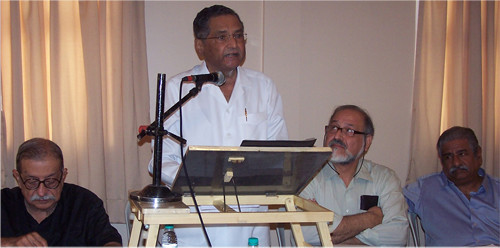
From left: Areez Khambatta, Burjor Antia, Khojeste Mistree and Dinshaw Mehta
"What is the problem of Parsis in Bombay we don’t know,” observed Bomi Heerjee of Indore wondering whether they are "laid-back with the fruits and comforts of the metropolis.” He felt there was need to make them "adventurous, innovative, forward-looking so that they understand there is scope outside Bombay… The Parsi mettle deserves to be tried and tested.”
"Instead of using our resources on this vision…the focus has shifted to a negative, destructive approach… (with) glorification of the wrong things,” commented Antia who sought to ascertain whether his views were supported by the largely orthodox Federation body by taking a "snap poll” on issues like the Maloo-D’Souza navjotes and Mikhail Chistyakov’s attempts to become a priest. "Is it proper on the part of the community to glorify such irreligious acts?” he enquired. Since no one replied in the affirmative he concluded that the Federation delegates were unanimously in agreement with him and "the whole community is against such kind of actions.” Antia announced, "Once the floodgates of conversion are opened, quantity will replace quality. With the morass of amorphous tide, extinction of the community will be certain and immediate” and there will be no Parsi community as it exists today and no Federation meeting.
"It is ethnic traits that regulate the characteristics of a tribe and race,” declared Antia referring to the icons the community has produced in the industrial, political and nuclear fields. "Have mixed marriages produced such icons?” he challenged (J. R. D. Tata and Neville Wadia’s names seemed to have eluded those present). "All strong characters and peoples are race conscious, and are instinctively averse to marriage outside their own racial group,” Antia quoted the words said to be of Nobel Prize winners Will and Ariel Durant from their book The Lessons of History. He was convinced "Parsi Zoroastrians have survived because our forefathers did not indulge in hotchpotch of religion and race.”
Viewing the past as "glorious,” the present as "perilous” and the future as "dim and dark” he was sanguine the continuity of the ethnic group lay "in the hands of the educated and enlightened community. If we are steadfast to our religion and traditions we will survive.” He advocated allegiance even if one’s bones may be broken or memory lost or soul leaves the body as recommended in the Vendidad (pargarad 19). "The principles of religion do not become obsolete because man has reached the moon.” Being a visionary Zarathushtra understood doctrines which science has just begin to discover.
Sympathetic to the present BPP trustees who are the favorite "whipping boys” of the community, Antia, who had once resigned from the BPP board as he could not function with a co-trustee, now declared, "Why break (their work)? Why not strengthen?”
Seeing in Antia’s inspiring message "the encouragement to carry on the fight” against conversion, against the renegade priests, BPP chairman Dinshaw Mehta sought support from the Federation members to pass resolutions they could produce in court (see "Reining in the radicals,” Parsiana, October 21, 2010). Ervad Yezdi Panthaky representing Saronda regretted that the people supporting the renegade priests "are mostly from the priest class.” He also felt that "the digressive views of editors favoring some (reformists) is not becoming the community.”
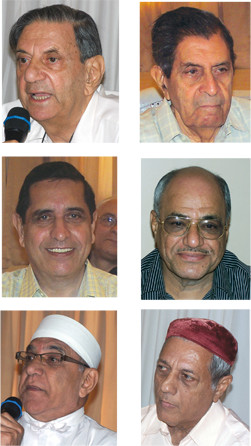
Clockwise from top left: Jamsheed Kanga, Bomi Heerjee, Kerfegar Antia, Marzban Giara, Ervad Yezdi Panthaky and Noshir Paghdiwalla
Vice president of Federation (south zone) Kerfegar Antia referred to his experience of writing a letter against conversion that Parsiana carried, which elicited other letters all critical of his views "but not a single one in my favor.” When one of the delegates commented, "There is no need to keep on writing. What’s the point?” vice president of west zone B Areez Khambatta advocated, "Be in attack mode. Siddhi aanglié ghee nahi niklé (ghee cannot be emptied unless the finger is bent). We have to be red blooded. Show them a daandaa (stick)... Laakdi aagal bakri naaché (a goat can be tamed with a stick)… With their expertise in writing they take advantage of us, humiliate us… turning and twisting so that right becomes wrong and wrong becomes right… That’s what I objected to…Take strong action by boycotting them even from Federation meetings.”
"As an editor no one has the right to take a one-sided view,” maintained Panthaky recalling how the founder editor of Parsiana Dr Pestonji Warden insisted that the people who roll out the first issue of Parsiana should all be Parsis.
Wasting the time and energy of the community in litigation is indicative of "a sick mind” stated Burjor Antia, a senior partner in the legal firm of Mulla and Mulla. Instead of spending lakhs on litigation by going to the courts or the Press, he recommended setting up a Central Arbitration Tribunal comprising well read persons. When Noshir Paghdiwalla of the Borivli and Suburban Zoroastrian Association mentioned, "Who can be better than the high priests (as arbitrators)…but are we able to digest their information?” Antia responded that along with the high priests some social workers and other well-known persons should also be included. A small community which is declining at the rate of seven percent each year (it’s around one percent – editors) has to learn to "coexist by adopting a policy of live and let live and being tolerant; not belittling the community or the Parsipanu brand.” There is no need to fear the decline in community numbers for "there are 24 countries in the United Nations with a population less than the Zoroastrian strength in India,” remarked Antia.
"In our community priests only talk among themselves unlike in the olden days when (High Priests like Dasturs) Khurshed Dabu and Navrooz Minochehr-Homji guided us in all matters,” stated Jamsheed Kanga representing Satara. "In the history of the Parsi Punchayet, in the 1940s-50s in Sir Rustom Masani’s time there used to be a conclave of priests every few years. The Punchayet should organize a healthy dialog whereby if the priests say something, they explain why it is right or wrong. We are a very intelligent community, not dumb driven cattle. No one questions their (high priests’) learning but we should not be condemned for asking questions. Why abuse, ridicule, blame those who ask questions? If they can’t answer they should say so,” added Kanga.
"There is no dearth of religious education but dearth of people willing to learn,” stated Marzban Giara representing Jam-e-Jamshed. He alluded to the regular discourses conducted by the K. R. Cama Oriental Institute and Mehta mentioned that the Punchayet organizes fortnightly talks by scholar priests or high priests under the auspices of the Zartoshty Brothers Fund. Working with Burjor Antia and the M. F. Cama Athornan Institute, and with the "blessings of Nusli Wadia” they are planning to introduce a course that will produce religious scholars.
"How many religious talks have you been to?” Federation joint honorary secretary and BPP trustee Khojeste
Mistree enquired of Kanga. Describing Kanga’s statements over the two days as "hogwash,” Mistree claimed, "By nature I’m quiet. I’m a person who will listen with an open mind.” Being provoked by Kanga’s statements, he countered, "Don’t make a sob story. It’s time you heard what the High Priests have to say… They have castigated the renegade priests… But you want to challenge their authority (Kanga being one of the appellants who has challenged the BPP diktat barring Ervads Khushroo Madon and Framroze Mirza from performing religious ceremonies at the Doongerwadi and two Punchayet owned agiaries). Scriptural evidence will not come in the form you want… You cannot have a dialog with a person who has a totally closed mind. You are no academician… do not understand Avesta-Pahlavi…There is no sense talking with a politician… Now that you are retired perhaps you should study the religion.”
(The next report on the Federation proceedings will appear in the December 7, 2010 issue of Parsiana.)
◆ ◆ ◆
From the archive