
10WZC
The fate of the faithful
Global representatives shared their experiences of attempting to preserve the religious identity
That time is ticking away for the community becomes evident in unexpected ways. There were only two sessions at the 10th World Zoroastrian Congress (10WZC) that accommodated presentations from as many as seven speakers each. At both these sessions, speakers who were originally assigned 20 minutes each, were requested by the organizers to truncate their contents within one-third that time. With his eyes constantly on the timepiece, Dorab Mistry, former president of the Zoroastrian Trust Funds of Europe (ZTFE), chaired both the discussions: "Affirming the Global Parsi Iranian Zoroastrian Identity” that was the topic explored on the first day, December 27, and the one on the second day devoted to "Practices of the Zoroastrian Faith in India and Other Parts of the World – Future of Parsi Irani Communities in India and the Diaspora.”
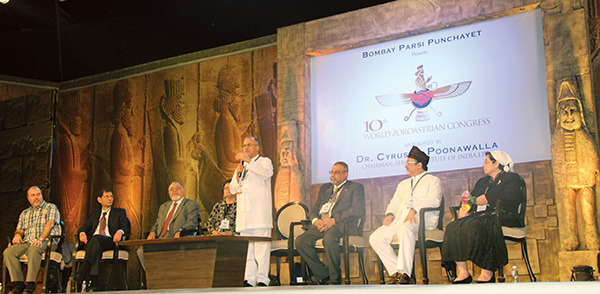
(From left): Malcolm Deboo, Sarosh Maneckshaw, Parviz Varjavand, Katayun Kapadia, Dorab Mistry,
Bomi Patel, Firoz Pestonji and Pervin Mistry;
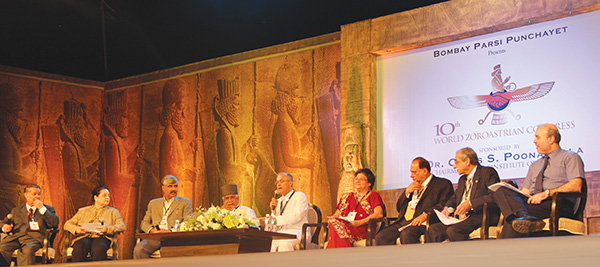
(From left): Alayar Dabestani, Meher Bhesania, Dr Esfandiar Ekhtiyari, Dinshaw Mehta, D. Mistry,
Kapadia, Sarosh Bharucha, Rohinton Rivetna and Deboo
The Zoroastrian community is "fast becoming exogamous (marrying outside the ethnic group), compromising and disintegrated world-wide.” Fortunately, "its integrity and industry is alive and well,” observed Rohinton Rivetna, former president of the Federation of Zoroastrian Associations of North America (FEZANA) at the first day’s discussion. Whilst change as an evolutionary trend is inevitable, when dismantling the old identity we need to do so after deep thought. If there is no identity there would be no community, just as if there is no demographics there would be no community, he believed. "Where did our identity come from? From the Prophet who came from Iran,” stated Rivetna before amplifying that although a religion develops from the prophetic vision, the beauty and rationale of its customs may lie hidden. Referring to the language divide between the Iranians and Parsis, Rivetna commented, "If we don’t understand the language of each other, can we know each other?... How much do we know about Zarathushtis in Iran?”
"The Zoroastrian community in Iran is among the most literate and doing its best to help preserve its identity,” remarked Dr Esfandiar Ekhtiyari, the Zoroastrian representative on the Iranian Majlis. His speech in Farsi was translated into English by Alayar Dabestani from USA. Ekhtiyari further reminded, "During hardships they sacrificed their comforts but preserved their identity.” Coming to their help in those times were Parsis from India like Manekji Limji Hataria, appreciated Ekhtiyari. This debt was repaid when Iranian philanthropists like the Guiv and Zartoshty families contributed to establish the Zoroastrian identity in the UK and USA, pointed out Mistry.
"Parsis in Bombay continue to feel a strong sense of community identity,” maintained Bombay Parsi Punchayet (BPP) chairman Dinshaw Mehta. A major reason for this is community housing, he believed. According to his estimates, 25,000 Parsis in the city must be residing "in community conglomerates.” The Punchayet controls 4,500 flats; there must be another 1,000 flats in community buildings managed by different Parsi trusts with nearly 350 buildings at the Dadar Parsi Colony. This identity is quite distinct from the one experienced by those in Delhi, Iran or London. The UK community that was "always toeing the BPP line is now becoming independent and they have their own identity,” said Mehta, egging Mistry to share information on the ZTFE’s recent decision to grant equal rights to Zoroastrian women who have married out of the community. Citing lack of time, Mistry did not elaborate on this subject. (The ZTFE permits children of Parsi women married to non-Parsis membership to the association.)
The first Zoroastrian association in the West, the ZTFE was established in 1861 "to preserve our identity,” and two years later purchased a plot of land as an aramgah "to ensure Zoroastrian burial rites,” declared ZTFE president Malcolm Deboo. In 1929 they established their first Zoroastrian House which had to change locations and size as the community grew until in 2005 they moved into their present Zoroastrian Centre at Harrow. Munificent contributions from philanthropic Zoroastrians helped announce their presence in the region with the Readymoneys contributing towards the construction of a fountain at Eden Park, Sir Dhunjibhoy Bomanji for the erection of a statue at the Hague, and Jamsetji Tata establishing his connections with the Lancashire Mills. Deboo then alluded to their recent efforts to establish a chair in Zoroastrian Studies at the School of Oriental and African Studies (SOAS) with the financial support of the Zartoshty Brothers, and "The Everlasting Flame” exhibition held at SOAS in the last quarter of 2013. Two hundred posters of a priest tending a fire were placed in the London tube stations. Over 25,000 Zoroastrian and non-Zoroastrian visitors visited the exhibition that ran for two months. "What the ZTFE is doing is looking out to establish a Zoroastrian identity… so that others recognize us,” said Deboo.
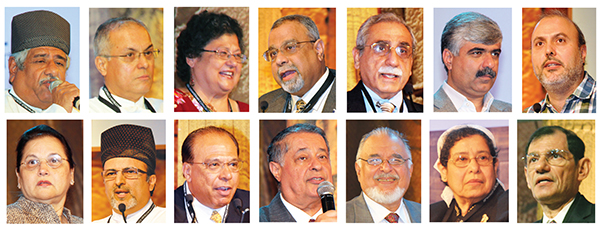
(Clockwise from top left): Dinshaw Mehta, Dorab Mistry, Katayun Kapadia, Bomi Patel, Rohinton Rivetna,
Dr Esfandiar Ekhtiyari, Malcolm Deboo, Sarosh Maneckshaw, Pervin Mistry, Parviz Varjavand, Alayar Dabestani,
Sarosh Bharucha, Firoz Pestonji and Meher Bhesania
"Whilst we all follow the Zoroastrian religion we do not follow the same rituals, practices” observed FEZANA president Katayun Kapadia. "How will we maintain the religious identity so that there is no assimilation in the host country?” she enquired referring to their efforts in North America to institutionalize gahanbars, participate in multifaith activities as also those organized by the United Nations, initiate the Zoroastrian Symphony Orchestra, come together for Zoroastrian sports, create awareness of the Cyrus Cylinder when it was touring North America. "Our tiny community faces a danger of multitude schisms… Being born into a particular religion is not an accident of birth but God’s divine plan,” she believed and urged all the members to be "knowledgeable about their religion, culture and history” and appreciate that "Zoroastrian precepts have been borrowed by many major religions.” She also recommended that the Return to Roots program that encourages overseas Zoroastrian youth to familiarize themselves with the lifestyle of their counterparts in India be institutionalized. "The future of the community is precarious. We need to make collective, united efforts… so that Zarathushtis are identifiable, first to each other and then to the world,” she advocated.
"We are a middle-of-the-road organization,” announced Sarosh Bharucha, then president of the Zoroastrian Society of Ontario, adding, "We do not excommunicate those who have married outside the faith. We accept intermarried couples. (Outmarried) women have the same privileges as men. Our mobeds perform ceremonies for intermarried couples, the navjotes of their children and even of the adopted children. Our dadgah room is open to all… We believe, ‘once a Zoroastrian, always a Zoroastrian.’ In Canada, our land is large, our hearts are larger… Six thousand Zoroastrians have made Toronto their home. Ontario is ‘D’destination of choice.” Ending with some lines from Arthur Hugh Clough’s poem "Say not the Struggle Naught Availeth” Bharucha reinforced, "When daylight comes, comes in the light…But westward look, the land is bright!” Jested Mistry, "The Canadian tourism portal couldn’t have done a better job!”
Urging the community to be "a cut above the rest,” Meher Bhesania of Dubai who had chaired the Ninth WZC reinforced the importance of playing "a more meaningful role in the 21st century…by addressing the challenges in quantity, quality and entrepreneurship.” With the community numbering around 2,000 in the Gulf Cooperation Council she felt "affirming the Zoroastrian identity should be the buzz word.” If the identity could be promoted with some graphic logo or design, it will be further strengthened.
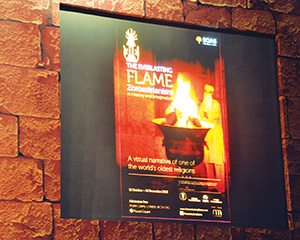
Poster of "The Everlasting Flame" exhibition
Religious rejuvenation
At the session on "Practices of the Zoroastrian Faith in India and Other Parts of the World – Future of Parsi Irani Communities in India and the Diaspora,” there was not a single speaker from India. Five of the seven panelists were from North America, the other two being from the UK and Australia.
Migrations from India to the West in the 1960s started "not for religious purposes but purely materialistic reasons,” commented Ontario resident Pervin Mistry who regretted that the "religion of faith has become a cult of convenience.” According to her, mobeds in the West took religious education in their own hands instead of appreciating that "religion is based on truth that can never change. Our perception of truth changes with time or spiritual evolution…Change is the most mischievous weapon and fails at the end.” To those who recommend we should pray in a language that is understood, she counseled, "Manthra Spenta is the soul of Ahura Mazda… If we give up one discipline, the next generation will never pick it up…We need to remain steadfast.” Zoroastrians from Iran who settled in India in the eighth century managed to retain their religion "because of closed door policies” unlike those who migrated to Europe and China who merged with the mainstream because of intermarriage, she added.
Kapadia mentioned that "it requires adaptability to practice the religion” in North America and that "practice is encouraged with an eye on the future growth of the population…Our prayers and rituals need to make sense and provide an irresistible gravitational pull” to the younger generation who finding them irrelevant to daily life may dismiss them not because they are drawn to another religion but choose instead to follow "no religion.” Under the guidance of two mobed councils in North America they observe gahanbars and perform jashans according to different calendars "upholding the commitment to autonomy of each member association and harmony in diversity.”
She further referred to the efforts of Ervad Soli Dastur whose one hour weekly sessions on the Internet seek to educate the elders on the rituals and practices of the faith. Considering that the future in India is grim with community numbers expected to come down to 30,000 by 2050, Kapadia stated, "The North American diaspora may be the number one Zoroastrian community.” To acquaint the younger generation with "the glory and grandeur of our religion,” she felt it was imperative to "respect the values of others with wisdom and compassion. It is not how we pray that matters but how we choose to live the choices that we make.”
There being fewer mobeds in North America, instead of multiple priests there may be one priest performing a ceremony, stated erstwhile FEZANA president Bomi Patel referring to complex rituals like the vendidad undertaken at the inauguration of the North Texas Darbe Mehr and the farishta at the inauguration of the Zoroastrian Center in California. "In all our ceremonies, everyone is welcome depending on the wishes of the family/mobed/association. We respect that.” He further clarified, "Neither do we force nor dissuade conversion but accept them as part of our family.” With Roshan Rivetna’s demographic study showing there has been a 33.5% rise in community numbers in the US between 2004 and 2012 and 12% in Canada in the same period, Patel declared, "The future of the Zarathushti faith does not look bleak.” They have learnt that when "laying the groundwork for the next generation, we need not only traditions and practices but we also need open-mindedness and acceptance.”
"The reform movement has rung the death knell for Parsis in North America,” declared Sarosh Maneckshaw of Houston before describing the profile of a typical North American Zoroastrian: "very well educated, upper middle class, assimilated and integrated within North America, abandoned rituals and traditions, stopped wearing the sudreh-kusti… A typical North American Parsi is secular, pluralist and universalist. We love everybody…” The Parsi identity in North America "will disappear within the next two generations,” he feared. Instead of the apocryphal narration of Parsis adding sugar to milk, "we have added water to milk and diluted our identity,” he asserted. Critical of Ali Jafarey’s "reform movement” and the subsequent demarcation between Parsi and Zoroastrian, Maneckshaw regretted, "The word ‘Parsi’ is not used by FEZANA and seldom appears in the FEZANA Journal.”
In Iran, "we are left with a lot of property, fire temples, waqfs without anyone attending to them,” mentioned Parviz Varjavand who reported that "number-wise, the future looks grim as the young group is shrinking, with youngsters emigrating to the West.” Having returned to Iran after a stay in Lebanon, the US and Canada, Varjavand added, "There is a strength in the native soil that does not exist anywhere else.” Whenever the two groups from Iran and India "come together, there is always rejuvenation,” stated Varjavand. Migrants to America "get their strength from Iranian sources of knowledge and priesthood.” They are proud of their women mobedyars. It is not that they are swayed by Ali Jafarey, "The Iranians have a mind set that is very down to earth and different.” He shared his elation that the body of water continues to be known as the Persian Gulf although there are attempts to rename it the Arabian Gulf.
The first navjote in the UK was performed during World War I by Dastur Maneckji Dhalla and the first wedding by Ervad Sorabji Kutar during World War II, stated Deboo, adding, the Parsi community became more established there following the Independence of India. Originally the migrants were entirely from the subcontinent but in the 1960s several came from Africa and in 1979 from Iran. "We participate heavily in interfaith activities…to say who we are and to help the hosts understand us.” The community in the UK is "not radical…has progressed rationally,” said Deboo who felt "the future appears to be mixed.” In a subsequent email to Parsiana Deboo shared the 2011 census data according to which there are 4,105 Zoroastrians in England and Wales, with 2,235 Zoroastrians spread over 33 buroughs in London.
The Parsi community is known for its "history, integrity, ethnicity… but we will go nowhere unless we have a game plan,” observed Firoz Pestonji, president of the Business Association of Western Australian Zoroastrians. Whilst WA or West Australia was once deprecatingly referred to as Wait Awhile, it is now euphemistically described as the Wealth of Australia with its vast resources of mineral and gas. From 1,000 in 1999 to over 2,500 in 2013, the Zoroastrian community in Australia has shown an increase of 2.5 times in the last nearly 15 years. Pestonji had brought with him flowers of different hues to represent different countries and just as placing them together formed a beautiful bouquet, the coming together of Zoroastrians from different regions would constitute a "wonderful community,” he was sanguine.
At the session on "Practices of the Zoroastrian Faith in India and Other Parts of the World – Future of Parsi Irani Communities in India and the Diaspora,” there was not a single speaker from India. Five of the seven panelists were from North America, the other two being from the UK and Australia.
Migrations from India to the West in the 1960s started "not for religious purposes but purely materialistic reasons,” commented Ontario resident Pervin Mistry who regretted that the "religion of faith has become a cult of convenience.” According to her, mobeds in the West took religious education in their own hands instead of appreciating that "religion is based on truth that can never change. Our perception of truth changes with time or spiritual evolution…Change is the most mischievous weapon and fails at the end.” To those who recommend we should pray in a language that is understood, she counseled, "Manthra Spenta is the soul of Ahura Mazda… If we give up one discipline, the next generation will never pick it up…We need to remain steadfast.” Zoroastrians from Iran who settled in India in the eighth century managed to retain their religion "because of closed door policies” unlike those who migrated to Europe and China who merged with the mainstream because of intermarriage, she added.
Kapadia mentioned that "it requires adaptability to practice the religion” in North America and that "practice is encouraged with an eye on the future growth of the population…Our prayers and rituals need to make sense and provide an irresistible gravitational pull” to the younger generation who finding them irrelevant to daily life may dismiss them not because they are drawn to another religion but choose instead to follow "no religion.” Under the guidance of two mobed councils in North America they observe gahanbars and perform jashans according to different calendars "upholding the commitment to autonomy of each member association and harmony in diversity.”
She further referred to the efforts of Ervad Soli Dastur whose one hour weekly sessions on the Internet seek to educate the elders on the rituals and practices of the faith. Considering that the future in India is grim with community numbers expected to come down to 30,000 by 2050, Kapadia stated, "The North American diaspora may be the number one Zoroastrian community.” To acquaint the younger generation with "the glory and grandeur of our religion,” she felt it was imperative to "respect the values of others with wisdom and compassion. It is not how we pray that matters but how we choose to live the choices that we make.”
There being fewer mobeds in North America, instead of multiple priests there may be one priest performing a ceremony, stated erstwhile FEZANA president Bomi Patel referring to complex rituals like the vendidad undertaken at the inauguration of the North Texas Darbe Mehr and the farishta at the inauguration of the Zoroastrian Center in California. "In all our ceremonies, everyone is welcome depending on the wishes of the family/mobed/association. We respect that.” He further clarified, "Neither do we force nor dissuade conversion but accept them as part of our family.” With Roshan Rivetna’s demographic study showing there has been a 33.5% rise in community numbers in the US between 2004 and 2012 and 12% in Canada in the same period, Patel declared, "The future of the Zarathushti faith does not look bleak.” They have learnt that when "laying the groundwork for the next generation, we need not only traditions and practices but we also need open-mindedness and acceptance.”
"The reform movement has rung the death knell for Parsis in North America,” declared Sarosh Maneckshaw of Houston before describing the profile of a typical North American Zoroastrian: "very well educated, upper middle class, assimilated and integrated within North America, abandoned rituals and traditions, stopped wearing the sudreh-kusti… A typical North American Parsi is secular, pluralist and universalist. We love everybody…” The Parsi identity in North America "will disappear within the next two generations,” he feared. Instead of the apocryphal narration of Parsis adding sugar to milk, "we have added water to milk and diluted our identity,” he asserted. Critical of Ali Jafarey’s "reform movement” and the subsequent demarcation between Parsi and Zoroastrian, Maneckshaw regretted, "The word ‘Parsi’ is not used by FEZANA and seldom appears in the FEZANA Journal.”
In Iran, "we are left with a lot of property, fire temples, waqfs without anyone attending to them,” mentioned Parviz Varjavand who reported that "number-wise, the future looks grim as the young group is shrinking, with youngsters emigrating to the West.” Having returned to Iran after a stay in Lebanon, the US and Canada, Varjavand added, "There is a strength in the native soil that does not exist anywhere else.” Whenever the two groups from Iran and India "come together, there is always rejuvenation,” stated Varjavand. Migrants to America "get their strength from Iranian sources of knowledge and priesthood.” They are proud of their women mobedyars. It is not that they are swayed by Ali Jafarey, "The Iranians have a mind set that is very down to earth and different.” He shared his elation that the body of water continues to be known as the Persian Gulf although there are attempts to rename it the Arabian Gulf.
The first navjote in the UK was performed during World War I by Dastur Maneckji Dhalla and the first wedding by Ervad Sorabji Kutar during World War II, stated Deboo, adding, the Parsi community became more established there following the Independence of India. Originally the migrants were entirely from the subcontinent but in the 1960s several came from Africa and in 1979 from Iran. "We participate heavily in interfaith activities…to say who we are and to help the hosts understand us.” The community in the UK is "not radical…has progressed rationally,” said Deboo who felt "the future appears to be mixed.” In a subsequent email to Parsiana Deboo shared the 2011 census data according to which there are 4,105 Zoroastrians in England and Wales, with 2,235 Zoroastrians spread over 33 buroughs in London.
The Parsi community is known for its "history, integrity, ethnicity… but we will go nowhere unless we have a game plan,” observed Firoz Pestonji, president of the Business Association of Western Australian Zoroastrians. Whilst WA or West Australia was once deprecatingly referred to as Wait Awhile, it is now euphemistically described as the Wealth of Australia with its vast resources of mineral and gas. From 1,000 in 1999 to over 2,500 in 2013, the Zoroastrian community in Australia has shown an increase of 2.5 times in the last nearly 15 years. Pestonji had brought with him flowers of different hues to represent different countries and just as placing them together formed a beautiful bouquet, the coming together of Zoroastrians from different regions would constitute a "wonderful community,” he was sanguine.
◆ ◆ ◆
From the archive