
Of palaces and kings
The Palace of Darius at Susa — The Great Royal Residence of Achaemenid Persia edited by Jean Perrot; translated from the original French publication by Dominique and Gérard Collon. Pp. xxxii + 507. (I. B. Tauris & Co. Ltd., London, 2013). Price not indicated.
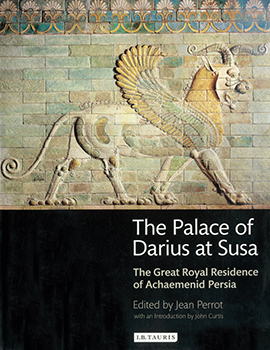 This magnificent volume, replete with several modern color photographs, some early monochrome plates, pertinent architectural drawings and detailed plans, with diagrams to accompany its authoritative text, will remain an imposing monument to the best of French scholarship. Originally published by Les Presses de l’Université Paris-Sorbonne in 2010, it now makes its appearance in a robust English translation by Dominique and Gérard Collon.
 Its impressive sponsorship listing includes deeply committed individuals and well-known foundations, among whom is the Bombay family of the late Cooverji Hormusji Bhabha.
Fourteen awesomely erudite chapters dealing with particular aspects of history, archeology and artifacts are prefaced by a well-integrated Introduction by Dr John Curtis, Keeper of Special Middle East Projects at the British Museum, London. In the finest traditions of mutually respected cross-Channel scholarship with its thoroughgoing researches, it is fitting to acknowledge this multi-faceted Franco-British cooperation whose results have culminated in the large tome under review.
From the French edition of the late Professor Jean Perrot (1920-2012) who had led two major archeological expeditions to Iran between 1968 and 1979, the collection includes his Foreword and three chapters, "The Franco-Iranian Programme,” "Restoration, Reconstruction” and "Darius in his time.” He cites Balzac’s observation: "And, for man, the past resembles the future singularly. Is not telling him what was, almost telling him what will be?” It is with such clear-cut purpose that this volume sets out to detail Susa’s historical and archeological setting.
Rash indeed would be the impetuous student-reader who, in understandable haste to savor the well captioned excellently reproduced plates, would plunge into the various deeps without due regard for Curtis’ important Introduction. He briefly covers the Biblical story and the mid-19th century British digs which firstly noted the condition of the three gigantic Susa mounds: the Apadana (Audience Hall), the Acropolis (Citadel), and the Ville Royale (Royal Precincts).
Their finds were unappreciated and no more work was done at the vast site until recommenced from the 1880s onwards by the French who had judiciously wrung excavating concessions — with some preliminary haggling — from the Qajar monarchs. Initially it was allowed that the precious metal finds could be expatriated against compensatory financial consideration to Iran. In 1900 they obtained sole rights from Shah Muzaffar ed-Din to remit all finds to France.
Among the estimable names of the early French excavators are the Dieulafoy husband and wife duo, Marcel and Jane, who methodically dug at Susa where the redoubtable Jane, clad in male attire (to not attract attention in Muslim lands!), worked devotedly beside her husband, he skilfully drawing, and she photographing everywhere and unearthing the friezes and glazed tilework now to be seen in the Louvre Museum, Paris. Jane had even made time to author a novel, Parysatis, (illegitimate daughter of Antaxerxes I, Emperor of Persia) Parizad, which formed the basis of Saint-Saëns’ opera of that name (1902).
Susa was the capital of Elam that lay east and north of the upper Persian Gulf. Its hoary civilization ranges conventionally across the Proto-, Old-, Middle-, and Neo-Elamite epochs from the late 4th millennium BCE to 539 BCE when Cyrus II ("the Great”) from the adjacent highland province of Anshan incorporated it within the Achemenid Empire. Susa itself was founded around 4000 BCE, and in Neo-Elamite times became its capital. Its choice of location for the winter palace of Darius I and his successors may have been prompted by its ancient cultural, historical, and perhaps even militarist potentials.
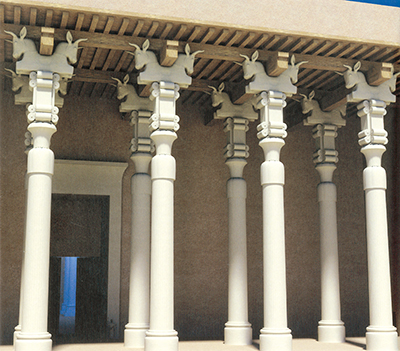
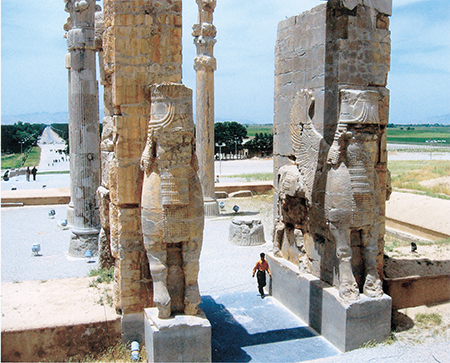
Column capitals of the north portico of the Hypostyle Hall
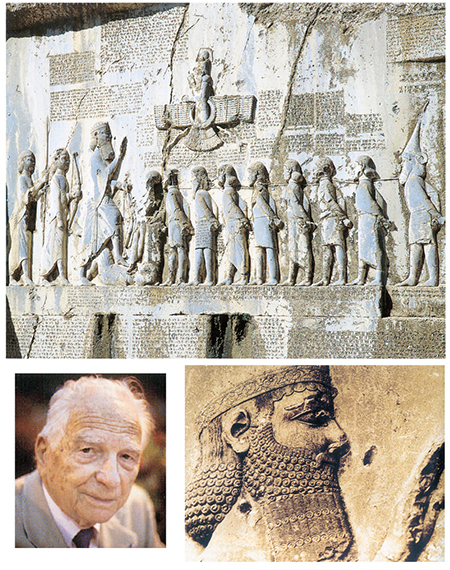
At any rate, it was important enough for his major inscriptions (e.g., at Behistun, and here at Susa) to be graven in the three central languages of the Empire – Akkadian (Babylonian), Old Persian, and Elamite which, unlike the first two, was neither Semitic nor Indo-European. All were recorded in cuneiform (wedge-shaped) characters, and of these Old Persian — or "Aryan” as Darius calls it — presents the least complexities of decipherment.
The site at Susa well illustrates the symbiosis of Persians and Elamites (inhabitants of Khazistan and Fars in southern Iran). As meeting ground firstly for Semites and Elamites, the region was to pivotally serve for Elamite expansion. For the Achemenids who later brought Elam under Persian suzerainty, its importance extended deep into the new, Aryan, empire. Thus it was that in Darius I’s cuneiform proclamations, Elam was mentioned directly after the ancestral heartland. It will be recalled also that the thousands of administrative clay tablets from Parsa/Persepolis were impressed in Elamite, indicating again the cultural influence of the language and its scribal learning on the very economy of the new Aryan dynasty.
Inscriptions at Susa
Darius I (ruled 522-486 BCE) was undoubtedly the mastermind over the entire conceptualization of the palace, citadel and royal precinct at the vast Susa complex. It has been averred by some observers that Susa’s importance exceeds overall even that of Persepolis. Several inscriptions dictated by His Imperial Majesty — "Imperial” in every rightful sense — have been retrieved and closely studied by technical archeologists and historians of all shades.
Mostly fragmentary, and ingeniously reconstructed from scattered clay copies, they mainly give us Darius’ lineage and Aryan ancestry, his indebtedness to Ahura Mazda for his kingship, personal achievements and high moral character.
As per details available of Darius’ building activity for his Susa palace: on his orders the materials were gathered and imported from afar; he arranged that the foundations be dug to bedrock depths varying from 60 to 30 feet (18 to 9 metres), then packed with tamped down rubble (hardcore) upon which his palace was constructed. The sun dried bricks were shaped and laid by Babylonians; cedar came from Phoenicia (Lebanon); sissoo wood (yaka, Persian jagh) from Gandhara and Kerman; ebony from (Upper?) Egypt; gold, silver and ivory from neighboring lands, as did lapis lazuli, carnelian, and turquoise; stone columns were cut and carved by Asiatic Greeks from the western reaches of Darius’ far-flung satrapies... Those massive stone columns rested on bell shaped, finely carved bases, and topped by huge addorsed (back to back) bull capitals. And, as the Great King had stated on his Behistun cliff relief, "the people unitedly worked upon it.”
Religious Aspects
Darius I was avowedly a strict monotheist, his sole deity being the "greatest of gods” — Ahura Mazda. His Behistun and Susa inscriptions refer to the "other gods that are” and "all the gods” — very likely the deities worshipped by his subject nations. Persian monotheism has been discussed at length by Jean Perrot who confronts it with the Yahweh of the Jews, the latter being less than favorably placed by him.
Darius’ son Xerxes/Khshayarsha (ruled 486-465 BCE) framed his inscriptions in much the same vein and titulature as his illustrious father; yet he appears to be less tolerant or fervent in his adoration of Ahura Mazda. His trilingual carvings are seen on the bases of the palace columns and one on the monumental gate.
It is with Artaxerxes/Artakhshathra II Mnemon (the cognomen given him by the Greeks on account of his astonishing memory) who ruled from 404-358 BCE that the staunch monotheism of his predecessors weakens into a polytheism returned by his opportunist Magians. On column bases and a marble tablet, one reads "by grace of Ahura Mazda, Anahita and Mithra.” The importance of this theological expansion cannot be overstated, for both court and religious affairs had entered into a slow decline since the times of monotheistic proclamations of his great-great grandfather Darius I, the "Great.”
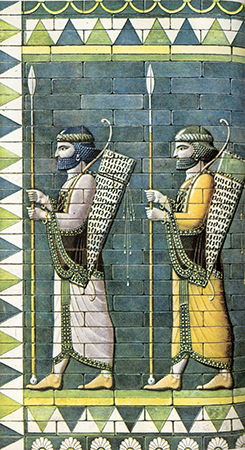
The ‘Immortals’ — an elite contingent of
Persian soldiers from Susa
The Darius statue
Excavations at the eastern Great Gate on the Apadana mound in late 1972 brought to light a huge upright stone statue, with inscriptions identifying it as that of Darius I, "the Great.” Although of unmistakably Egyptian workmanship, Darius the King is shown with full Persian dress (as on the Parsa reliefs). A richly ornamented wide belt with front secured knot supports a scabbard for the king’s dagger, shown with crescent topped pommel. Sadly, the monarch’s head was knocked away and smashed up by fanatics who had also broken off bits from the facing torso. His left hand, bent at the elbow grasps the customary lotus; the broken off right may have held his Staff of Justice. The surviving main portion nevertheless holds immense continuing interest for archeologists, historians, Egyptologists, philologists and art experts. For, what the three metre (10-foot) standing monolith had revealed was its diverse expressions of majesty in the three imperial central languages, all in cuneiform, as also in Egyptian symbolic and pictorial hieroglyphics within their customary lozenge shaped cartouches (frames enclosing names of rulers).
The trilingual inscriptions were carved along the right vertical pleats of the king’s garment; the Egyptian characters were incised on its left. The whole, being well preserved, remains impressive despite being subjected to earlier vandalism.
The statue, integral with its plinth, is of Egyptian manufacture from the grey basalt quarried at Wadi Hammamat to the east of the major bend in the Nile north of Aswan. It was backed up in place against the right door jamb of the monumental stone gateway at Susa. Archeologists have argued for a similar sculpture placed against the left jamb of the gateposts. Others have claimed that the statues were painted, as on the Parsa and, later, the Sasanian reliefs. Minute tell tale flecks of reds, whites and blues had been noticed in deep crevices during restoration work.
A very detailed description with beautifully accurate drawings of this Susian sculpture is given by Jean Yoyotte in the eighth chapter. Its rectangular square cornered pedestal has Egyptian engravings on all four sides: the shorter front and back depict the union of Egypt’s Upper and Lower Kingdoms under Persian suzerainty. The long sides have hieroglyphs within cartouches each displaying the names of 12 satrapies within the Persian Empire. Egypt had come under the sway of the Achemenids from the times of Cyrus II’s son, Cambyses II who founded its 27th, Persian, dynasty.
Why this monolith was moved from its original setting at Heliopolis to Susa gives rise to speculation. Darius the Great’s son Xerxes I, unable to maintain Persian hold over the African province, had lost and then regained it. Therefore his father’s statue could have been moved to Persia around those troubled times to take its place at the Apadana gateway. Today it is housed at Tehran’s National Museum where it takes pride of place amongst other sculpted forms.
"Land of the glazed brick”
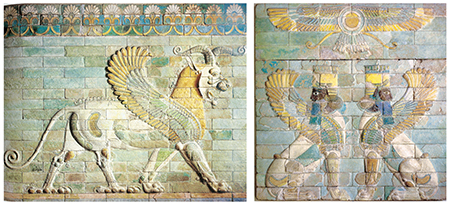
For the reviewer a major joy among the many contained in this work has to be the depiction on skilfully complemented glazed bricks of archers and servitors amidst lush decorative borders with stylized floral friezes, as well as of fabled monsters — sphinxes, striding lions and other beastly terrors. Their execution is well-nigh perfect, it being tempting to speculate on their original locations within the palace complex for best impact on royal residents and visiting dignitaries. Today these richly colored panels have been restored and exhibited to great effect in the Musée du Louvre, Paris, as indeed are the several small finds from Susa and elsewhere. Those finds include a variety of decorative and utility objects — many, alas! in fragments and with disfigurations.
The real glory must accrue to the artisans who beautifully designed and fashioned the vitreous brick murals. Their confident skills were the products of long experimentation with silicated clay and the fluxes necessary to achieve the enduring bonds of dissimilar materials. Their tasks were performed to perfection. As an inscription states: "Declares Darius: At Susa much excellent work was ordered; much excellent work was done.”
There is much else in this superb volume which, for reasons of space, must be left unrecorded in this summation: mostly technical, some speculative — but then such is the nature of 21st century studies which boldly attempt to evaluate the histories and archaeological finds of some 3,500 years ago and further back.
By way of conclusion, may it be urged that further studies on the diverse aspects of Achemenid civilization be made — with this weighty volume as appropriate departure points. Whilst it is a fascinating exercise to look into the minds and design purposes of architects and artisans of some two-and-a-half millennia before, it must be granted that it is interpretation and intuition which impel all serious enquirers. Some will tend towards their personal perspectives of the very many illustrations, for surely it is not possible to agree in every detail with the findings of generations of dedicated, committed scholars. Just as surely it can be advantageous for thoughtful students and percipient researchers to responsibly add to the enormous corpus of knowledge embodied in this excellent compendium. The wisdom of the ancient past insistently beckons proper future research.