
Zoroastrians and Bombay
Today we’re used to say Mumbai
It wasn’t quite that way
So please forgive if I don’t try
And stick with old Bombay.
Though somewhat shrouded in a mist
The roots of both are same
Bombay has a Portuguese twist
Mumbai’s the original name.
By any name these seven isles
Did not amount to much.
The Portuguese with all their guiles
Could see no future as such.
But Parsis came in the early days
And helped the Portuguese,
Began to learn European ways
And learnt to sail the seas.
Now Charles was looking for a Queen.
A wedding was in the works
From Portugal came Catherine
And one of many perks
The British gained from the deal
Were the isles of Bombay.
In retrospect one might feel
That they would rue the day
They gave away all those mud flats
But what imagination
Could have foreseen a city that’s
The power of a nation?
With the Portuguese came in
And on their own they played a part
In a military win.
Now shortly after the British came
A plague made them withdraw.
Bombay looked like easy game
But Parsis came to the fore.
They bravely fought the rowdy raiders,
Held on with determination,
Drove away the fierce invaders
And rose in the estimation
Of the British, when they returned.
Perhaps it was their gratitude
Or the respect the Parsis earned
Or enterprising attitude.
The reason might be all of these
The facts are very clear
Everywhere one sees Parsis
While others don’t come near.
The British brought the rule of law
Which made the Parsis strive.
They seized the chances that they saw
And they began to thrive.
They started off as go-betweens
Dubash, Dalal or Shroff.
But soon became men of means
But critics would often scoff
That Parsis were just compradors.
But they traded on their own
And quickly reached far off shores.
And soon the trade had grown
And spread quite wide both East and West.
And often they succeeded
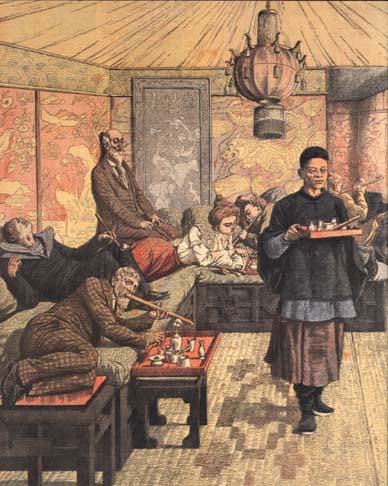
But China was by far the best.
Much offered, little needed
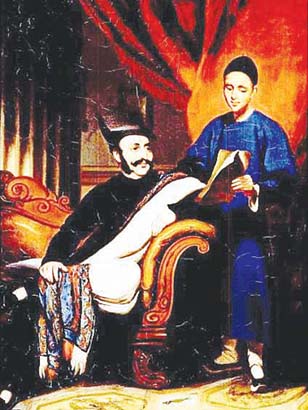
Sir Jamsetjee Jejeebhoy with his Chinese secretary
We then got them in opium’s thrall.
We should have let them live.
Though this indeed was quite a blot
Much charity ensued.
No matter how the gains were got
Good progress was pursued
And Canton’s loss was Bombay’s gain
As hospitals were built
And causeways spared commuter pain.
They gave not from their guilt
But feelings of noblesse oblige.
Asceticism was disdained
Their storied wealth gave them prestige
But only if they deigned
To share their wealth for public good
To satisfy a need.
Their wealth, they always understood
Was not for private greed.
Zoroastrians were always taught
That for the good they stood,
In a cosmic battle that is fought
Between the bad and good.
And education was a cause
Dear to the Parsi’s heart.
New institutes without a pause
Played a major part
In ensuring that our nation
Would ultimately rise.
Parsis then led in education
And nobody denies
For years they had the major share
Of degrees in every field.
The explanation would lie there
For the influence they wield.
They gave their money and their time
And no example’s better
Than the one I celebrate in rhyme
Sir Pherozeshah Mehta.
From Lincoln’s Inn to the bar
He quickly honed his skills.
As a lawyer he went very far
But then gave up those thrills.
In politics he played a role
He chose the middle road.
Freedom then was not his goal
But all the same he’d goad
The British to allow self rule
As mayor he played his part.
He was astute and no fool
Saw through the British art
Of keeping Parsis on their side
With excessive praise
And claiming there’s a big divide
With Parsi and Indian ways.
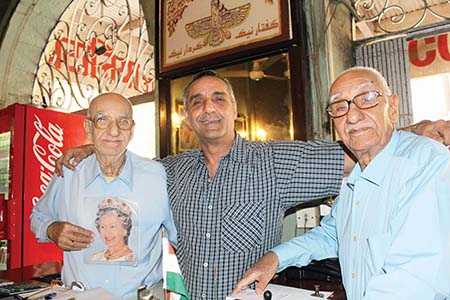
Photo: Jasmine D. Driver
And believed in this divide.
But there were others who ensured
That India would keep her pride.
Madame Cama comes to mind,
The first to raise our flag.
No greater patriot one could find
Quite safely we can brag.
There is the moderate patriot school
That saw some British good.
They merely sought dominion rule
By that they understood
On local matters we would vote
Within Imperial sway.
It is important that we note
This was the British way.
Now Canada went that way
And then Australia too.
And Naoroji was the first to say
Something that’s very true
The British didn’t walk the talk
And had unBritish rule.
They talked of cheese but gave us chalk
And always tried to fool.
The next Parsi to be MP
In the British Parliament,
Sir Muncherjee Bhownagree
Would readily assent.
The benefit of doubt, you see,
The British got from him.
They called him, "Sir Bow and Agree!”
But he wasn’t quite so dim.
So army spending was protested
And the Africa campaign.
While science training was suggested
He often did complain
That economic exploitation
Made India very weak.
His defence of our nation
Shows he wasn’t meek!
Both these MPs worked with the
Shah
For brethren in Iran.
Their efforts went very far
The jizya saw a ban.
And thanks to them Iranis came
And brought us fine cafés.
They added to Zoroastrian fame
And do as well these days.
I welcome all from our homeland
And the diaspora as well.
And governments from any land
Where we are treated well.
And some might think that we would claim
Back our ancestral land.
But that we’re sure is not our aim
For Bombay’s in our hand.
In 1900 six percent
Of Bombay were our tribe.
We punched above our weight, that meant
That almost every scribe
Who wrote a piece about Bombay
Would laud our contribution
But now this is a different day
We look for a solution.
Our share in Bombay took a drop —
Much less than one percent.
We fear we may reach a full stop
But our Government is bent
On well ensuring our survival.
Do learn what they propose.
Can we hope then for a revival?
Only Ahura Mazda knows!
Two ways have often been proposed
And you can take your pick.
The traditionalists have supposed
That we should only stick
To partners found within our fold
And quickly start to breed.
The other camp, now I am told,
Believes that what we need
Is to accept many more
Into the Parsi pool.
Of course, it is hard, to be sure,
Deciding on a rule.
Now should our pool be shallow and wide
Or narrow but quite deep?
And can we bravely turn the tide
Or let the water seep?
Maybe we are destined to last.
Or maybe we’ll disappear.
But we can glory in our past
And hope the world will cheer
Our contribution to mankind
Whether we’re here or not.
Our influence you’ll always find
We will not be forgot.
In museums we will be preserved
And you can have a look
At the many ways we have served
In both the aisles and book.
So come and visit NGMA
And CSMVS
The first has something new each day
The second I have to guess
My Parsi audience will be lost.
I’ll call it Prince of Wales!
Please visit both at any cost
And understand the trails
That Zoroastrians left far and wide
But Bombay was the hub.
To this city we are tied
And that to me’s the nub.
In Bombay, Parsi thoughts
were made
And Parsis then gave back.
Much was gained and dues were paid
And I have tried to track
The linkages between the two
And much has now been told.
Much more could be said, it’s true
But now it’s time I fold.
I’m sure that you will all agree
Bombay’s a special place
To hold this WZC.
And so I rest my case.
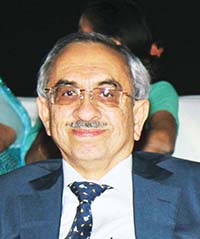 This poem, penned by Nadir Godrej, vice chairman of the 10th World Zoroastrian Congress, was read by him after the opening session of the Congress on December 27, 2013. Godrej is the managing director of Godrej Industries and chairman, Godrej Agrovet.