
History
The greatness of Cyrus
Despite the scurrilous attack in a European journal calling Cyrus a “Persian despot,” there is historic proof of the ruler’s noble nature and grand achievements
In the English language edition of the popular journal Der Spiegel ("The Mirror”) of July 15, 2008, appeared a two-part illustrated article by Matthias Schulz under the headline "UN treasure honors Persian despot.” It was a scurrilous piece of hackwork, justified on the grounds that the treasure in question, the Cyrus Cylinder, served to perpetuate an antique hoax. Revived during the last Shah of Iran’s celebration of 2,500 years of the accession of the emperor Cyrus II (who ruled from 559 to 529 BCE), this item was touted as a "human rights charter.” The perverse article caused instant outrage among the Iranian Zardushtis which spread to the overseas Parsi Jarthostis, resulting in a flurry of denunciations and measures ranging from the learned to the ludicrous. To judge characters and events from remote history in the light of modern researches and re-workings is always a less than exhilarating exercise. Through the fog of fuzzy facts and fatuous fiction, this writer attempts to set forth the illuminating story of Cyrus II ("The Great”), with due restitution.
In an age when greatness and goodness were rare in princes and kings, there emerged a chief of mature years, Cyrus, to set free his Persian clans from the domination of Astyages, the Median ruler of Anshan in Elam, southwest Iran. Kurush, to give him his proper Old Persian name, came from a long line of petty kings; his father Kabujiya/Cambyses I had married Astyages’ daughter.
History has recorded for us three Kurushes: the first bearer of the name was our Cyrus’ grandfather; Cyrus II, "the Great,” is the subject of this article; the last known to carry the name, as Cyrus the Younger, the rebellious cadet brother of Artaxerxes II (404-359 BCE), was killed at the battle of Cunaxa, near Baghdad, in 401.
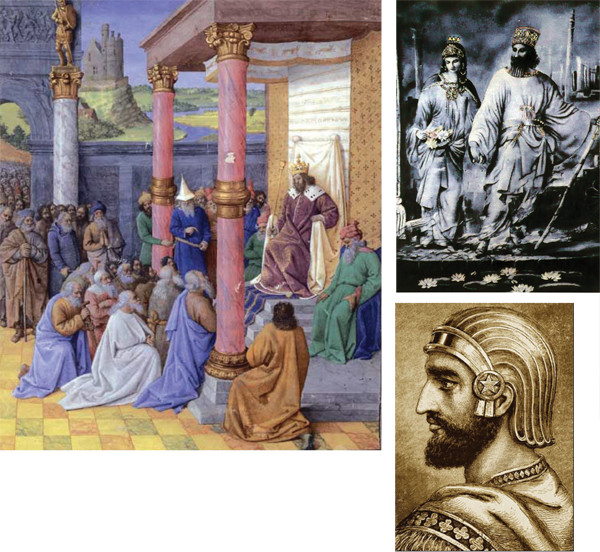
Various artists’ renditions of Cyrus: (left) Meeting the Hebrews in Babylon (wikimedia.org); with wife Mandana (Photo Jasmine D. Driver); Cyrus portrait (Iran Chamber Society)
A legend surrounding Cyrus has it that Astyages saw in a dream that his grandson would overthrow him and seize the kingship. Terrified, he arranged to have the child put away, but a kindly shepherd with a barren wife, Spaka, rescued him, brought him up and concealed the boy’s identity until his adolescence, when his kingly qualities became apparent. Spaka, according to Herodotus, meant "bitch” — sobaka to this day means just that in Russian. With the resultant confusion, the infant was believed to have been suckled by a she-dog! Other legends sprang up around the royal infant, in the way that oral traditions and inexact memories usually do, but henceforth we shall keep to history.
The fact remains that Kurush did topple his maternal grandfather and assume the overlordship as "Great King of Anshan.” From then on, it was through conquest that he acquired a huge empire that extended from the Aegean, along the west coast of Asia Minor to the easterly province along the River Indus. On his final expedition, when aged 70, to the northeast regions of the Caspian, he captured the rebellious son of the Scythian Queen Tomyris. The young man died in captivity; Tomyris avenged his death by killing Kurush whose body was brought back to Parsagada, the heartland of his Persian clan, and entombed in the limestone mausoleum which still stands in isolated splendor on the Murghab plain.
Kurush’s character aroused the admiration of classical Greek authors as much as the composers of two Old Testament Judaic texts: the prophetic Deutero-Isaiah, and the scribe Ezra/Esdras. Herodotus, himself a Persian subject, wrote of him that "he was a father to his people;” Xenophon used his high reputation for his model of an ideal ruler.
The Jews had every cause to exalt Kurush’s memory. He was "the anointed of the Lord whose right hand He has grasped” — a singular honor with fulsome praise in a Biblical text for a non-Jew! The Ezra texts give the Great King’s edicts — once in Hebrew, then in Aramaic — for the rehabilitation of the exilic Jews from their Babylonian captivity; for the reconstruction of their Temple in Jerusalem and the restitution of its sacred vessels. Furthermore, Kurush even arranged for the repatriation of those Jews who wished to return; it is noteworthy that many chose to remain in Babylonia under Persian sovereignty.
On October 29, 539 Kurush entered Babylon, then the greatest city of the times, peacefully, and by invitation of the city’s disgruntled priesthood. Until then, the ruler Nabunaid (Nabonidus) had imposed his will upon the city and its priests by forcing worship of Sin, the Moon god of Harran, to the exclusion of the great god, the belu rabu, Marduk whose religious prominence had now been usurped. Upon Kurush’s invasion, Nabonidus fled to Syria, but was then exiled to Kerman in south central Iran where he was permitted, through Cyrus’ magnanimity, to live out his life in studious peace and compile his famous Chronicle for posterity.
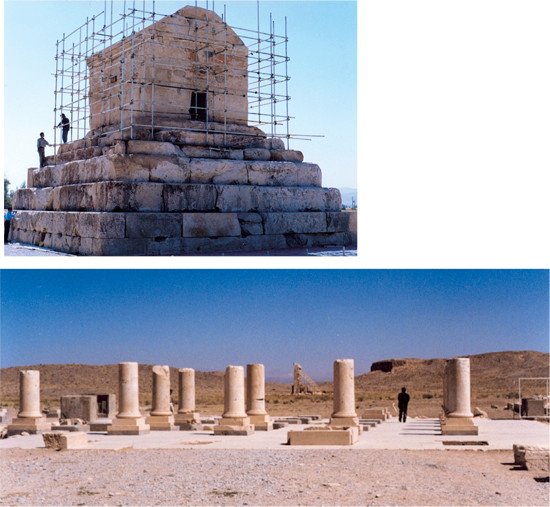
Cyrus’ tomb and palace at Parsagada (Photos: Namrita Rustomji)
Kurush’s tolerance and magnanimity were celebrated in High Antiquity. His fame as a gracious and an all-embracing ruler endured. When Alexander, the Macedonian, rampaged through the Middle East up into South Central Asia with his expansionist dreams, he had wished to recreate and extend the Great King’s empire. In his fit of drunken madness and notorious instability, he torched the glorious Parsa/Persepolis complex, causing irreparable damage — worsened in later times by hate-filled Muslim roughs who further disfigured its magnificent reliefs. Aristotle’s former pupil had not shared the master’s high ideals.
From Alexander’s evil act, said to be in revenge for Khshayarsha/Xerxes I’s burning of the Athens Acropolis over a century before, a small good emerged — the preservation by the great fire of the hundreds of clay tablets from the Treasury and Fortification areas of Parsa. Unlike the Greeks with their disproved claims to democracy, proven despising of the fair sex and maltreatment of their slaves, the Ancient Iranians were clearly shown to have exercised care and decency over their menials and workforces. Through a horrible irony, for all their destructiveness, it was the Greeks who had helped preserve the good name and high ethical character of their old enemies, the Persians!
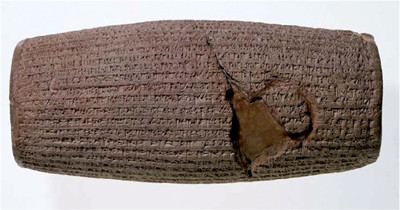
Cyrus cylinder (middleeast info.org)
It is this writer’s belief that once Alexander had ruptured his thin veneer of civilization through his monstrous actions and, confronted by their terrible results, he had belatedly repented enough to realize the grandeur of Persian achievements and their benefits to the diverse populations in the conquered territories of Kurush’s, and his successors’ vast empire. It is well attested that when Alexander came upon Kurush’s dilapidated mausoleum at Parsagada, overwhelmed by the simplicity of his universally distinguished predecessor, he arranged to have the despoiled sarcophagus restored as best as possible, with its now vanished inscription "O man! Here lies Cyrus, who once ruled the earth! Do not, therefore, begrudge him this little portion of earth where he now lies!”
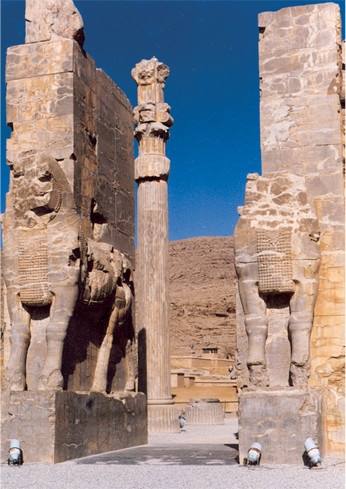
Persepolis gate
(Photo: Namrita Rustomji)
Of Kurush’s own religious beliefs, we cannot affirm that he was either Mazdayasnian or Zoroastrian. Faint traces of a rosette — and not a farohar! — have been discerned atop his mausoleum. Exactly the same pattern lies under the feet of the left-most of the three standing figures carved on the Taq-i Bostan relief — a figure frequently misrepresented as Zarathushtra, but which is actually a depiction of the rayed solar god Mithra. Mithra we know of old to be the deity of sacral friendship and the solemnly-given word (the enforcer of the contract): Kurush was most probably a Mithraist, one whose own noble qualifications fit those of this ancient divinity. (Our Zarathushtrian Ahura Mazda, by the Prophet’s own definition, has Mithra’s divine qualities incorporated within his "severalness.”)
There remain some important facts about the "notorious” Cyrus Cylinder: in appearance, as seen today, its shape is akin to a fat cigar, some eight inches across and about two-and-a-half inches at its widest diameter. It bears some 45 lines of Akkadian cuneiform composed by the Babylonian priests of Marduk on traditional neo-Babylonian and not Iranian lines; being much damaged with missing fragments, what remains on its inscribed clay can be read as two parts.
Firstly, an "impersonal” section dealing with the events at the time of Kurush’s entry into Babylon with reference to its great god "Marduk, who grasped the hand of Cyrus and appointed him by name for the kingship.” The second gives the great king’s lineage, and his own account of his presence and activity in the conquered city, including, "Marduk, the great lord, who gained for me the whole-hearted affection of the people.”
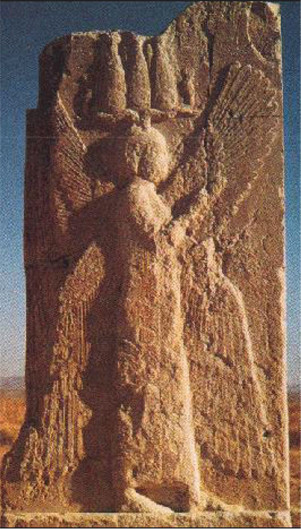
A four-winged genius on a jamb of the gateway at Parsagada. Above the figure there was an inscription, now dest-royed, which declared in three languages: ‘I, Cyrus, the king, the Achaemenid (built this).’ The genius, carved in the simple manner which was typical of the early period, was thought to be a protective spirit guarding the entrance to the royal residence Caption courtesy: Persian Mythology, John R. Hinnells
Photo: Iran Chamber Society
Whilst the inscription clearly outlines the humanitarian qualities of Kurush, it is as clearly not the "human rights charter” that some have exaggeratedly proclaimed. The object is, in fact, a building foundation text, much in line with other building inscriptions in the Assyrio-Babylonian tradition. For those unsettled by this writer’s "debunking” of the great king’s character, may they be doubly reassured that other, greater texts have fully, and unequivocally, attested to Kurush’s noble nature and grand achievements.
A parting note: it may puzzle some that whereas the Old Persian, Babylonian, Elamite, Greek and Old Testament texts clearly spell out the great king’s name as Kurush, etc, why is it that among us Parsis it is consistently Cyrus (pronounced "sai-russ”)? What then is its answer? Blame the Dark Ages schoolmen who, erratically, transcribed the Greek ku- as cy-. Think of cyan, cybernetics, cycle, etc, and then give ourselves pats on the backs for, at least, remaining Zoroastrian (oops! beg pardon! — Zarathushtrian)! Had the Great King’s name really been in long-standing use among us, this strange lapse would never have been countenanced — we’ve restored it in our affections barely a century ago, thanks, yet no thanks to western scholarship! Should we, knowingly, blame or bless those ancient Greeks?
Farrokh Vajifdar is vice president of the Royal Asiatic Society of Great Britain and Ireland. An author and editor, he is an independent researcher into Ancient Indo-Iranian culture, history and religions.
◆ ◆ ◆
From the archive