
Romanticizing Cyrus
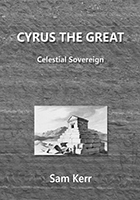
Cyrus the Great — Celestial Sovereign by Sam Kerr. Published in 2015 by Lulu.com, Sydney, Australia. Pp: xvii + 315. Price: Not mentioned.
 Three pertinent questions: Why, despite authentic renditions of the great king’s name as Kurush (Behistun, Old Persian), Kurash (Behistun, Elamite), Kurash (Behistun, Akkadian); Greek Kuros; Hebrew and Aramaic Kurash, is his name repeatedly spelt Cyrus and duly pronounced "sai-russ?”
Why do Parsis, unlike the Iranis, lavish Cy- and not Ku- on their newborns? Why does the roll call of Parsi boys’ names omit the names of Achemenid great kings like Cambyses and Artaxersis though Partho-Sasanian names are fitted in?
For the first and second questions the blame rests with the medieval, monkish, scribal traditions which invariably transcribed the classical Greek Ku- as Cy-. Think of cyber- this, that, and whatever; the Greeks, affecting disdain of their neighboring "barbarian” super power, fudged through Persian names with -es, -is, -os and -us endings as better sounding!
The asnswer to the third gripe, is embarrassing to relate: Until the late 19th century, we simply had no idea of our Achemenid grand monarchs’ names! These names slowly registered, albeit through defective Greek forms, among western educated Parsis — much to the chagrin of shrewd joshis (horoscope makers) who had until then got away with impressing native Gujarati names.
To the rescue comes Sam Kerr, his feisty narrator’s six-shooters ablaze, to once and for all fill in our historical memory blanks. Long impassioned with the noble qualities of head, heart and history of the charismatic sixth century BCE Persian monarch, Kerr’s Cyrus the Great has resulted in the birth of this intellectual love child. Indeed a bonny child, full of his creator’s energy and enthusiasm, Kerr’s Cyrus is largely a work of fertile imagination. That being understood, his huge enterprise has much to be admired for its unrelenting drive — Cyrus even becomes a "celestial sovereign” (!) — with precious little to criticize at that sublime level.
Dedicated to the memory of Prof Emerita Mary Boyce, the book has a foreword by Kaikhosrov Irani, Emeritus Professor of Philosophy at City College, New York. A hurried word of caution here — Irani would surely never have intended "assailable” in describing the clarity of Kerr’s presentation. Might the good professor not have meant "unassailable?”
Not always clear are some of the half dozen maps chosen to illustrate the spread of the great king’s imperial acquisitions. Meant to corroborate the extensive text — a boldly told story in 14 chapters — Kerr’s selection is hampered by overshaded guides to Cyrus II’s empire building: a minor quibble to be overlooked by most.
One could, however, quibble over Kerr’s overall categorization of his own work. Does it classify as "a fictionalised historical biography?” A "quasi-historical narrative?” He debates these unnecessarily! His Cyrus the Great is, to our mind, a robustly fashioned romantic chronicle, with considerable revisionist re-working, yet free of pretentious intellectual posturing.
The author might well have done his readership a grand favor by generally keeping away from the very many highbrow articles and historical divergences of modern scholarship which doubtless would have clogged his free flowing narrative. His restrained bibliography and well attuned, but occasionally quirky, footnotes will sufficiently whet the appetites of those readers who wish to further investigate this towering personality from a universally well remembered and rightly revered past: Cyrus II, "the Great,” truly belonged to all the ancient world!
It is this belonging that could be classed as historicism (belonging only to its period and historical context). In a sense, Kerr’s Cyrus with his ingenious reconstruction and liberal application of direct speech between heroes, villains and auxiliary personalities results in an exhilarating and entertaining read!
In the case of Cyrus II, the Babylonian priests of Marduk/Shamash on their Akkadian scripted Cylinder hailed him as their great savior; the Jews, liberated from the Assyrio-Babylonian yoke, copiously lavished on him the highest praise, under the aegis of Yahweh/"Ha-Shem.”
In sharp contrast, Cyrus’ son and heir Cambyses/Kambujiya II was execrated by those Egyptian priests whose long accustomed generous temple subsidies were curtailed by the Persian monarch. Amidst all his supposed oppressions and misdeeds, Cambyses II was accused of burning the mummy of the last native Egyptian pharaoh, and stabbing to death the Apis bull, the deeply venerated symbol of prosperity and fertility for all Egypt. Could this carefully selected albino bull have provided the settling in India of the varasyaji?
Cambyses II was portrayed as mad, bad and sad — all this despite the Egyptians’ own accurate records denying his desecration of the first, and wholly refuting the bull’s wanton slaying — the particular Apis’ natural death occurred well after Cambyses’ own demise! The much admired but sometimes contested Herodotus had unfortunately chosen to repeat those slanders, and even highly rated modern scholarship has been unable to shake free of them. (For reasons of space, we must await the full stories detailing the aftermath of Cyrus II’s rule — perhaps Kerr will direct his pen to much anticipated sequels on Cambyses II and Darius I?)
The much touted Cyrus Cylinder makes its briefly prefaced appearance in Chapter 12 which, to the observant reader, provides the hub for Kerr’s appraisal of the great king: his star qualities leading one into the now legendary "first human rights charter” field. An unshakable myth, ever since Ashraf (the last Shah’s twin sister) barged into U Thant’s United Nations office to demand such an acceptance, has turned into a pseudo-historical shibboleth in popular Zoroastrian perceptions. The Babylonian priests had claimed Cyrus’ advent as an intervention by their chief god Marduk; the Jews declared that Cyrus was an instrument of Yahweh. The great king had truly been a deliverer, a liberator and a savior.
The question of Cyrus’ own religion has been resolved by Kerr early on in his book. If, however, one is to follow Herodotus, Cyrus from an early age was taught to ride, shoot and speak the truth — just as the young Persian nobility was instructed. The Greek never mentioned Mazda or Zarathushtra, nor did the writer take cognizance of the politico religious documentation from Persia itself. To this reviewer, the fine qualities of the great king bespeak an ethico militaristic Mithraic upbringing: the great God of the great king was the ancient Mithra.
Having travelled past relevant historical signposts, along which arduous journey Kerr’s story unfolds, it becomes evident that the author has been captivated by deep hero worship and generous helpings of a richly charged emotive logic. Why not indeed? Cyrus the Great is a jolly good read for all!