
Books
Everlasting catalog
The Everlasting Flame: Zoroastrianism in History and Imagination edited by Sarah Stewart. Published in 2013 by I. B. Tauris and Company Limited [in association with the School of Oriental and African Studies (SOAS), University of London], 6, Salem Road, London W2 4BU. Pp: xix + 259. Price: £ 45.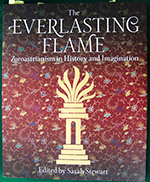
Curated by editor-in-chief Sarah Stewart, secretary of the British Institute of Persian Studies in London, this handsome volume is a weighty and wonderful souvenir of the unforgettable "Everlasting Flame” exhibition in London. It more than suffices as a dazzling memento of its fine displays during the 2013 autumn months. Likewise, it is a remarkable reflection on the editorial expertise of Stewart and her four collaborators: Firoza Punthakey Mistree and Pheroza Godrej, authors of A Zoroastrian Tapestry: Art, Religion and Culture; Ursula Sims-Williams of the British Library; and Almut Hintze, professor of Zoroastrianism at SOAS.
Printed on high gloss, fine art paper with excellently reproduced illustrations, this inch thick, 9” x 11” catalog has the added attraction of eight scholarly essays portraying the extremely rich, wide-ranging aspects of 5,000 years’ cultural history of the Iranian plateau, Central and Far Asia, with its hefty 1,300-year slice of Parsi presence on the Indian subcontinent.
Stewart’s descriptive Introduction is a bland piece touching on aspects of Zoroastrian beliefs and practices. Whilst it is better to err on the side of caution by soft-pedalling on certain issues, is it still necessary to suggest "... it (Zoroastrianism) was perhaps conceived as a universal doctrine for mankind;” that "The Gathas belong to (a) .... tradition of wisdom poetry and consist of rhetorical questions .... ”? Tremendous strides in Gatha interpretation have been taken since such 1970s truisms, and even with her indication of Gatha puyan, "return to the Gatha,” among Iranians everywhere, nothing much else has been offered.
"Words without context” is the initially unsettling title of Hintze’s essay covering the proto-history of the Zoroastrian faith. After plunging into a dualistic schema, the absence of any geographical, historical and archeological markers in Zarathushtra’s 16 Gathic hymns highlight his time transcending practical philosophy. The hymns are unwaveringly aimed at human activity through cultivated proper thoughts, right-speaking, and beneficent works.
Printed on high gloss, fine art paper with excellently reproduced illustrations, this inch thick, 9” x 11” catalog has the added attraction of eight scholarly essays portraying the extremely rich, wide-ranging aspects of 5,000 years’ cultural history of the Iranian plateau, Central and Far Asia, with its hefty 1,300-year slice of Parsi presence on the Indian subcontinent.
Stewart’s descriptive Introduction is a bland piece touching on aspects of Zoroastrian beliefs and practices. Whilst it is better to err on the side of caution by soft-pedalling on certain issues, is it still necessary to suggest "... it (Zoroastrianism) was perhaps conceived as a universal doctrine for mankind;” that "The Gathas belong to (a) .... tradition of wisdom poetry and consist of rhetorical questions .... ”? Tremendous strides in Gatha interpretation have been taken since such 1970s truisms, and even with her indication of Gatha puyan, "return to the Gatha,” among Iranians everywhere, nothing much else has been offered.
"Words without context” is the initially unsettling title of Hintze’s essay covering the proto-history of the Zoroastrian faith. After plunging into a dualistic schema, the absence of any geographical, historical and archeological markers in Zarathushtra’s 16 Gathic hymns highlight his time transcending practical philosophy. The hymns are unwaveringly aimed at human activity through cultivated proper thoughts, right-speaking, and beneficent works.

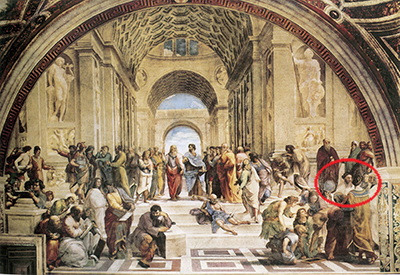
Sarah Stewart: memorable memento; Raphael’s School of Athens mural depicting
Zoroaster (encircled) with other Greek thinkers
With Sims-Williams’ indulgent participation in "The Judaeo-Christian World” through her thoughtful text and well captioned illustrations from rare British Library volumes, one enters the "magi-cal” world of Zoroaster as sorcerer, astrologer, necromancer, and "Founder of the Seven Liberal Arts.” Substantial clues lie unrecognized in the Raffaello "School” fresco where an 18th century key had wrongly identified "Zoroastres” and Claudius Ptolemy, as also the "Dark Philosopher” Heracleitus, and the serenely depicted lady mathematician-philosopher Hypatia (martyr to a vengeful Christian mob). Arguably, the Iranian Sage Zoroaster is the key philosopher figure on this Vatican mural, for the two centrally placed Greek thinkers Plato and Aristotle are shown debating the whereabouts of Ahura Mazda’s several agencies — the Amasha Spantas in relation to the earthly creations under their care!
The sixth century mosaics in Ravenna, Italy of the Three Magi, and the Roman Empress Theodora attended by her court ladies are presented, the latter showing three diminutive Wise Men on the Empress’ hem. Whilst both themes provide evidence of the imprint of Sasanid Mazdayasnian theology on Byzantine minds, questions remain over its effect on Judaeo-Christian perceptions — even on the very identities of the Magian trio.
The New Testament’s Matthew 2.1-2 (Revised English Bible, 1989) refers to "astrologers from the East arrived in Jerusalem” enquiring after the whereabouts of the Christ child. This writer confesses his passion for the 1526 Tyndale translation which goes thus: "Beholde, there cam wyse men from the est to Jerusalem saynge: where is he that is borne kynge of the Jues? we have sene his starre in the est, and are come to worship hym.” Bringing the Chaldean (members of ancient Semitic people) and the astrologist factors together, one wonders whether the Triad really were Zoroastrian priests or converted Babylonians!
Wickedness personified is "Canoaster” (read "Zoroaster”), unhelpfully credited with the discovery of "the magic art of spells and other wicked words and wicked things” (!). This 15th century stuff and nonsense is to be found in Il Tesoro, "The Treasury” of Medieval learning, itself a translation from a 13th century French encyclopedia!
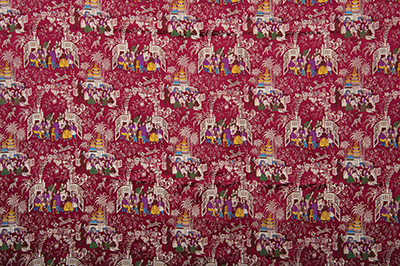
Tanchoi sari
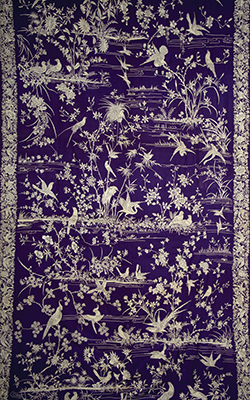
Chinese gara embroidered with a variety of birds and flowers
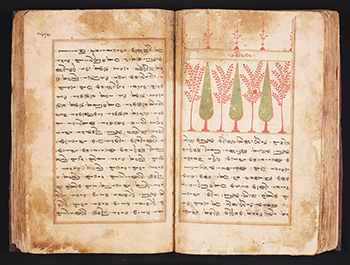
An illustrated Videvdad Sadeh
The Gathas were long recognized as a code for moral right living. Despite this, one is constantly thrust towards the realms of death and disposal of the dead. Everlasting Flame brims over with sections and illustrations of dakhmas, ossuaries, and terrifying depictions of Hell — discourtesy of Arda Wiraz, whose menaces are largely directed at misbehaved madams.
Frantz Grenet, professor at the Collège de France, surveys "Zoroastrian Funerary Practices” among the Sogdians, Chorasmians to the Iranian north-east, and far to the Chinese east. From the tall tales of Onesicritus it appears that in Bactria it was customary to throw out alive the disabled, the infirm and the decrepit for dismemberment by especially reared "undertaker dogs.” But when one reads that in 14th century Thana, north of Bombay, Parsi corpses were exposed in the open (!) in fields, then the ancient story might just have had stray grains of truth! Historian Wei Jie had reported much the same disregard of proper disposal in the Samarkand region.
What is certain is that in fourth century BCE Samarkand, dog bones had been found contained with human bones — as trenchantly prescribed in the Vandidad! To those who dispute such readings as the concoction of hostile foreigners, it must be asked why today’s priests pray all these Vandidadic passages during the midnight-to-dawn Ushahin-gah ceremony. Would they countenance such mixed exposure of man and canine in the dakhmas in India? In ancient times the bones were gathered up and deposited in ornate portable ossuaries (tabankuk; Pahlavi astodan); elsewhere they were stored in rock-cut vaults.
Grenet has contributed a further chapter, "The Silk Road, Central Asia and China,” jointly with Nicholas Sims-Williams and Pavel Lurje, with further depictions of ossuaries and retrieved documentary fragments. Among these is the ninth century CE Sogdian Zoroastrian Ashem Vohu prayer from Dunhuang; its archaic script poses challenges.
Tolerance and intolerance contrarily show themselves in Joisten-Pruschke’s essay, "Jewish and Christian relations with Zoroastrianism.” Immigrations and resettlements of non-Iranian populations historically had occurred within the Achemenian, Parthian and Sasanian empires, resulting in inevitable cultural and religious fusions and conflicts. The case of the military colony under Achemenid administration at Elephantine on the Nile illustrates the destruction and rebuilding of the Jewish temple there — with the proviso that burnt offerings would no longer be permitted by the Mazdayasnian official in overall charge.
Under the Parthians the situation of the Jews was favorable. The fortified Roman border town in Syria of Dura-Europos on the right bank of the Euphrates had both synagog and Christian church. Both had frescoes reflecting their respective religious themes; both were in Iranian style with clothing and ornaments in Parthian taste, adapted from earlier Persian forms. When the Sasanians invaded in the mid-third century CE the two non-Iranian religions with their following had already become neighborly. The occasional persecutions by the Mazdayasnian priesthood were neither systematic nor widespread, and seemed to depend largely on policies dictated by hard-pressed Persian monarchs.
Other than history repeating itself, this volume contains repetitions of history — inevitable when papers are separately presented under an over-arching theme of identity. Thus one reads of imperial state religion under the Achemenids (300 years), then briefly through the Parthian Arsacid period (of some 500 years), followed by 400 years of imperial Sasanid rule. Philip Kreyenbroek, professor of Iranian Studies at the Georg-August University, Germany, dwells on the necessarily oral transmission of Mazdayasna. His essay retains a considered summary of the likeliest routes of their transmission and transfiguration. Despite well-attested contacts between the competing Abrahamic and eclectic faiths in imperial Iran, there is as much conjecture as confirmation.
The chapter "Imperial and Post-Imperial Iran” produced jointly by Jenny Rose, lecturer in Zoroastrian Studies at Clarement Graduate University in California, and Stewart is filled with fragmented Achemenid reliefs, Susian tilework, jewelry, seals, Sasanian silver, and coinage — all informatively commentated.
Of primary interest to the majority of Parsiana readers would be the exhibits, illustrated in "The lure of China and the art of Parsi portraiture” by Punthakey-Mistree and Godrej and "Parsi Salon” by the former, of the business and domestic lives, and condition of the great and good ancestral Parsis. Here are depicted carefully posed ship builders, entrepreneurs, traders with and in China, the Tatas, and several high-pugreed and fiercely moustachioed sethias. Much attention is given to the elegant manorial rooms occasionally over-stuffed with heavily decorated furnishings. All a matter of taste, one surmises: beautiful fabrics, some with export-Chinese motifs, and decorative metalwork occupy much interesting space. The reproduction of the Achemenid winged-lion gold rhyton by Zal Amrolia is a tribute to his painstaking craftsmanship.
The well-pictured "Fire Temple” by Stewart and Punthakey-Mistree is of particular interest to the pious and priest-loving for the portraits of past prelates among whom are Dasturs Noshirwan Framroz and Dinshah Jivanji Garda (of Yajasne ba nirang fame). They had respectively been heads of the Surat Shahanshahi and Qadimi fire temples. The scholars K. R. Cama and R. P. Karkaria are portrayed in abstracted moods. Ses and slippers appear; perhaps less welcomed will be the daringly skimpy women’s sudreh — hardly "sacred” in this instance! Lots of devotional lay and priestly metalware apparatus is paraded. Quite an entertaining chapter!
Stewart’s conclusion, "the future of the religion is in the hands of young Zoroastrians” leads one to fervently hope that it will not be realized through endless repeats of the doctrine of the seven creations via ninth century Pahlavi texts, nor by tedious explanations of inexplicable Parsi rituals, but from the intelligently selected applications of the Sage Zarathushtra’s resolutely preserved mãthras in this 21st century and beyond.
◆ ◆ ◆
From the archive